
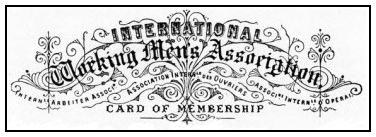
Abridged from a pamphlet, “The First Three Socialist Internationals”, published in 1989. Though idiosyncratic in its slant on some points, this tells the story of the three large-scale efforts so far to make socialism an organised international movement.
Even before the founding of the official First International (The International Workingmen’s Association) in 1864, three attempts were made to form an International Alliance of workers against their common oppressors. Two of these were based in Britain, one in Germany and France. The British attempts were those of the earliest of modern working classes, created by the original Workshop of the World. Its length in history of Socialist theory was equalled only by that of France, which it surpassed in numbers and technical development. This British pre-eminence would soon reveal its drawbacks. As yet, it was a positive factor.
In 1845 the British Chartist (democratic working class) leader, GeorgeJulian Harney (1817-1897), founded a Society of Fraternal Democrats, Chartists and foreign political refugees. It never developed outside Britain and disappeared with the Chartist movement itself after 1848. Shortly after its foundation, the Communist League began in France — a working-class movement which, though weak, had had its consciousness stimulated by its democratic revolution — and in Germany, where such a revolution had yet to occur and where the bourgeoisie would not be able or willing to lead the country’s still tiny working class to achieve it.
Karl Marx (1818-1883) and Friedrich Engels (1820-1895) were leading theoreticians of the Communist League, writing its Manifesto in the revolutionary year of 1848. After that year’s defeats the League declined, under the pressure of European reaction. In 1852 it was liquidated by Marx and Engels to save comrades imprisoned in the German State of Prussia.
During the 1850s, the British skilled workers built up their industrial strength in a series of “new model” trade unions, which were to survive as such bodies had not done before. This encouraged the ex-Chartist Ernest Jones (1819-1869), to start a third International Association, named thus, in 1855. Marx was invited to join but refused because it included (already) among its leaders the Russian Liberal refugee Alexander Herzen (1812-1870), who was making his peace with the new Tsar. The Association lasted four years before it collapsed.
The traditions set by these three bodies were strengthened by events after 1860. Not only had British trade unionism grown but the French workers were also active and were even helped, for a time, by the Government of what was then the Second Empire, against the Republican capitalists. This misalliance did not last long, but resulted in a delegation of French workers visiting the British World Exhibition of 1862. There the more radical of them met their British comrades and agreed to work jointly on matters of common interest. On their return home they sponsored election candidates and agitated for the repeal of the anti-trade union laws, which were reformed partially in May 1864. In what was then merely the German Confederation, in 1863 a mass agitation to form a working class political party was started by Ferdinand Lassalle (1825-1864). Lassalle claimed to be a follower of Marx yet he kept his belief in an “Iron Law” by which real wages could not rise under capitalism, which Marx had renounced. He was also opposed to the emancipation of women.
Consciousness was raised too by several international democratic struggles: by the War of Italian Unity (Risorgimento) from 1859; the American Civil War from 1861; and what was, in fact, the most effective of these as a catalyst for Anglo-French working-class unity, the Polish Uprising of 1863.
The First International
Just after Lassalle’s murder, on 28 September 1864, a meeting of representatives of English, French and German workers was held in London. It resolved to set up a Committee to form a new International Workingmen’s Association (IWMA). Twenty-five out of forty-nine seats on this Committee were occupied by British representatives, mainly from the skilled unions. Karl Marx was just one of six who represented the German workers. However, he wrote the new International’s Inaugural Address and its Rules.
The IWMA was, in practice, a European body (albeit with branches in the USA and, eventually, Australia). In 1871 an attempt to start an Indian section was agreed on the understanding that it be open to native Indians, but it never prospered. In fact, both Marx and Engels insisted on limiting the new International’s scope to “countries in which modem capitalism exists”, as the Rules put it, and emphasised the role of the “most advanced countries” in the struggle. Their reason was that large areas of the world were still pre-eminently tribal, Asiatic, or even, as with Cuba and Brazil, dominated by slave economies. Few of these had a proletariat in the modern sense.
The new International had more immediate problems. The largest national working-class political organisation was that of the German followers of Lassalle, organised around the paper Sozialdemokrat. Their new leader, Johann von Schweitzer (1833-1875), declared that they were in full solidarity with the IWMA, but asked to remain only as an associate member due to the laws of Prussia, the largest German State. Though this was later to be agreed in this and other cases, the International rejected this proposal, with Marx and Engels in full agreement. They had always considered Lassalle’s perspective too much limited to Germany and they may have suspected what has been established since: that Lassalleanism was helped on its way by a Prussian State bribe. The International’s German Section remained limited to Marx and his small group of German followers, led by Wilhelm Liebknecht(1826-1901).
Within the International too, the Marxists were in a minority. To their right was the largest group: the British craft union leaders, whose initiative had started it. Their perspective was limited to the need for democratic rights, particularly for their unions which were still handicapped by Combination Acts, and for the vote for all heads of household in general elections. Beyond these demands they would be content to conform to the British Liberal Party but, as they had yet to be won, they stayed loyal to the International and practically militant. To Marx’s left were the groupings dominating French socialism: the Proudhonists and the Blanquists. The former were followers of Pierre-Joseph Proudhon (1809-1865), who is best known as the pamphleteer who exposed the moral and legal illegitimacy of private property titles. He advocated a system of communally-based craft economics rather than the new factories. The Proudhonists agreed with the Lassalleans about the uselessness of trade union action and in their opposition to women’s rights. They also opposed claims for national self-determination (particularly the Poles).
The followers of Louis-Auguste Blanqui (1805-1881) were formally more extreme since they advocated that the working-class leadership be organised as a secret society to seize State power by a coup. When no coup was obviously possible, however, they were ready enough to accept Marx’s lead.
Their support and that of the British trade union leaders — who recognised his ability to relate to the situation’s practical needs — enabled Marx to give the IWMA guidelines to make it relevant to the Socialist and democratic struggles of the time. Though it was only being formed at the end of the American Civil War, it sent a goodwill message to Abraham Lincoln on his reinauguration and received a very friendly reply from the first President of what has become the party of Nixon, Reagan and Bush. Partly to radicalise the British, an overture was made to the head centre of the Fenian Brotherhood, James Stephens (1826-1901) but though he is said to have agreed to join, nothing seems to have developed beyond this apart from the International’s defence of his movement against its repression by the British State.
The IWMA was more immediately effective in other democratic and trade union campaigns. In the first, it was most successful in Britain, its campaign bringing about urban household suffrage in 1867. For the latter, it did not initiate so much as support the trade union struggle that developed over Europe and America. By 1869, even the Proudhonists had been involved in these struggles. Regularly defeated in the International on issues in which their principles proved irrelevant, they were disintegrating. The Lassalleans too were forced to recognise that trade unionism had its uses. However, their intervention in them was handicapped by excessive political control, particularly the dogma of the Iron Law of Wages. Weaker vis-a-vis the International, they voted to affiliate in 1868.
The Basle Congress
The next year, the IWMA reached its highest point at its Congress at Basle. Its previous assembly had demanded workers’ control of production and resources and the nationalisation of transport and communications. Now it called for the nationalisation of the land. However, it also saw the first appearance of a Russian delegate, Mikhail Ivanovich Bakunin (1814-1876). Against Marx, he passed a proposal to abolish the rights of
inheritance, which he claimed would win the peasantry to Socialism. His contributions challenged Marx from all points. He intensified Proudhon’s hostility to the State and to religion and his mistrust of trade unionism. He developed Blanqui’s concept of the coup into counterposing to the working-class party a small international society ready to organise acts of “propaganda by deed”. Even the British were wooed through Bakunin’s opposition to the International’s support for the Fenians and his demand for a Federal Committee, independent of the International’s General Council, to run the British struggle. For all this, other than on inheritance, Bakunin won support immediately. In the eighteen months after Basle, his supporters’ chief achievement was to split the International’s affiliated Franco-Italian-Swiss Federation.
The IWMA’s chief problems were still those set by its class enemies. Basle was followed by a general intensifying of class war. In Britain, the Liberal reluctance to run working-class candidates was answered by the forming of a Land and Labour League as a distinct independent working-class political body. In Germany, the Liberals who had sought to ally with the Marxists ended their approaches. In France, the Imperial Government raided the International’s bureau.
However, these problems were reduced by the French defeat the following year in the Franco-Prussian War. Not only did the French Empire fall as a result, but most of Germany was united as an Empire under thePrussian hegemony. This encouraged further Socialist unity between the Marxists under the anti-Prussian Liebknecht and August Bebel (1840-1913) and the pro-Prussian Lassalleans, all of whom could oppose the new capitalist order and its first repressive move — the imprisonment of the Marxists for opposing the new Empire’s seizure of Alsace-Lorraine. In France, the new regime’s attempt to hold back too radical a change had the immediate result of provoking the Paris Commune, was influenced less by Marx than by the communal perspectives ofProudhon and the insurrectionism of Blanqui, the followers of both of whom dominated its government. Nonetheless, Marx drafted the IWMA’s statement of unconditional support for the Commune as a working-class state in insurrection against the state of the capitalists.
Disintegration
The Commune’s defeat intensified the pressures weakening the International. Their identification was used to justify new repression of working-class bodies in France, Spain and Germany. The IWMA was not strong enough to weather the storm. Its more right-wing British trade union leaders had achieved their aims as regards the franchise, expected to get freedom for their unions and were, in any case, annoyed with Marx because he supported both a successful rank-and-file movement for a nine hour day and the Commune. His support for the latter gave them an excuse for resigning. In Germany the growing unity of the Socialists, both Marxist and Lassallean, was stimulated by the persecution of the new Empire but this also gave both groups the excuse to distance themselves from an International body that compromised them more than it helped them. At the same time the Commune’s rising and its suppression by the new French Republican State encouraged illusions in the local communalist hostility to all (save, in effect, localised) state power: the illusions of Bakunin’s followers, the Anarchists. Marx’s support for the insurrection could not be related accurately to his belief in working for political reform. The Anarchists grew in number to dominate the International’s sections in Switzerland, Spain, the Netherlands, Belgium and Italy; in France itself the Blanquists remained dominant.
The IWMA tried to remain united. At its London Congress in September 1871, it promised to investigate many of the issues raised by the Anarchists. The remaining British members were allowed their own Federal Committee, though a separate Irish section with its own place on the General Council was formed at the same time. The attempt failed: mutual ill-feeling increased as European capitalism’s attacks increased. Marx and Engels blamed the Lassalleans as well as the Anarchists for disrupting the IWMA.
This merely caused their German followers to react towards national unity and against internationalism. However, the Anarchists themselves were divided; the Italians broke with the IWMA before the next Congress. There, at the Hague, their comrades were expelled. The Blanquists were alienated by the decision to move the International Centre to New York. Finally, the remaining British leaders, who objected to Ireland’s independent section, attacked Marx when he reasserted the principle of independent working-class political action against class collaboration. They left the International to block with the Anarchists, whose objections were to political action as such. From 1873 world slump weakened the working-class and hence the IWMA. It liquidated at Philadelphia in 1876. The Anarchist breakaway survived it by a year. Harried by capitalist economics and politics, particularly in Germany, the labour movements retreated tactically to concentrate on immediate matters.
The Second International
Attempts were made to revive the IWMA. In 1878 an international bureau was founded after a Congress at Ghent but it only resulted in a new Congress in 1881, after which it expired. More significant were efforts made by groups of French Reformist Socialists [Possibilists], from backgrounds unconnected to the IWMA, to start an International based on the trade unions. Between 1883 and 1889 they called four World (in fact, again, European and American) Congresses to discuss the demand for an eight-hour working day. Stimulated partly by this and partly by opposition to these Congresses’ refusal to admit political parties, the French Marxists counterposed to the 1889 event an International Congress in Paris. It founded a Labour and Socialist International: the Second International.
It was able to do so partly because the world’s Labour and Socialist movement had grown stronger since 1876. Recognisable Marxist parties or groups existed in most West and Central European countries (though not, yet, in Ireland) and in the USA and Argentina. In Britain the skilled workers unions with their reformist leaders were being matched, at last, by more radical organisations of the unskilled. In the German Empire in 1890 the Socialist Party won 1,650,000 votes.
Though the numbers of Socialists had increased, the divisions between them had been rationalised. The chief ideological division in the new International was now clearly between Marxism and Anarchism. Though there were different degrees of enthusiasm in approaches to the programmes of each, this was as yet an academic question when so much of either programme had to be won. Outside the International there was a third current, equivalent to that of the British skilled unionists in the IWMA, though distinguished from them by its commitment to independent working-class political organisation. Closer to Marxism than to Anarchism, it rejected much of what it regarded as the political dogma of each, committing itself only to lead the workers to improve their lot. They often accepted Marxist economics, but so did many Anarchists. Their chief stronghold was not Britain where, in 1889, there was still little mass support for any Socialist organisation, but France. There the Possibilists held more parliamentary seats than the Impossibilist Marxists. Of the other currents in the IWMA, Lassalleans and Proudhonists had their traditions remain an influence within the mainstreams, particularly German and American Marxism (LassalIeanism) and Anarchism (Proudhonism — but unadulterated Proudhonism would be revived as an inspiration for French proto-Fascism, which could accept a Socialism opposed to trade unions and women’s rights). Blanquism survived as a distinct current in French Socialism but, weary of preparing for a re-run of the Paris Commune, its members found themselves dividing increasingly on Possibilist-Impossibilist lines.
What had not changed was Socialism’s Eurocentrism. During the Second International’s quarter-century of life, only three Afro-Asian countries had their workers represented at its Congresses. These were the white proletariat of South Africa, the new industrial proletariat of Japan and, at the end, the workers of Armenia. This fact was not because the other Afro-Asian countries lacked modernity: though less advanced than Japan, they were developing. Increasingly, Eurocentricity reflected a general political problem in the Second International.
In its early years it looked as if the new body’s major crisis would be repeat of that which had hastened the collapse of the IWMA. Marxists and Anarchists fought a battle for control. This was expressed on the programmatic issue of “political action”: recognition of the State so that the organised workers could seize its power. Against this Marxist idea, the Anarchists posed the view that any State was bound to be the workers’ enemy so their class could only be the loser by having dealings with it. At the new International’s Third Congress at Zurich in 1893, the Marxists had a motion passed limiting affiliation to organisations that accepted political action. This was reaffirmed at the Fourth Congress, in London in 1896. From then on, the Anarchists were outside the Second International. Their exclusion came at the same time another development moved the organisation further to the right.
• Continued in Solidarity 756
Comments?We welcome replies, corrections and debate pieces. Contact us