
“The unity of the working masses is paramount; they will establish their own discipline of equals and, using the technical and cultural achievements, make the railways run like clockwork… When this is done scientific and technical knowledge will no longer help a handful of men to get rich and stuff their money-bags, but will help to improve the operation of the railway system as a whole”
— V I Lenin, Extraordinary All- Russia Railwaymen’s Congress January 5-30 (January 18-February 12), 1918
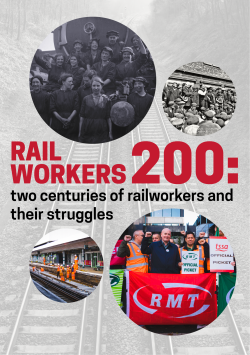
September marked 200 years since George Stephenson’s Locomotion No. 1 took the first passenger service train from Stockton to Darlington. The Rail200 anniversary has thus seen many thousands of words and speeches on what a momentous feat the work of Stephenson, Brunel, Trevithick and Locke have delivered. Janine Booth’s bookRailworkers 200 tells us about those whose labour built, ran and at times defended the railways.
“Railways combine within themselves the basic capitalist industries: coal, iron and steel; … and they are the most striking index of the development of international trade and bourgeois-democratic civilisation.” Lenin said in Imperialism: the Highest Stage of Capitalism. Booth’s bookRailworkers200: Two centuries of rail workers and their struggles details the class conflict and solidarity that created the modern railway.
Booth’s own experience as a railworker on London Underground and activity in the RMT and with the Tubeworker bulletin gives her an insight into the industry missing from many other accounts.
Using bulletins produced by other socialist and Marxist activists, official union records, parliamentary debates, and other testimonies, Railworkers200 gives the perspective of the “servants of the rails”.
Railway history is fairly central in the history of the labour movement. Booth charts the formation of Britain’s first rail unions, from the Amalgamated Society of Railway Servants to Aslef, the Railway Clerks’ Association and eventually the National Union of Railwaymen (now the RMT), and shows how these organisations transformed industrial Britain and played a key role in the formation of the Labour Party.
Alongside the 1919 strike, the 1926 General Strike, Beeching cuts, and the colour bar, the book also recounts lesser-known stories of rail history, such as Bakerloo line women who struck for equal pay in 1918, and the parallels with the fights of outsourced cleaners on the current privatised railway.
The book covers everything from the first actions by 1830s navvies right through to the strike wave of 2022-23. As we now enter, in Britain, a period of what should eventually be all-encompassing renationalisation, the struggle of railworkers has a new political edge.
An argument made convincingly in the book, and long advanced by Workers’ Liberty and Solidarity, is that of industrial unionism. Booth backs up the case that gains in safety, pay, equality and dignity have been won, and held onto when solidarity across grades has been at its strongest. Railworkers’ organisation, at a rank-and-file level, has been vital in pushing their unions to fight, not just industrially, but also for gender equality, LGBT+ rights, and against racism.
As Booth has said in a promotional video for the book, rail workers have built, operated, maintained, defended and fought for the railway. To build a democratically run railway operated in the interests of passengers and workers, we must learn from the struggles of the past 200 years to forge a vision of the railways as a system run for social need rather than private profit.
---
Buy the book here.
Comments?We welcome replies, corrections and debate pieces. Contact us