
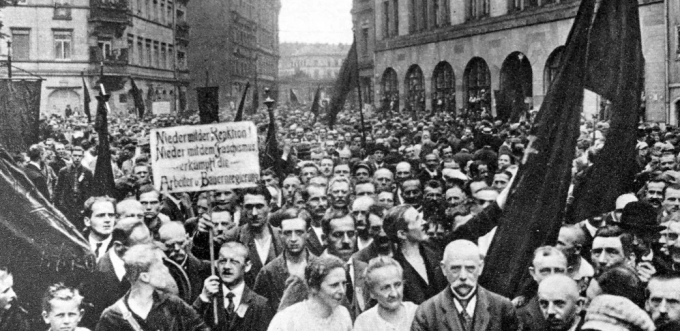
Picture: Joint anti-fascist demo in Dresden, 1923.
The basic idea of “united front” goes back to the very beginnings of Marxist politics, but the form of words originates in discussions in the German Communist Party (in December 1920 in Stuttgart, then across Germany) and in the Communist International in 1921-2. Trotsky wrote the “theses” below for the French Communist Party. The French CP was not ultra-left, as were many Communist Parties which opposed the “united front”. It had taken the majority of the old French Socialist Party, and was reluctant to propose united actions to the reformist remnant party, dismissing it as insignificant.
After assuring itself of the complete independence and ideological homogeneity of its ranks, the Communist Party fights for influence over the majority of the working class. This struggle can be accelerated or retarded depending upon objective circumstances and the expediency of the tactics employed.
But it is perfectly self-evident that the class life of the proletariat is not suspended during this period preparatory to the revolution. Clashes with industrialists, with the bourgeoisie, with the state power, on the initiative of one side or the other, run their due course.
In these clashes – insofar as they involve the vital interests of the entire working class, or its majority, or this or that section – the working masses sense the need of unity in action, of unity in resisting the onslaught of capitalism or unity in taking the offensive against it. Any party which mechanically counterposes itself to this need of the working class for unity in action will unfailingly be condemned in the minds of the workers.
Consequently the question of the united front is not at all, either in point of origin or substance, a question of the reciprocal relations between the Communist parliamentary fraction and that of the Socialists, or between the Central Committee of the two parties, or betweenl’Humanité and Le Populaire [the two parties’ newspapers]. The problem of the united front – despite the fact that a split is inevitable in this epoch between the various political organisations basing themselves on the working class – grows out of the urgent need to secure for the working class the possibility of a united front in the struggle against capitalism.
For those who do not understand this task, the party is only a propaganda society and not an organisation for mass action.
• Wherever the Communist Party already constitutes a big, organised, political force, but not the decisive magnitude: wherever the party embraces organisationally, let us say, one-fourth, one-third, or even a larger proportion of the organised proletarian vanguard, it is confronted with the question of the united front in all its acuteness.
If the party embraces one-third or one-half of the proletarian vanguard, then... the party must assume the initiative in securing unity in these current struggles. Only in this way will the party draw closer to those two-thirds who do not as yet follow its leadership, who do not as yet trust the party because they do not understand it. Only in this way can the party win them over.
• If the Communist Party did not seek for organisational avenues to the end that at every given moment joint, co-ordinated action between the Communist and the non-Communist (including the Social-Democratic) working masses were made possible, it would have thereby laid bare its own incapacity to win over – on the basis of mass action – the majority of the working class. It would degenerate into a Communist propaganda society but never develop into a party for the conquest of power.
It is not enough to possess the sword, one must give it an edge it is not enough to give the sword an edge, one must know how to wield it.
Separating
After separating the Communists from the reformists it is not enough to fuse the Communists together by means of organisational discipline, it is necessary that this organisation should learn how to guide all the collective activities of the proletariat in all spheres of its living struggle.
This is the second letter of the alphabet of Communism.
• Does the united front extend only to the working masses or does it also include the opportunist leaders?
The very posing of this question is a product of misunderstanding.
If we were able simply to unite the working masses around our own banner or around our practical immediate slogans, and skip over reformist organisations, whether party or trade union, that would of course be the best thing in the world. But then the very question of the united front would not exist in its present form.
The question arises from this, that certain very important sections of the working class belong to reformist organisations or support them [yet] the circumstances thus make wholly possible joint action on a whole number of vital issues between the workers united in [different] organisations and the unorganised masses adhering to them.
The Communists, as has been said, must not oppose such actions but on the contrary must also assume the initiative for them, precisely for the reason that the greater is the mass drawn into the movement, the higher its self-confidence rises, all the more self-confident will that mass movement be and all the more resolutely will it be capable of marching forward, however modest may be the initial slogans of struggle. And this means that the growth of the mass aspects of the movement tends to radicalise it, and creates much more favourable conditions for the slogans, methods of struggle, and, in general, the leading role of the Communist Party.
Potential
The reformists dread the revolutionary potential of the mass movement; their beloved arena is the parliamentary tribune, the trade-union bureaux, the arbitration boards, the ministerial antechambers.
On the contrary, we are, apart from all other considerations, interested in dragging the reformists from their asylums and placing them alongside ourselves before the eyes of the struggling masses. With a correct tactic we stand only to gain from this. A Communist who doubts or fears this resembles a swimmer who has approved the theses on the best method of swimming but dares not plunge into the water.
• Unity of front consequently presupposes our readiness, within certain limits and on specific issues, to correlate in practice our actions with those of reformist organisations, to the extent to which the latter still express today the will of important sections of the embattled proletariat.
But, after all, didn’t we split with them? Yes, because we disagree with them on fundamental questions of the working-class movement.
And yet we seek agreement with them? Yes, in all those cases where the masses that follow them are ready to engage in joint struggle together with the masses that follow us and when they, the reformists, are to a lesser or greater degree compelled to become an instrument of this struggle.
• A policy aimed to secure the united front does not of course contain automatic guarantees that unity in action will actually be attained in all instances. On the contrary, in many cases and perhaps even the majority of cases, organisational agreements will be only half-attained or perhaps not at all. But it is necessary that the struggling masses should always be given the opportunity of convincing themselves that the non-achievement of unity in action was not due to our formalistic irreconcilability but to the lack of real will to struggle on the part of the reformists.
In entering into agreements with other organisations, we naturally obligate ourselves to a certain discipline in action. But this discipline cannot be absolute in character. In the event that the reformists begin putting brakes on the struggle to the obvious detriment of the movement and act counter to the situation and the moods of the masses, we as an independent organisation always reserve the right to lead the struggle to the end, and this without our temporary semi-allies.
This may give rise to a new sharpening of the struggle between us and the reformists. But it will no longer involve a simple repetition of one and the same set of ideas within a shut-in circle but will signify – provided our tactic is correct – the extension of our influence over new, fresh groups of the proletariat.
• It is possible to see in this policy a rapprochement with the reformists only from the standpoint of a journalist who believes that he rids himself of reformism by ritualistically criticising it without ever leaving his editorial office but who is fearful of clashing with the reformists before the eyes of the working masses and giving the latter an opportunity to appraise the Communist and the reformist on the equal plane of the mass struggle. Behind this seeming revolutionary fear of “rapprochement” there really lurks a political passivity which seeks to perpetuate an order of things wherein the Communists and reformists each retain their own rigidly demarcated spheres of influence, their own audiences at meetings, their own press, and all this together creates an illusion of serious political struggle.
• Abridged from Trotsky’s Theses on the United Front of March 1922.
Comments?We welcome replies, corrections and debate pieces. Contact us