
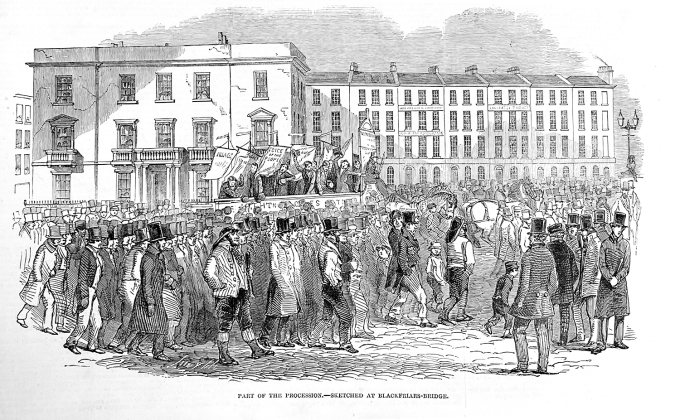
In his 2007 book Chartism: a new history, Malcolm Chase described Chartism as “the first (and arguably still the greatest) mass movement in industrialised Britain”.
The Chartist movement was started in 1836 by members of the London Working Men’s Association and the more left-wing London Democratic Association. In February 1837, these groups jointly organised a meeting at the Crown and Anchor Tavern, at which 3,000 people resolved to petition the government for the “People’s Charter”, demanding: enfranchisement of adult males; payment of MPs; no property qualification for MPs; secret ballots; equal electoral districts; and annual parliaments. Faced with the 1832 Reform Act and the vicious 1834 Poor Law Reform Act, they were trying to get control over parliamentary decisions.
Most early Chartists were London artisans, but they rapidly linked up with industrial workers in the Midlands, the North, Scotland and Wales. National profile speakers emerged, especially Feargus O’Connor, son and nephew of leading United Irishmen. Most national spokespersons were men, but women textile workers were a central driving force.
Petitions with thousands of signatures went to parliament in 1839, 1842 and 1848, all to be rejected. Chartist activity also included armed uprisings (eg Newport in 1839), an embryonic general strike (1842), armed torchlit demonstrations, “exclusive dealing” (i.e. boycotting anti-Chartist shopkeepers), and many Chartist papers. Adult education too was integral to Chartism.
In 1815 the government had imposed a fourpenny tax on newspapers, marked by a red dot. Papers without this were “unstamped”, hence illegal. Struggles over this began in 1830. Activists printed and distributed unstamped papers and were imprisoned. In 1836 the government cut the tax to one penny, ending the struggle. Many who became Chartists were active in the unstamped campaign and in the process formed ideas about what workers needed to know.
Meanwhile, in the 1820s writers like Thomas Hodgskin sought to bring economic ideas focused on a labour theory of value to working-class audiences. Stimulated in 1830 by machine-breaking and rick-burning amongst agricultural workers, the upper-class Society for the Diffusion of Useful Knowledge (SDUK), launched a serial publication aimed at countering ideas like Hodgskin’s.
Again, activists resisted. Thus in April 1833, writing in the unstamped Poor Man’s Guardian, a ‘labourer from Poplar’ argued that: “Useful knowledge, indeed, would that be to those who live idly on our skill and industry”. The paper’s editor supported this, contrasting knowledge “calculated to make you free” with SDUK publications, which were “published expressly to stultify the minds of the working people and make them the spiritless and unresisting victims of... plunder and oppression”.
Societies for the Diffusion of Really Useful Knowledge appeared, including one fronted by William Hassell, a foreman in the printshop of unstamped activist Richard Carlile. This campaign was such that in November 1833 the rightwing trade unionist Francis Place noted that: “The unionists will read nothing which the Diffusion Society meddles with”.
A conception of adult education developed from these two struggles.
In the August 1833 Working Man’s Friend, the wood carver James Watson, repeatedly imprisoned in the unstamped struggle, asserted the necessity for the “mental emancipation” of the working classes.
In September 1835, London-based radicals formed the Great Marylebone Radical Association and issued a Declaration of the Rights of Man containing the words: “Instruction is the want of all; society and government ought, therefore, to do all in their power to favour the progress of reason and truth; and to place instruction within the reach of all”.
Similarly, when the London Working Men’s Association was set up in June 1836, the preamble to its rules asked: “Think you a corrupt Government could perpetuate its exclusive and demoralising influence amid a people... united and instructed?... Could corruption sit in the senate-house — money-getting hypocrisy in the pulpit — and debauchery, fanaticism, poverty, and crime stalk triumphantly through the land — if the millions were educated in a knowledge of their rights?...” and concluded: “Be ours the task, then, to unite and instruct them; for... the good that is to be must be begun by ourselves”.
In March 1837 the East London Demoratic Association stressed that for it too “the political and social education of the people” was a central aim.
In November 1837, O’Connor launched a weekly stamped paper, the Leeds-based Northern Star. In its first issue, drawing a link between agitation and education, he wrote: “Behold that little red spot... it is my license to teach”.
Ideas about the aims of valid workers’ education were already current amongst industrial workers. For example, the September 1830 issue of John Doherty’s United Trades’ Co-operative Journal, published in Manchester, had argued that the “master manufacturers” would be “speedily overwhelmed” by “the might and irresistible power of acquired and accumulating knowledge” [which] “may eventually sweep their cherished order from all but our recollections”.
Education
A January 1836 meeting in Glasgow heard Arthur Wade claim that the unstamped press revealed “the movements of the mass towards that point in the education of the mind when the many will be emancipated from the rascality of the few”.
In 1838, the Nottingham Working Men’s Association member James Sweet, writing in the Midland Counties Illuminator, urged readers to “Prepare your minds... Be ready, upon all occasions, to give a reason for the faith that is within you; and tell those who inquire what you want, that you are seeking after truth... “
In May 1839, a Kettering Radical Association pamphlet announced: “So long as we were kept in ignorance, there was little difficulty in enslaving us: but now... we have acquired the knowledge of our rights, and begun to feel our strength”.
In November 1839 in Bath, following John Frost’s Newport rising, Charles Bartlett was charged with saying that “if a hair of John Frost’s head was hurt, I hope you will be prepared with arms”. Contesting this, he insisted that he: “always recommended the people to educate themselves in political knowledge”.
When the National Charter Association (NCA) was set up in Manchester in July 1840, attendees included “The Diffusion of Political Knowledge” under “Some means for the attainment of the great end”.
In August 1840, a Manchester Chartist told a banquet marking the release of three imprisoned Chartists: “Our oppressors cannot fetter the human mind, which laughs to scorn their puny efforts to arrest its onward progress”.
In 1841 O’Connor claimed that the Northern Star had become “the mental link which binds the industrious classes together”.
At the 1842 funeral of the Sheffield Chartist Samuel Holberry, George Julian Harney said of “our haughty rulers”: “We tell these puny Canutes, that despite their bidding, the ocean of intellect will move on”.
In an 1844 statement, Burslem miners said: “We require knowledge of a superior description to any which it has been the fortune of the majority of us to receive, and above all... we should endeavour to obtain and disseminate this knowledge, as it will enable us... to discover the necessity for union of mind and action to relieve us from the difficulties and hardship by which we are surrounded” .
Chartist educational methods included travelling “lecturers”, collective reading of papers, especially the Northern Star, and discussion.
Amongst miners this role of lecturers was well-established. For example, when banned from union work after a defeat in 1832, the Northeast miners’ leader Thomas Hepburn: “travelled long distances on many a dreary night, and addressed meetings to advocate the political rights of the people, advising his hearers to get knowledge”. The approach expected of lecturers is clear also from the 1844 statement put out by a Burslem miners’ conference, which instructed them to: “by all legal means endeavour to properly throw open their [own] minds to the pursuit of knowledge, as... that alone... will enable us properly to remove the causes which at present impede our progress”. Again, in the March 1844 Miners’ Magazine, W P Roberts, “the miners’ attorney” and a Chartist lecturer, said: “The great thing I want to accomplish is to induce you to think — to talk, to argue — upon those matters which concern you; when once you really do, you are sure to think rightly”.
In his History of the Chartist Movement (1854) the former coach builder and Chartist lecturer R G Gammage reported that within two years of the NCA being set up: “There were upwards of four hundred localities in connection with that body, and forty thousand names... on the books. County and district organizations existed far and wide, and lecturers were engaged for several months together to agitate the country”.
Around the same time (March 1842) the Halifax Chartist William Thornton argued in the Northern Star for forming debating societies and “lecturing classes” (i.e. tutor training) “to place Chartism on a proper basis by making every man his own lecturer...” .
Discussion too was central. In 1831, Richard Carlile, writing in the unstampedCosmopolite on “What is education?” had argued that “Discussion cannot be too free; cannot be carried too far; cannot take up an improper subject”.
Collectively
Many Chartists thought likewise. For example, in 1838, the Mossley Working Men’s Association acquired a room, where they read the Northern Star and other papers collectively, explaining: “We have no secrets; we admit anybody, whether they are members or not; we read the news of the week, and discuss it paragraph by paragraph, as it is read...”
Then in August 1840, at the banquet held in Manchester to celebrate his release from prison, John Collins insisted: “it [is] only by converse between man and man that [his listeners] could hope to improve their condition. It was not by groaning, or shouting, or hissing, that they would gain their object, but by meeting and instructing each other”.
Many discussions took place in Chartists’ homes. Thus from June 1839 reading groups in Sunderland discussed “works by which human nature may be elevated by the consciousness of its dignity” hastening the time when “each man is fit to be his own leader”.
In November 1839, Nottingham Chartists acquired a former Methodist and Primitive Baptist chapel and re-opened it as the “Democratic or Chartist Chapel”, used on Saturday evenings, for “mutual instruction” and the reading of Chartist papers.
InThe Condition of the Working Class in England (1845), based on his 1842-44 stay in Salford, including conversations with his partner Mary Burns and with former factory worker and first NCA chairperson James Leach, Frederick Engels noted that: “Trades unionists, Chartists, and Socialists [i.e. Owenites], have founded... schools and reading rooms for the advancement of education... almost every Chartist institution, has such a place,... and in the reading rooms, proletarian journals and books alone, or almost alone, are to be found.”
Where, then, did the Chartists’ educational confidence come from?
In the 4 March 1837 London Mercury Bronterre O’Brien reported on the Crown and Anchor Tavern meeting, One speaker had said that both landowning aristocrats and industrial capitalists were: “vastly inferior to the working classes in all those departments of knowledge which society most needs, and without which it could not exist an hour”, asking rhetorically: “what does the aristocrat or shopocrat know of husbandry or ship-building or any other of the useful arts?” Another speaker then said: “They pretend that our ignorance is the sole cause of their excluding us (but) it is our knowledge not our ignorance they fear. If we were really ignorant, they would give us the franchise... expecting that while we had it in name and appearance, they themselves would possess the substance and reality!”
Many rank and file Chartists at that time would have been close enough to an artisan, homeworker or independent agricultural background for this claim to ring true.
Comments?We welcome replies, corrections and debate pieces. Contact us