
In his new book Our Dollar, Your Problem, the former International Monetary Fund (IMF) chief economist Kenneth Rogoff presents a “timeline of the global safe asset”, in other words of the money-commodities which have underpinned the capitalist world market, from 1509 to 2025.
From 1509 to 1816 it was silver, mostly in the form of Spanish pieces of eight or Dutch florins. From 1816 to World War One, it was gold, mostly via the British pound, reliably exchangeable for 7.32238 g gold. The words “I promise to pay the bearer on demand £x” on Bank of England notes meant literally that you could go to the Bank of England with a note and get gold coins in return. All the Bank will pay you now is another note.
Between 1914 and 1947 there was no reliable “world money”, though gold was still used as a reference. (The pound was tied to gold only from 1925 to 1931. The US dollar was devalued in 1934 from $20.67 per troy ounce to $35 per ounce).
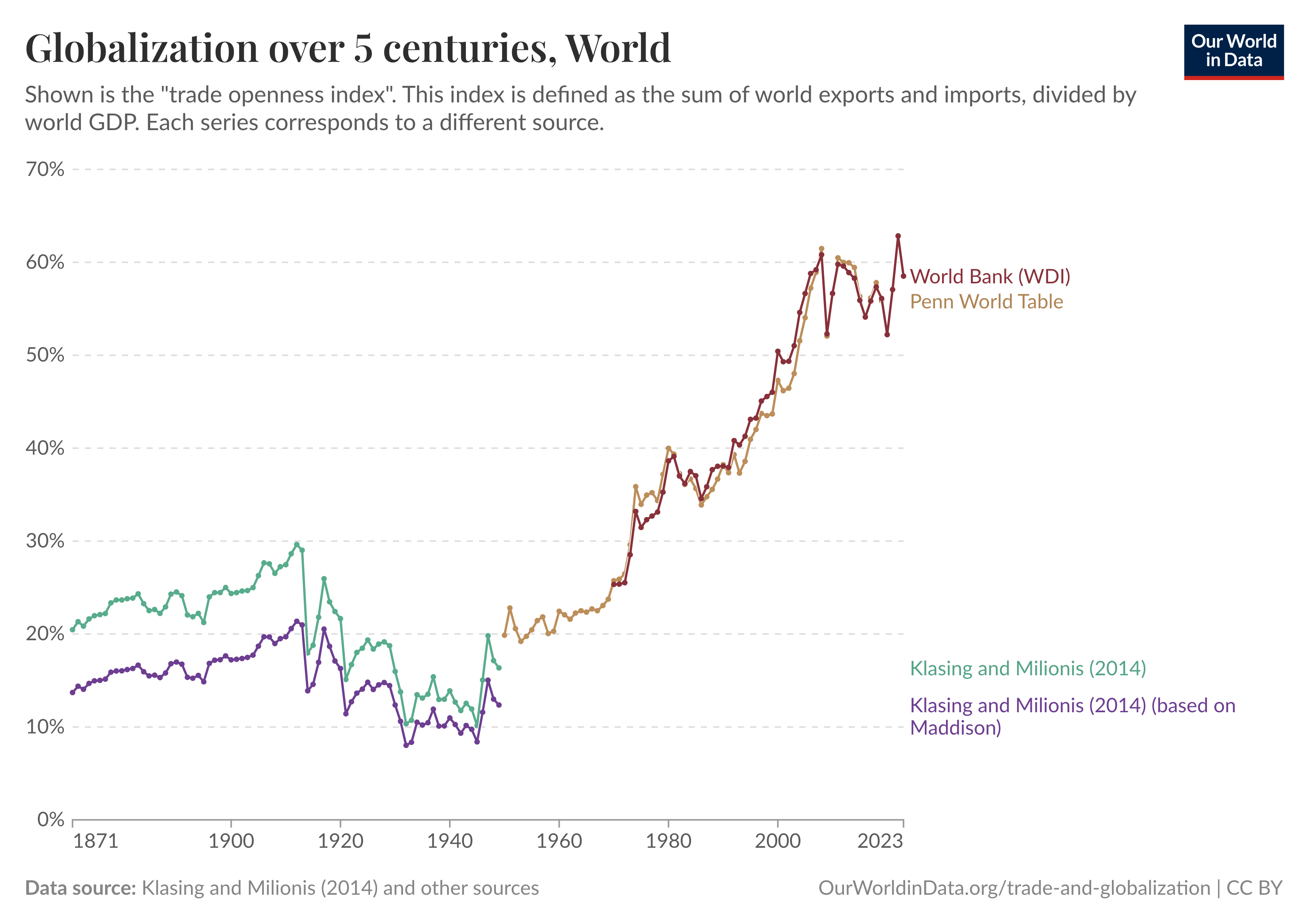
Trade did not vanish, but it did badly. Those were decades of wars and crises. Worldwide exports plus imports had been maybe 25% of world output in 1910, but were only 15% in 1929 even before the Great Depression, and around 10% in 1939.
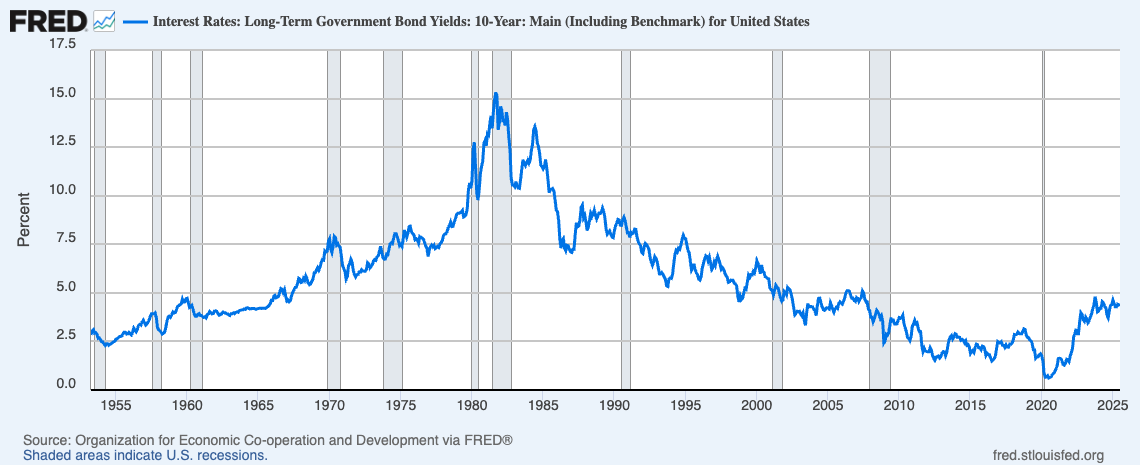
From 1947 to the early 1970s, the “world money” was the US dollar, linked to gold at $35 an ounce. Then the US abandoned the promise to exchange dollars for fixed amounts of gold. After great turmoil in the 1970s and early 1980s a modified regime took shape, with the dollar as “world money” though without a link to gold. Surprisingly in some ways, that regime survived the 2008-9 financial crash centred in the USA without a surge in interest rates or inflation.
But what after 2025? Rogoff predicts a new era, “a much less dollar-centric world”.
The title of Rogoff’s book refers to US ruling-class attitudes since the early 1970s: the dollar is their currency, they manipulate it in their interests, and how it functions as “world money” is mostly other countries’ problem. He argues the set-up is unstable.
“Over the coming decade, the world will experience higher interest rates and inflation… the dollar’s unique borrowing privilege might be considerably less amid a considerably more fragmented global financial system…”
Within the US, “the odds that the system can reset without having a serious crisis seem low. [This] can take many forms, but most would involve higher, more unstable inflation and much higher nominal interest rates…”
Worldwide, he expects “a sustained period of global financial volatility marked by higher real interest rates and inflation and more frequent… financial crises”.
All that may be delayed; the crises may be smaller than 2008-9; and even if not, the “dollar epoch” will not vanish overnight. But it will be troubled. And Rogoff quotes his mentor Rudi Dornbusch: “In economics, things take longer to happen than you think they will, and then they happen faster than you thought they could”.
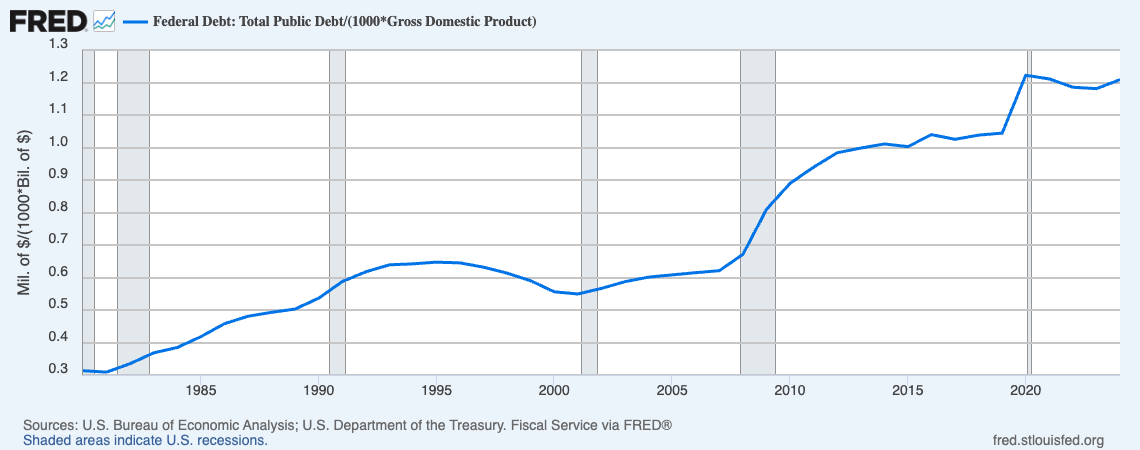
Rogoff finished his book just before the election of Trump 2.0 in 2024. He has written since then that “Trump’s actions could prove devastating to American institutions and the global economic order”. But the book is essentially about the unviability of ever-increasing US government debt as a foundation for world markets. The dollar as “world money” means that capitalists worldwide need stashes of dollars, and a chief form is holdings of US government IOUs (bonds).
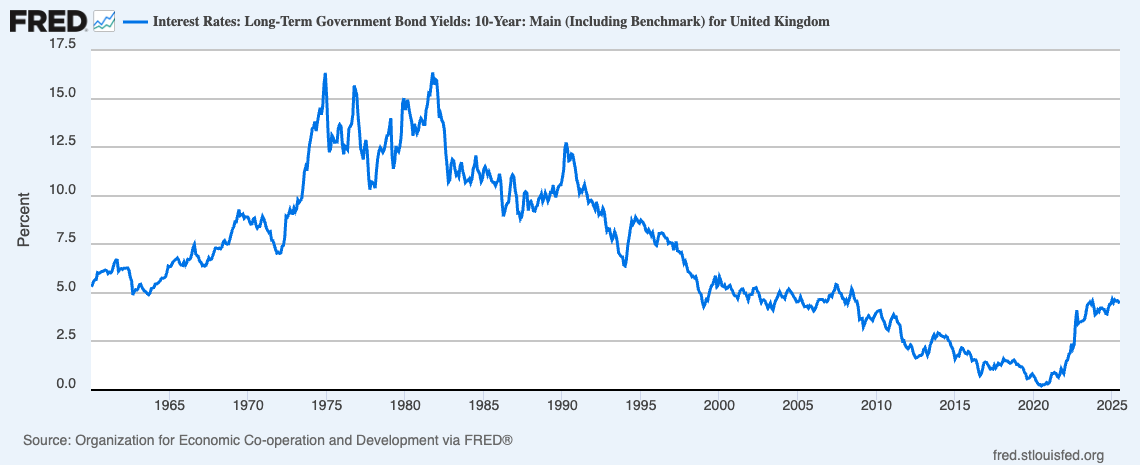
Rogoff is a right-winger, and an article of his in 2010 suggesting that government debt above 90% of a country's annual output would depress its economic future was part of the Tories' case for austerity then (although in his book Rogoff claims to favour better social provision. “Austerity” didn’t work in its own terms. UK government debt was 60-odd% of annual output in 2010, rose to over 90% by the time the Tories left office, and remains over 90%).
In the book Rogoff tends to puff himself by suggesting that other economists consider rising debt no problem (for the US, anyway), and believe that the low interest rates on government debt since 2009 will continue indefinitely. Actually, few economists doubt that debt is a problem. Despite the excesses of Rogoff’s 2010 article, his 2009 book with Carmen Reinhart on government debt, This Time It’s Different, is a serious work.
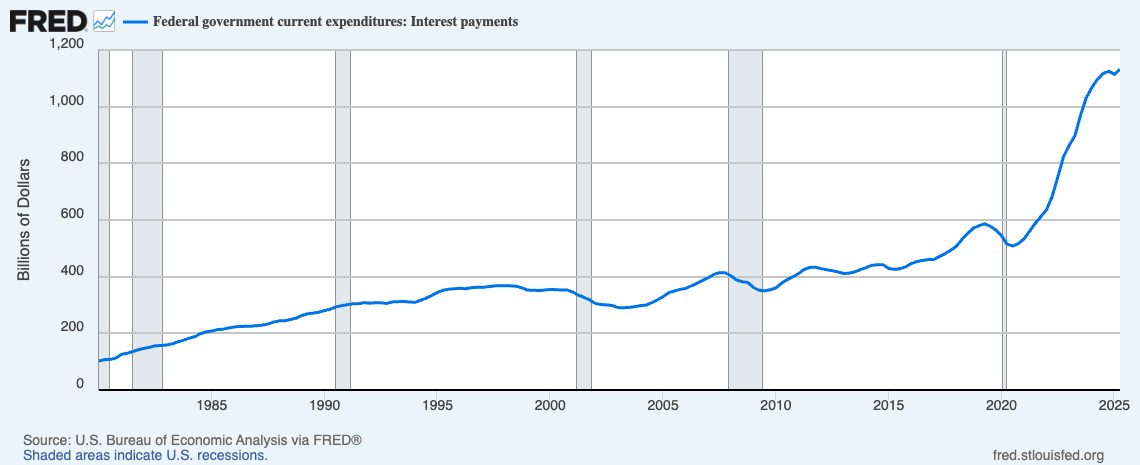
A government with huge and rising levels of debt constantly has to sell new bonds (IOUs) to replace those falling due, and risks finding it has to offer high interest rates to get buyers. As the interest offered rises, so does the share of government revenue siphoned away from social provision into pay-outs to rich bondholders.
The US has been able to run an explosion of government debt since the 1980s with relative ease because governments and capitalists in the rest of the world have been greedy to buy US bonds as a way of making sure their wealth stashes are stable in terms of “world money”, i.e dollars. There are limits to that appetite.
Rogoff’s book is useful on other counts. It explains why the fixed exchange rates which countries ran before the 1970s (the pound, for example, was fixed at $2.80 from 1949 to 1967) were more subject to crises (the UK “devalued”, i.e. changed the rate, in 1949 and 1967; France, in 1969, 1958, 1957, etc.) than the floating exchange rates more common since then.
It suggests a plausible reason why “Quantitative Easing” (central banks buying up bonds held by banks and so preventing a crash in prices of those bonds and putting more cash into the system) after 2008-9 failed to lead to high inflation. The central banks paid the commercial banks by crediting the accounts those banks are obliged to hold with the central bank and paying interest on the new holdings. The commercial banks kept the holdings rather than splashing the cash.
Cryptocurrency is more than a scam, Rogoff argues, because it facilitates illegal and tax-evading trade, which may be 20-odd% of all economic activity. In that it partly replaces cash dollars. There is some $22,000 in $100 bills out there, somewhere in circulation, per household of four in the USA. Most of it is probably being used by people wanting to minimise records of their deals.
He explains, however, that cryptocurrencies cannot replace the dollar as “world money”. Nor, in the foreseeable future, he further explains, can the euro or the renminbi. The immediate “alternative” is much more fragmented and “sticky” world trade.
He does not comment on the possibility discussed by other economists that the Trump boost to cryptocurrency use may generate a mass of unstable and dodgy debt, and thus a crisis.
Rogoff also does not pursue the impact on world economic dislocation of the US-led sanctions against Russia after Putin’s invasion of Ukraine in 2022. He does note: “the dollar has also become a de facto branch of the US armed services. For over three decades now [in fact for longer] the US has increasingly weaponised financial sanctions as an alternative to military intervention”. (They are “cheaper” politically and financially than “boots on the ground”, but often not effective in their own terms).
An April 2024 IMF working paper by Gita Gopinath and others supplements Rogoff on the world-market-fragmenting (but not really Putin-war-deterring) effects of US-led sanctions against Russia and others. They find that since Russia's invasion of Ukraine, trade and direct investment flows between rival "geopolitical blocs" (for example, the US-led and the China-led) have shrunk relative to those within blocs. Trump's new tariffs will sharpen that trend, which they compare to the economic division into blocs created by the Cold War after 1947.
Karl Marx declared in 1847 that in a “revolutionary sense”, he favoured free trade over protectionism. “Do not imagine that in criticising freedom of trade” – as he did - “we have the least intention of defending the system of protection. One may declare oneself an enemy of the constitutional regime [i.e. bourgeois rule of law, some element of democracy] without declaring oneself a friend of the ancient regime [i.e. absolute monarchy]”.
The regressive effects of nationalistic economic policy are much greater now. As Gopinath notes: “In… 1947-52 global goods trade was only 12% of GDP [output]… in 2019-23… 44%. Including services, trade exceeded 60% of global GDP in 2022”. And these days “intermediate goods” (already-processed inputs to production) account for more of trade than either raw materials or consumer goods. Many of those “intermediate goods” require high technology and are produced only in a few countries, so disrupting trade also means disrupting production.
It may become more difficult, but will also become more urgent, to develop and sustain international workers’ unity and solidarity, and opposition to disruptive barriers between countries.
Comments?We welcome replies, corrections and debate pieces. Contact us