
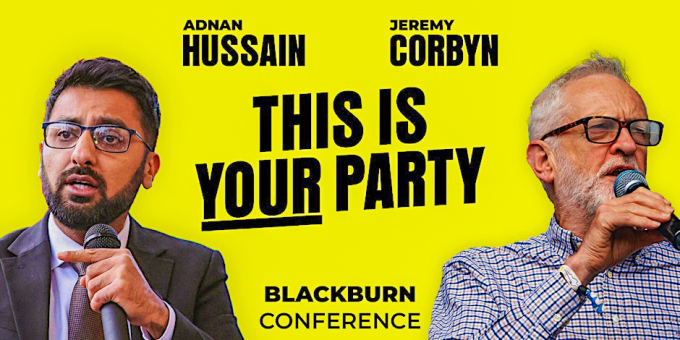
During the Corbyn leadership campaigns in 2015 and 2016, regional organisers had the role of coordinating supporters. It was particularly vital to secure CLP nominations and encourage Corbyn supporters to speak with other Labour members, persuading them to attend their local nomination meetings.
Later, some of those organisers helped get the first local Momentum or “For Corbyn” groups set up.
Corbyn’s leadership election was an intervention into an established political party, with pre-existing local organisation, and many people who had some access to membership data and some idea of the make-up of their local parties. Although limited, there was a political programme that Corbyn stood for, and a long record you could point to.
The new Sultana-Corbyn project, “Your Party”, in starting from scratch, has none of that launch-scaffolding. But its bureaucracy is also much more closed off. No regional organisers have been appointed, and those who have signed up to “keep informed” have yet to receive direction on what that leads to. We can give some money to the unknown officials running the show, and we’ve been reassured that a founding conference, or at least a national event, will be called before the end of the year. Beyond that, we have very little.
And what we do have is contradictory. Corbyn has reiterated his desire for a federal organisation, which somehow latches together the Independent Alliance of MPs (which comprises himself, Sultana, and all of the “Gaza Independents” who are not particularly left-wing), various independent councillor networks, and other campaigning groups. That is also the favoured position of the SWP, who seem mostly concerned for access to mobilise “Your Party” supporters to back Stand Up to Racism actions and other activities convened by the SWP.
Zarah Sultana has called for “Your Party” to use One Member One Vote (OMOV) to make decisions at a founding conference with a large hybrid (online as well as in-person) element. In an interview on the New Left Review Sidecar blog, she says “we should be striving for mass participation, as opposed to a narrow delegate structure which could be unrepresentative of our base. And finally, we should have a genuine forum for debate and discussion, not a situation where decisions are made by an executive team and rubber-stamped by everyone else”.
Without any guidance about local groups, it is entirely in the hands of those who want to set something up to take the initiative. There are absolutely no rules, as yet, as to who has the franchise to set up these groups or what role local organisations being set up now, or already in existence, will play when it comes to the conference. An email on 26 August suggests that local groups that have set up meetings can now get Your Party administrators to advertise them.
Sheffield is so far the only local meeting to have secured a high-profile key figure, in the shape of Andrew Feinstein. But no clarity was given on the relationship between local groups and the national party.
Data
The data, now over 800,000 email addresses and postcodes from people who want to “keep informed”, is still being held centrally, and who will get control or access to it remains unclear. Control of that data will help determine whether local groups can reach the people who signed up. A spread of 800,000 people goes well beyond the reach of the entire organised activist left. Meetings that are being called now are largely advertised only so far as existing groups can reach.
Multiple groups are overlapping in some areas. A lot of these groups are just on social media or on WhatsApp. Both the SWP and Socialist Party have advertised meetings about “Your Party” to favour their particular intervention into it. They currently have as much legitimacy to do so as any group of activists who wish to operate now as Your Party.
Reports of meetings in Sheffield, Leeds, Croydon, and the Isle of Wight suggest that the majority of people brought to actual meetings so far are existing members of left groups and reactivated Corbynites. Reports from the Isle of Wight meeting are the most positive, with more young people in attendance than in other reports.
The new organisation will probably fight, and soon, about the role of the existing organised left. Workers’ Liberty will argue that there should be no exclusion of existing political organisations. Every strand of opinion should be able to argue for its politics and organise as a faction if and when necessary. At the same time, we’ll be arguing for “Your Party” to be more than an electoral initiative. We want people organised to advocate for socialism, for working-class political representation, and for a genuine fight against cuts and austerity, week in week out, on the streets, on picket lines, in workplaces. “Your Party” should, where it exists, work with Labour members on joint campaigning against welfare cuts, for trans rights, and for peace in Israel-Palestine.
In some places, “Your Party” is now an extension of an existing or about-to-exist group with a focus on the local elections in 2026. Islington and Ealing have Community Independent groups of councillors, as does Liverpool. In Harrow “Aspire”, whose launch meeting will be addressed by both Pamela Fitzpatrick and Jeremy Corbyn, will want to affiliate, if such a thing is allowed, to the national “Your Party”. Jamie Driscoll’s “Majority” semi-party in the north-east has a conference of its own early in September, although without votes on policy.
Those groups, who may have pre-existing policy and platforms, will then relate to national policy, how? Presumably, such groups, along with Corbyn and Fitzpatrick, will favour some sort of federal model.
If the question of organisation remains unclear, so also does the political basis of the group. The only clear statement from Andrew Feinstein in the Sheffield meeting on politics is that the new party should be ideologically broad.
Rather than learn from the problems of Corbynism and its failure to tackle antisemitism, there seems to be a risk that “Your Party” will instead embrace the political lines of the more anti-Israel “hardline” of the Corbynite movement, the politics of the Palestine Solidarity Campaign and the Gaza Independents.
Zarah Sultana has criticised Corbyn for (as she sees it) equivocating on the question of antisemitism, notably in that, with ostentatious reluctance, his Labour leadership endorsed the IHRA definition of antisemitism. (The most-disputed passage there says “claiming that the existence of a State of Israel is a racist endeavour” “could” be antisemitic. That clause is said to outlaw criticism of racist policies by Israel, but it doesn’t: it says that to condemn thevery existence of any version of an Israeli state can be antisemitic).
Sultana is also unclear on Brexit, saying that Corbyn’s Labour “triangulated on Brexit, which alienated huge numbers of voters”. It did, but is her alternative that Corbyn should have been pro-Brexit all along, or anti-Brexit all along? She herself was not visible in the anti-Brexit movement. The left now should fight to rejoin the EU and for the reintroduction of free movement across Europe, rather than accept Brexit as a “done deal”.
The rest of Sultana’s Sidecar piece seems mostly a shot across the bows at the rival camps, most likely the previous Corbyn staffers like Karie Murphy. The organisers will soon need clarity on the next steps to keep a fragile coalition together. We can’t advise them on that, but we can take part in the meetings that are being called now, and argue the need for working-class socialist politics, for more-than-electoral activity, and for a democracy based on accountable structures, delegates, meetings, motions, votes, rather than “plebiscitary” snap votes and e-consultations.
Comments?We welcome replies, corrections and debate pieces. Contact us