
Photo: Facebook
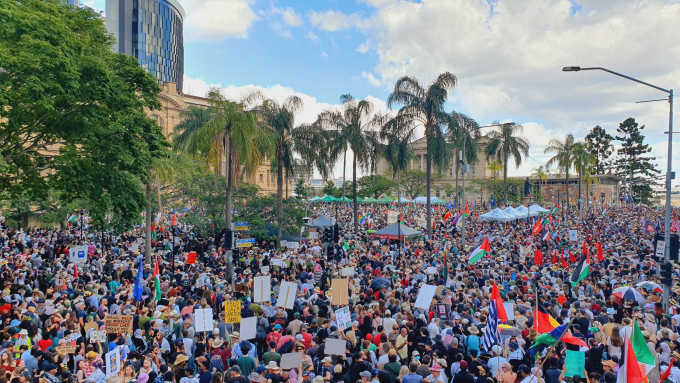
On 24 August Netanyahu's new attacks in Gaza brought the biggest demonstration for many years in Brisbane. The organisers said 30,000, the cops said 10,000, and my guess is that the organisers were much nearer the truth.
I can give only limited observations, and no model for intervention on such demonstrations, because others who might have collaborated with me were unavailable for various reasons, such as working on jobs far from Brisbane, and my mobility is limited by worsening arthritis. There is a Friends of Standing Together group in Sydney, but none in Brisbane. Still, the demonstration was big enough to make even limited observations worthwhile.
The route was changed at the last minute because of police obstructiveness, and I didn't find out until late. The allotted new assembly point, Queen's Gardens, was packed full and overflowing into nearby streets by the time I got there from the previously-advertised place. That made it difficult to get round the crowd, sell literature, and seek conversations – or, rather, even more difficult than it was already because of the arthritis.
Most of the few I talked with, though, were not habitual protest-goers. They had come out, when they wouldn't usually, for simple human reasons of being horrified by the suffering in Gaza. Some said that Australian prime minister Albanese's promise to "recognise Palestine" had encouraged them to think protesting could make a difference. The Brisbane Times had a vox pop from one elderly demonstrator who said she had failed to demonstrate against the Vietnam war or the wars in Afghanistan and Iraq, and now thought it was about time she got out and about.
There was a wide range of ages: a lot of young people, but also, it seemed to me, more parents bringing children, and more elderly people, than on the big London marches, although over the decades general "public opinion" in Australia has been markedly more pro-Israel than in Britain.
Almost all the placards were home-made. The demonstration was called by a local Justice For Palestine group. It distributed a leaflet which however only advertised future meetings and gave no political slogans or arguments. There were a lot of Palestinian flags, and a scattering of individuals carrying union flags (not banners). Socialist Alternative had a contingent near the back of the march, visible but smaller than I expected, with a banner saying "From the river to the sea". The Socialist Alliance had a smaller contingent. It looks like Solidarity (the "official" Australian group linked to the SWP-UK) remains tiny in Brisbane.
The demonstration organiser who spoke to the media about the negotiations with the cops on routes was a Green candidate in the last federal election (in the next-door electorate to me). Several Green and some Labor councillors or MPs were in the crowd; so was the Queensland Greens senator and federal Greens leader Larissa Waters. But there was no organised Green or Labor contingent. I didn't do well with selling literature, but then I saw no-one else "working the crowd" with papers to sell or leaflets to distribute, other than a glimpse of one comrade clutching the Socialist Alliance's Green Left Weekly.
Several of the organisers at the front of the march (there were very few stewards, though hordes of cops) were visibly (i.e. by hijabs, etc.) Muslims. So far as I could tell, this was a Muslim-community, rather than political-Islamist, presence. In the earlier years of this century, when I spent more time in Brisbane, Muslims were mostly Bosniac or Kosovar, and hijabs were almost unknown; in the 2021 census, 4% of people in Brisbane had parents born in India, and on one account 1.8% of the total are Muslim. Brisbane is a city where 36% of the people were born overseas, and 57% have at least one parent born overseas.
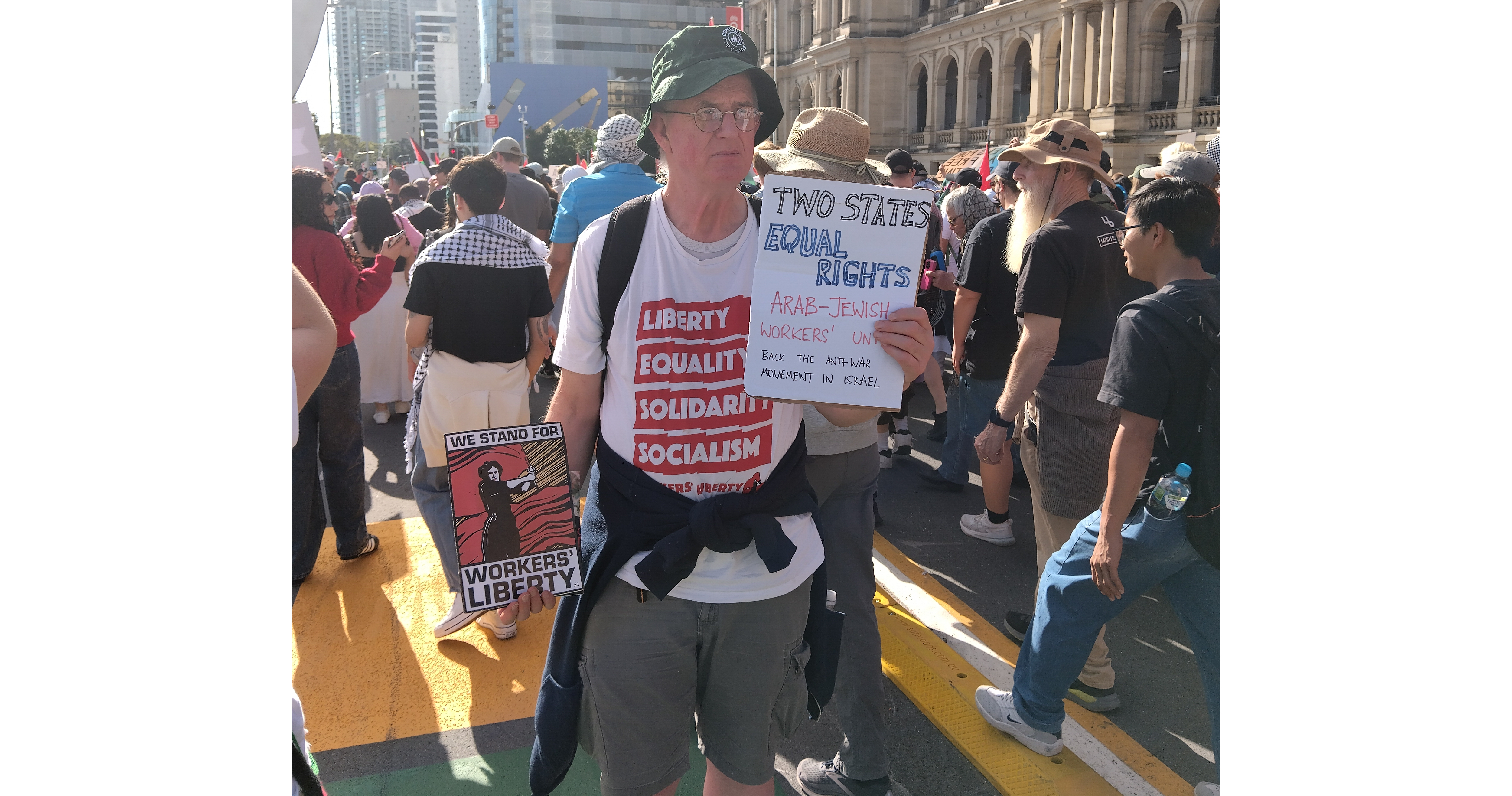
I had made two placards saying "two states, equal rights, Arab-Jewish workers' unity, back the anti-war movement in Israel". One young Asian woman (non-hijabi) denounced the placards, and insisted Israel must be abolished, but didn't stop to argue; another (hijabi) offered me a bottle of water as a friendly gesture. A few people stopped to take photos of my placards or told me they approved; when my arthritis stopped me going further, two people took the placards from me to carry themselves.
A lot of placards were simple: ceasefire now, stop the killing. Many said Free Palestine. I guess different people understood different things by that widely-shared slogan. One placard called for freedom in war-ravaged Sudan and Congo too.
There was as much of a "destroy Israel" tone as in London, but not through distribution of printed placards and the influence of large organised contingents with megaphones. Not because of the preferences of the majority of the protesters, either, I would guess, but rather from "spontaneous" dominance by the most vocal and and those seeking the angriest words.
The SWP's favourite chant in London – "one, two, three, four, occupation no more; five, six, seven, eight, Israel is a terror state" – was heard, and a variety of others: "from the river to the sea, Palestine will be free; from the sea to the river, Palestine will live forever". There were some chants against the Albanese government (as slow-moving in condemning Netanyahu as Starmer is).
Another home-made placard, trying to be consistent about settler-colonialism I guess, had the slogans "free Palestine, abolish Australia".
We need more activists to bring internationalist politics to such protests, so that a stable and constructive movement can be built out of them.
Comments?We welcome replies, corrections and debate pieces. Contact us