
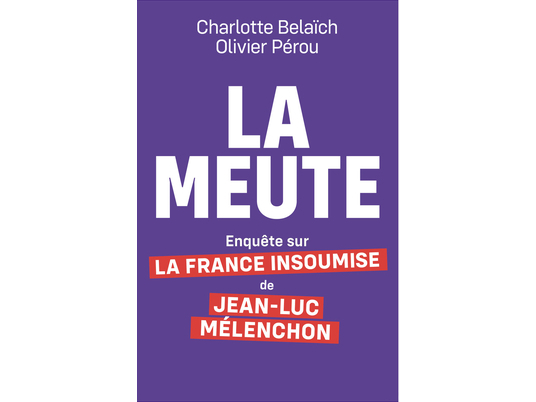
The Sultana-Corbyn project has been hailed by Jean-Luc Mélenchon as a British version of his own La France Insoumise. Let's hope he is wrong about that, both as regards the nationalistic politics of LFI and its structure. A new book published in France, La Meute, covers the internal workings of LFI. LFI boasts that "We are not a vanguard party that charts the political course for the masses. We help them to organise themselves. The emancipation of the people will be the work of the people themselves"; but formally speaking it has only three members, all the rest of its 500,000 or so supporters having little status beyond electronic communications. The article translated here, by Olivier Delbeke of Arguments pour la Lutte Sociale, dissects Mélenchon's trajectory and methods.
The authors of La Meute aim to provide a journalistic and sociological account of the phenomenon that is the inner circle of La France Insoumise (LCF), the Imperium, which revolves around its leader, an aspiring Bonaparte. From this point of view, it is quite successful: the revelations obtained from various participants, both former and current members of LFI, are nauseating. The picture that emerges there is of an atmosphere and a set of customs that are completely foreign to any emancipatory project in which those "below" consciously take matters into their own hands and move forward in a collective, coherent, thoughtful and rational manner, in a context where discussing differences is a matter of course and not a crime of lèse-majesté, and where the final decision is informed by prior debate.
Even though it provides elements in this direction, this book really didn't aim at that sort of political reflection.
Yet the existence today of the political and social phenomenon that is LFI poses a problem for the entire left, because Jean-Luc Mélenchon's political career spanning more than fifty years reveals the failure of the entire left, from the Socialist Party [PS: Mélenchon was a PS minister 2000-2]... to the NPA!
If we can summarise JLM's political life in two acts, Act 1, the PS, Act 2, after the PS, there remains an essential element of continuity: the defence of the established order, and notably of the Fifth Republic [the "presidential-rule" constitution introduced by De Gaulle after he took power with a "soft" military coup in 1958], while presenting himself as a radical critic of the system.
From this perspective, it is important to take stock of Mélenchon, the PS's leading oppositionist for 33 years (1975-2008). Although initially trained within the OCI [the Lambertist "Orthodox Trotskyist" group, today split into POI and PT], Mélenchon was not one of the undercover agents of Lambert [who had a habit of sending such undercover agents into the PS and other organisations]; he joined the PS on his own initiative with his own projects, which appeared to be aimed at building a left wing based on a secular, republican tradition rooted in the real labour movement, trade unions and associations, with a dose of Jaurèsism, proclaiming the need to break with capitalism through combative reformism, with at least some real reforms.
These decades of infighting within the PS boil down to loyalty to two key figures in the party's history, at key moments in its rise to power in 1981 and then in 1997: Mitterrand and Jospin. Thus, the story of how JLM, who became Jospin's minister for vocational training, remained insensitive to the warnings of [Alexis] Corbière [Mélenchon's right-hand person for many years, a former member of the OCI and the Mandelite LCR, purged by JLM in 2024] who had "returned to the workplace", about the rise of social resentment, as expressed in teachers' staffrooms, towards Jospin and his policies, is edifying.
Mélenchon, like [Julien] Dray [another ex-LCR person once JLM's ally within the PS], like Lambert's undercover agents, ultimately served only one purpose: to prevent the emergence within the PS of a genuine left wing that rejected austerity and the institutions of the Fifth Republic and committed itself, in practice, to breaking with this neoliberal policy. We will be cruel enough to recall the Yes vote on Maastricht in 1992 and the adoption of Rocard's CSG principle [an extra tax for social security], which still survives today in [JLM's] Avenir en Commun programme, notably with the plan for a single levy merging the CSG and IRPP, i.e. the destruction of the cornerstone of the 1945 social security system.
After regaining its strength in the battle for the "socialist No" against the European Constitutional Treaty in 2005, JLM chose not to rely on the legitimacy of the No victory to raise the question of power through the dissolution of the National Assembly, which had approved the Treaty against the will of the majority expressed on 29 May, and to demand Chirac's departure. Instead, he participated in the manoeuvres of the Le Mans PS congress in November 2005, which resulted in the nomination of [right-winger] Ségolène Royal for the 2007 presidential election, just someone calculated to make Sarkozy look good, with the success we all know.
2007 was the negation of the grassroots surge expressed by the victory of the No vote on the Treaty on 29 May 2005, preceded by the great wave of strikes in the spring of 2003 against attacks on pensions and public services, the revolt in the suburbs in autumn 2005, and the victorious mobilisation of young people in alliance with workers against Villepin's First Job Contract in spring 2006. And JLM contributed fully to this negation...
Then the pendulum swung back in the other direction with Hollande's victory over Sarkozy in 2012 in a configuration rarely seen before: the beginning of the Front de Gauche, JLM's first candidacy, which then appeared promising, the left, led by the PS, conquering the presidency, the majority in the National Assembly, the vast majority of regions and large urban areas, all of which led us... to the Valls-Rebsamen-El Khomri labour law and to Macron, Hollande's putative son. The "PS rebels" spent their time in "hold me back or I'll do something terrible!" mode, refusing to open up the political crisis by voting resolutely against this cursed labour law.
Meanwhile, in 2008, Mélenchon suddenly bailed out of the PS. Without consulting the other forces of the socialist opposition, JLM laid the foundations for the Left Party, which was born in 2009 with some attractive attributes proper to an aggressive left-wing party finally breaking with social liberalism. Unfortunately, the early hopes were quickly stifled: the new party could be nothing more than a faction centred around its leader, centralised and tightly controlled. The PG would not be a new PSU amalgamating currents from different traditions. Admittedly, there were still congress debates and motions debated late into the night. But all that was quickly discarded with the launch of LFI in 2016. This launch also followed the scuttling of the Front de Gauche, Mélenchon's electoral alliance with the PCF, which was prevented from becoming a real, effective and unifying mass opposition to Hollande's social liberalism.
2016 embodies the break with the classic party form (paying members, established structures, congresses, debates, motions, elections of leaders, public votes on policy) through the choice of a gaseous movement where only the true organising centre, never elected, never accountable for its actions, knows everything, controls everything, decides everything, even the details.
The interest of La Meute is that it illustrates how JLM's entire strategy since leaving the PS has been based on the centrality of the presidential election, with the promise of a Sixth Republic as a lure for the gullible. Those who really want to pave the way for a genuine constituent assembly that will sweep away the Fifth Republic are kindly requested to wait for the election of the last president of the Fifth Republic!
In this gaseous magma including local action groups, with occasional contributions à la carte via the electronic platform, Telegram groups all over the place, and various structures more or less known only to the militant inner circle, the only voice that counts is that of the central core, aptly named La Meute (The Pack), centred around the old leader.
The position taken by an intriguer named Sophia Chikirou illustrates the principle that "where there are kings, there are queens". Except that in this case, Marie-Antoinette with her whims pales in comparison to the reincarnation of Jiang Qing, cloned with a touch of Helena Ceaucescu.
The more weight the presidential strategy gains, with the passing of time and the burden of advancing age weighing on Jean-Luc like everyone else, despite the deification of his person by his followers, the more glaring becomes the clan-like, pack-like, gang-like aspect surrounding the aspiring Bonaparte.
In the history of LFI, there have been many individual departures and accumulated disappointments, many sidelining and exclusions, but never a purge like the one that led to the non-renomination of six outgoing MPs in the 2024 legislative elections. This crisis, which began with the sidelining of Clémentine Autain, François Ruffin, Alexis Corbière, Danielle Simonnet and Rachel Garrido from the inner circle at the end of 2022, culminated in the crisis of May-June 2024. It is to be hoped that this will mark a turning point towards the final crisis of LFI. But for that to happen, the principles of democracy in all forms of organisation and action, and of unity against the common enemy while respecting differences and divergences, must prevail where "sound and fury" have taken their place.
It is not insignificant that at the origins of this crisis was the Quatennens affair, named after the MP [and official LFI "national coordinator 2019-22] who slapped his wife [and was eventually convicted in court of domestic violence, but was initially defended by JLM]. All those who, like Pascale Martin, Clémentine Autain, and Danielle Simonnet, put their finger on that sore point, made it possible for a new cycle to begin. The struggle for emancipation cannot tolerate retrograde and abusive practices, whether physical or psychological, in the private or public sphere. Machismo and male domination are at the root of the need for the women's liberation movement; they are also linked to the mechanisms that protect and perpetuate the established order, including the Fifth Republic. This is yet another reason why supporters of full democracy, and therefore of the expropriation of capital, must fight them without compromise.
Neither Caesar, nor tribune, nor president: constituent assembly!
Workers' Liberty has long had links with the comrades of Arguments pour la Lutte Sociale, and have learned from them on many issues, but disagreed on the 2005 European Constitutional Treaty referendum, where we considered a "no" vote inextricable from nationalism, and advocated abstention instead.
Comments?We welcome replies, corrections and debate pieces. Contact us