
At its December 2024 conference, the SWP declared its aim to “hegemonise the left” through “a broad, pluralist umbrella formation of left independent candidates running under the same banner”. Their chosen vehicle, We Demand Change (WDC), launched in March 2025. But when Corbyn and others refused to be “hegemonised,” the project was largely shelved. Only Manchester has a functioning WDC group.
In Socialist Worker 2963 (9 July), following Zarah Sultana’s break from Labour, they headlined “New Left can take on Starmer” — pointedly avoiding the word “party” — and reiterated: “At this stage, we believe an ‘umbrella’ organisation, with real roots and high-profile support, would be the best way forward”. In practice, SWP seeks a shared banner under which its candidates and allied Gaza independents can run in elections alongside Sultana and Corbyn.
SW 2964 (16 July) featured activist commentary (some from SWP members wearing various hats) warning the initiative risked becoming another Syriza or Podemos — formations which “prioritised winning elections over struggle” — and advocating instead “a megaphone for struggles in the streets and workplaces”.
By SW 2966 (30 July), an analysis piece argued the moment is ripe for a left challenge, but “parties of the left are also at risk of subordinating workers’ struggles to winning votes”. They call for candidates to “stand with Palestine” and uphold “a principled position on racism, disability and trans+ rights.” A back-page article welcomed the party but warned: “There are forces that are principled on Palestine but will throw refugees or trans+ people under the bus. Others want to talk about ‘community’ and play down overt class politics.” SWP support signing up to “Your Party” for updates — but little more.
If SWP fears the project becoming “another Labour Party”, the Socialist Party (SP) positively embraces that model. SP has pushed its own initiative — the Trade Union and Socialist Coalition (TUSC) — for years, with scant union backing and poor electoral returns. Their current slogan, “Time for trade unions to take the lead in forming a new working-class party,” reflects a long-held ambition barely changed for the new situation.
At the July conference of Unite the union, they pushed towards the union disaffiliating from Labour and build “a new workers’ party, centred on the trade unions, with a clear socialist programme”. When Sultana split, The Socialist 1329 (10 July) headlined: “The working class need our own party – the trade unions must lead”. But as the new initiative is being led by MPs, not unions, and we are now out of the union conference cycle, the call is largely abstract.
Inside pages argued that “The issue here is not primarily of a ‘left party’ that only attempts to bring together existing left forces, but struggling to create a workers’ party, which big sections of six million-plus workers already organised in the trade unions see as fighting for their interests.” They advocate democratic control of the union-party link — while rejecting One Member One Vote and offering no clear alternative.
They favour an umbrella model allowing different groups to stand candidates under the new party label. SP even generously offers to hand over its TUSC registration and federal structure, an offer that hasn’t been taken up. SP hopes unions can be won over and revitalised in the process. “What will be needed this time is not just to build a workers’ party with a mass base, but to fight for it to have a programme and leadership capable of leading a successful struggle for socialism”.
Counterfire’s initial response, via Michael Lavalette on 5 July, emphasised the “Palestinian movement, the anti-austerity movement,” and, oh, bringing up the rear “our trade unions” — omitting any mention of socialism, democracy, or class. Of course by “Palestine movement” read Stop the War and “anti-austerity movement” read the People’s Assembly — both organisations dominated by Counterfire.
Lindsey German later added that any party must be democratic and that weak union presence in the private sector limits the possibility of a fully working-class base. On 27 July, John Rees urged: “It is up to every socialist to throw themselves into the construction of a new party.” But his focus remained on anti-war and anti-austerity movements, with unions again taking a back seat. Most recently, Alex Snowden (3 August) argues the party must be “firmly rooted in where it came from: the mass movement for Palestine” and criticised Sultana for failing to back Stop the War and its stance on Ukraine.
Counterfire seems most likely to merge into the new formation by osmosis. Its monthly freesheet, and organisational presence mostly via Stop the War and the People’s Assembly (which Corbyn has explicitly supported as the kind of group to be included under his umbrella), may make formal negotiation unnecessary.
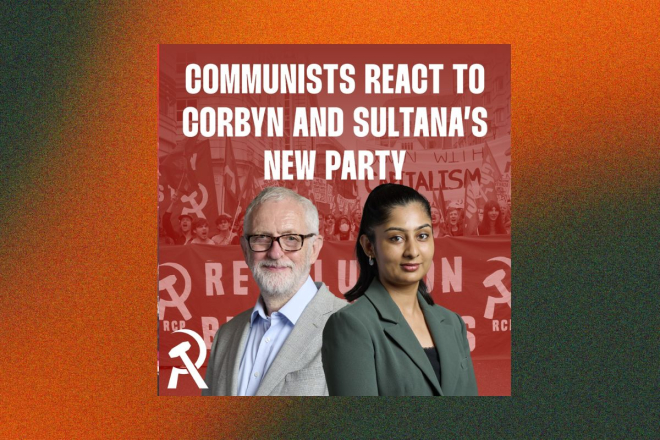
The Revolutionary Communist Party (RCP) might seem the most likely of the left groups to oppose the new party — but in fact it aims to embed itself within it. As the successor to Militant, and later Socialist Appeal, they seek a role inside the new formation like that they think Militant once played in Labour. Adam Booth wrote in The Communist #32 (30 July): “The RCP calls on all our supporters and readers to get organised with us to help equip this party and movement with the revolutionary programme needed to bring about ‘real change’: the eradication of capitalism and the struggle for socialism.”
Alan Woods adds: “We communists welcome the launch of a new left party in Britain with every possible enthusiasm,” even if it reflects “the vague and ambiguous programme of left reformism.” But he drew a line: “There is no question whatsoever of liquidating the Revolutionary Communist Party – the only real guarantee that the genuine programme of socialism will be maintained.”
Whether the RCP will make real organisational concessions in order to enter the Sultana-Corbyn project is uncertain. Given their culture, that seems unlikely.
Comments?We welcome replies, corrections and debate pieces. Contact us