
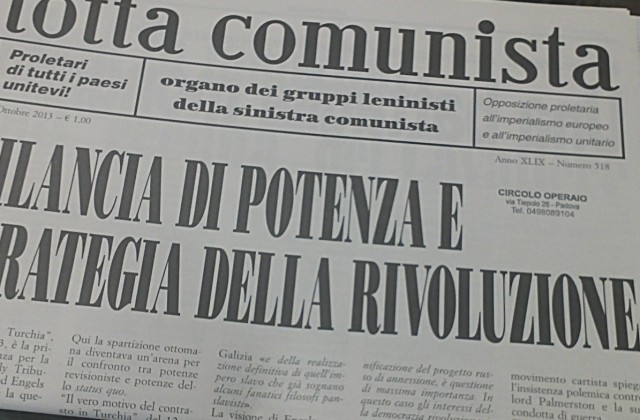
Following the 16-18 May conference in Paris of left groups from many countries, the French NPA-R has published this assessment of Lotta Comunista, the group with which it will be organising the follow-up in early 2025. Below is a translation with some notes from us. Our report on 16-18 May is here
Lotta Comunista (LC), which is celebrating its 60th anniversary this year, is an internationalist communist organisation in Italy. Although discreet, as it deliberately stays away from social media, it is the most important revolutionary group in the country.
Its militants claim to be Leninists, and although its historical core, which originated in Genoa with Arrigo Cervetto and Lorenzo Parodi, comes from libertarian communism [their first group, in the early 1950s, called itself “anarchist”], the fundamental features of its orientation, choices and theoretical elaborations come from the tradition of the communist left [i.e. of the “Italian Left” of the 1920s, distinct from the Dutch, German, etc. “ultra-left”]. Lotta Comunista draws on Amadeo Bordiga (founder of the Communist Party of Italy and great rival of Antonio Gramsci) for its analysis of the decline and fall of the October Revolution, and especially for his criticism of the United Workers’ Front [in politics: Bordiga was for the United Front in trade-union matters] and the electoral tactics that emerged from the congresses of the Communist International (strategic abstention, in their terms). This affiliation does not prevent it from having its own positions on the analysis of the Resistance to fascism (far from the positions of the Italian left-wing factions or Lutte Ouvrière in France) [Cervetto started politics in the “partisan” resistance to Nazi rule in northern Italy], or on the break after the Vietnam War with the Bordigist tradition of support for national liberation struggles. [LC argues that since the Vietnam war all national struggles are now “obsolete” and “reactionary”. We don’t know what the reference to “Bordigist tradition” means here: generally the “Bordigists” disdained national struggles even before the mid-1970s]
The comrades believe that we are going through a long cycle of “political passivity” and focus their intervention on building “workers’ circles”, Leninist nuclei in workplaces and places of study, and significant trade union activity (including the animation of the Genoa shipyard workers’ union and a presence in the industrial triangle of northern Italy). The most visible part of their activity is the sale of their press (a monthly magazine in newspaper form). Since the pandemic, they have developed what they call “class-based” volunteer activities, consisting of food collections and donations, which enable them to intervene and then organise working-class communities, often with immigrant backgrounds, the results of which are visible in their meetings and on May Day.
Our differences are significant. They concern issues of varying importance, but we will mention only the most salient ones: a certain distance towards the problem of oppressions; the question of party building (one element among others: territorial organisation rather than the workplace cells we favour); the national question, particularly with regard to current events in Palestine; a definition of a unified European imperialism that we consider premature, to say the least; and the role of strike committees in relation to trade union bureaucracies.
Studious activists will know their publishing houses in Italian, English, German, Russian, Portuguese...
Comments?We welcome replies, corrections and debate pieces. Contact us