
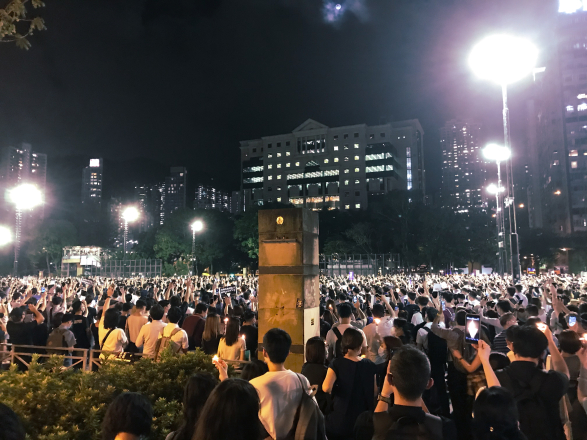
Picture: Tiananmen Square memorial in Hong Kong, 2020
June 4 marked the 36th anniversary of what is usually, in the west, called the “Tiananmen Square massacre”.
Yet for the Communist Party of Britain’s Dan Ross, there was no “massacre”. On 4 June the Morning Star carried Mr Ross’s piece (first written in 2022) which claims that stories of peaceful protesters being gunned down by the Chinese military are no more than western propaganda. In fact, it was armed “radicalised protesters” that attacked “unresisting soldiers” lynching and burning several of them and audaciously displaying their corpses.
Mr Ross tells us that these accounts come not from the Chinese government, but from the Washington Post and the Wall Street Journal “in the immediate aftermath of the events of June 4 1989.” As Mr Ross does not provide any dates or headlines for the particular reports he is quoting from, I have been unable to track them down. But he does name “the Washington Post’s Jay Matthews” (actually Mathews) as a source, and I’ve been able to find a piece by that reporter that at first blush seems to back up what Ross is arguing.
In an article entitled “The Myth of Tiananmen Square” originally published in the September/October 1998 Columbia Journalism Review Mathews states that “as far as can be determined from the evidence, no one died that night in Tiananmen Square”.
So Ross is correct: the story of the “massacre” is just western propaganda?
Different
Eh, not quite. Mathews goes on to state: “Hundreds of people, most of them workers and passers-by did die that night, but in a different place and under different circumstances.
“The Chinese government estimates more than 300 fatalities. Western estimates are somewhat higher. Many victims were shot by soldiers on stretches of Changan Jie, the Avenue of Eternal Peace, about a mile west of the square, and in scattered confrontations in other parts of the city, where, it should be added, a few soldiers were beaten or burned to death by angry workers”.
So, if Mathews is to be believed, the story of hundreds or thousands of peaceful students being massacred in the square itself is probably false, or at least a massive exaggeration. But the true story is even more damning of the Chinese authorities.
Mathews claims that: “The problem is not so much putting the murders in the wrong place, but suggesting that most of the victims were students”. He quotes the 1993 book Black Hands of Beijing: Lives of Defiance in China’s Democracy Movement by George Black and Robin Munro: “what took place was the slaughter not of students but of ordinary workers and residents — precisely the target that the Chinese government had intended”.
Mathews summarises the Black/Munro argument thus: “the government was out to suppress a rebellion of workers, who were much more numerous and had much more to be angry about than the students”.
Workers
In fact, Ross does mention the involvement of workers in what he calls the “events” in Tiananmen Square and elsewhere in Beijing on 3-4 June and immediately afterwards, but claims they were “ironically… concerned by the inflationary effects of market-liberalising economic reforms”.
But Yueran Zhang, writing in Jacobin (June 2019: “The Forgotten Socialists of Tiananmen Square”) takes a very different, and to me, much more convincing, view of the workers’ motivations: “even though discontent with marketisation proved crucial in forging workers’ participation, workers in the movement did not express any wish to return to the era before marketisation … ‘democracy’ was the core demand of the workers as well. Most importantly. ‘democracy’ as understood by workers was different from the liberal notion embraced by students and intellectuals; it was a distinctly socialist version of democracy premised on the agency of the working class”.
So I have to thank Mr Ross and the Morning Star: apologists for the Chinese ruling class they most certainly are, but they’ve forced me to look more deeply into what happened in Beijing in 1989. The events within Tiananmen Square may not have been a massacre: but a massacre did take place in Beijing on the night of 3–4 June and the main victims were workers.
• There are many accounts of 4 June. Workers’ Liberty clippings-book here
Comments?We welcome replies, corrections and debate pieces. Contact us