
Pitched as a programme to kick start a “national renewal”, Rachel Reeves’s 11 June Spending Review was an attempt to regain control of the political narrative — to differentiate Labour from the Tories, with a claim to be the real party of economic growth, and from Reform, with rhetoric about representing working people.
It was also an attempt to shift the querulous mood inside the labour movement over cuts to disability benefits and the two-child cap on child benefit.
Reeves’s presentation, alongside Labour's partial u-turn on winter fuel payments, shows that the campaign to fight Labour’s benefit cuts is working.
However the spending plans, which run from 2026 to 2029, fall far short of what is needed to rebuild the NHS and other vital public services. Without a campaign to change the trajectory, more cuts will happen.
Capital spending plans are not affected by Reeves’s “fiscally responsible” limit on day-to-day spending of an on-average 1.2% increase across all departments. Hence Reeves made a plethora of announcements on these plans — on transport, infrastructure, IT systems, house building — amounting to £113 billion.
Commitment to infrastructure building has become a synonym around the world for political seriousness about economic growth. Whether it works, or whether potential Labour voters care, is another matter. In any case infrastructure takes a long time to build and thus any political dividends will be a long time coming.
Reeves's tactic in her House of Commons speech was to pick out bits of capital investment and other spending, including in those departments which will suffer as a result of the 1.2% spending limit and the extra spent on health (the biggest departmental spender). Plans included nuclear power, trams and trains, an AI action plan, the British Business Bank. £39 billion for social and “affordable” housing over 10 years seemed impressive, but is it such a big contrast to the Tory average of £11 billion over five years? Lack of detail on the ratio of social housing to so-called “affordable” housing (often unaffordable) makes the claim of fixing the housing crisis unbelievable.
Reeves told us she was rejecting the Tories' “choice of austerity”, but what are Labour’s real priorities?
The average annual real-terms increase of 16% for Ed Miliband’s tiny Department for Energy Security and Net Zero (DESNZ) was a relatively cheap nod to clean energy. Reeves was careful, however, not to mention the now politically taboo words, “net zero”.
Similarly, in a more obvious nod to reactionary opinions, Reeves flagged up ending the use of hotels to temporarily house asylum seekers — predicated on speeding up deportations of “failed” asylum seekers.
The day-to-day budget for the health service in England will go up by 2.8% per year over the next three years (devolved nations getting a proportionate share of funding across the board). However, 2.8% is less than the roughly 4% annual increase the health service got before the Tories decided to run the NHS into the ground. That means, among other things, that Labour’s target of 18 weeks for hospital waiting times will not be met.
We oppose Labour’s increases in military spending (to raise it to 2.6% of GDP). The government should be channelling money into health and other public services and creating many more jobs in those services. Cuts in foreign aid which were explicitly linked to these rises are also regressive where that aid is linked to socially beneficial projects.
Most telling is what Reeves did not say in her speech but made clear the day after — there will be no u-turn on proposed cuts to disability benefits. Spending on benefits is not included in spending reviews. Nonetheless the clues were there.
Policies which will form part of the delayed Child Poverty Strategy included capping the cost of school uniforms and providing free school meals to all children in households receiving Universal Credit. Labour hopes these good policies will quell rebellion on the cap. It shouldn’t, not least because the cost of expanding free school meals make the settlement on schools in England very tight. Strip out that cost, and there is a real-terms freeze in the budget.
Reeves flagged up £3.5 billion for employment support: “helping people to access the skills they need to progress, tackling inactivity and ensuring more people are in better jobs. This includes … support for anyone on out of work benefits with a work-limiting health condition or disability.” Clearly the government does not want to stop cuts to Personal Independence Payments (PIP). It continues to falsely claim that there is a choice between “getting people back to work” and making those cuts.
As the campaign against the cuts has reiterated again and again, PIP is a benefit which helps disabled people manage their lives and be more mobile; it helps people get and stay in work.
This is central to Labour's austerity. They want the projected £5 billion cut to the benefits bill to help them stick to the 1.2% spending limit. But this is completely incoherent. The pressure of capital spending plans (paid for by extra borrowing), and some extra day-to-day spending in departments such as health and defence, will see Labour have to make another u-turn on their promise not to raise taxes.
Making cuts by making it harder to claim disability and sickness benefits was a nasty little innovation by the Tories back in the 1990s. The Tories went so far as to stigmatise disabled people and the long-term unemployed as malingerers. Is Labour’s approach any different?
Now as ever bargain basement “get ready for work” schemes will not “fix” people whose capacity to join a capitalist labour market is limited. Nor will it create jobs that have sufficient and thoughtful adjustments which fit the real needs and capacities of people.
Labour are working hard to shift the opposition in the parliamentary Labour Party and beyond. Liz Kendall has said that claimants with life-limiting and life-long conditions will not have to reapply for PIP. Claimants who have their benefits removed will have a longer grace period where they continue to receive the extra money.
This is not enough. Labour must stop these cuts.
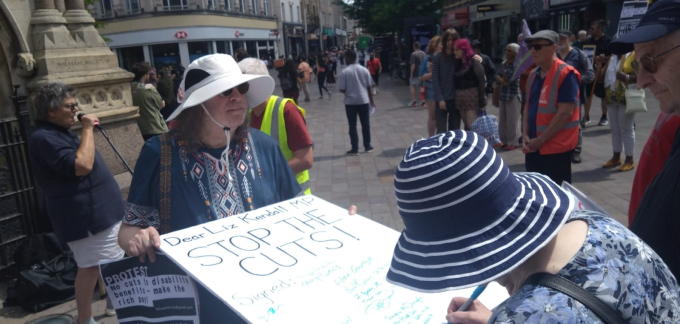
The big unions — Unite and Unison — should make good on their promises to run public campaigns on disability cuts. We now know that there will have to be new legislation on changes to PIP but it may be rushed through so time is still short. DPAC has called a protest on 30 June at 4.30pm in Parliament Square. There is a national day of action on Thursday 3 July. Join this and local protest and help build them; get your trade union or Labour Party branch to support.
We say, in contrast to Reeves’s fiscal restraint and phoney denial of Labour austerity, raise taxes on the wealthy and big business to increase the pool of money available to stop the cuts and rebuild public services!
Comments?We welcome replies, corrections and debate pieces. Contact us