
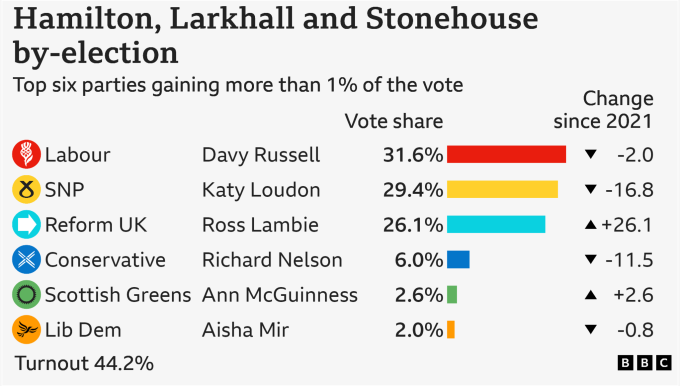
Contrary to pollsters’ predictions and the expectations of many activists on the ground, Labour won the 5 June Holyrood by-election in the Hamilton, Larkhall and Stonehouse constituency.
Labour won with 32% of the vote (2% less than in the 2021 Holyrood elections). The SNP, which had held the seat, came second with 29% of the vote (16% less than in 2021). Reform came third (26% of the vote, standing for the first time). The Tories just managed to hold on to their deposit (6% of the vote).
The Scottish Socialist Party candidate won 278 votes (1% of votes cast).
This was the first time since 2013 that Labour has gained a seat in a Holyrood by-election. But it was a particularly underwhelming victory.
Turnout in the by-election was 44%, well down on the 60% turnout in 2021, and also lower than the average turnout in by-elections (50%).
Labour’s 32% of the vote amounted to 8,559 votes. But in the equivalent Westminster constituency Labour had won 50% of the vote (21,000 votes) in the 2024 general election.
Labour’s candidate, Davy Russell – unkindly described as someone who struggles to put two sentences together even when reading them from a script – evaded debate and media coverage. He repeatedly refused to take part in television and radio hustings.
When an STV reporter finally cornered him and demanded to know whether he supported the cuts to winter fuel payments, Russell’s responses did not even reach the level of incoherence.
More importantly, Labour’s record in power did not inspire voters. On the doorstep voters raised issues such as the government’s cuts to winter fuel payments and disability benefits, the cost of living, and the abandonment of WASPI women.
As one “senior Scottish Labour figure” put it in an interview with LabourList:
“People voted last year to get rid of the Tory government, and that involved some tactical voting, but we’re definitely hearing loud and clear from voters that they feel let down by Keir Starmer and Rachel Reeves in particular. They feel that this government is not what they expect a Labour government to be like.”
The Labour right wing is hailing the result as the start of the run-in to a Labour victory in the 2026 Holyrood elections. This is nonsense.
Labour had a majority of just 600 votes and a lower share of the vote than in 2021. Its performance was only a shadow of its result in the 2023 Rutherglen by-election. https://workersliberty.org/story/2023-10-06/after-rutherglen-election-organise-left Opinion polling for the Holyrood elections still puts the SNP in a commanding lead (33%) with Labour and Reform neck-and-neck on 19%.
The by-election result was a major blow for the SNP and emphasised its lack of any political direction.
Having put independence on a backburner, it has lost the support of the true believers. The end of the faux radicalism of the Sturgeon years, signalled by Swinney’s election as party leader, has cost it the support of a swathe of "progressive" voters.
And Swinney’s repeated claims that the by-election was a two-horse race between the SNP and Reform has left him looking stupid and incompetent, with calls already being raised for (another) SNP leadership contest.
But none of this has benefited the Greens. They won 695 votes in the by-election, amounting to just 2.6% of the vote. SNP voters appear to have stayed at home rather than switch to another pro-independence and faux-radical party.
Reform, unfortunately, can be satisfied with its vote – 900 votes behind the SNP, and 1,500 votes behind Labour. Opinion polls suggest that this might be the start of a consolidated vote for Reform rather than just a passing protest vote.
It is always a mistake to read too much into a by-election result. For certain the Hamilton result cannot be read as the start of a surge of support for Labour in Scotland, and as a vote of confidence in Starmer-Reeves.
Longer-term electoral success for Labour in Scotland depends on the party membership and affiliated unions mounting a successful challenge to the current trajectory of Labour in power.
The apparent partial retreats on winter fuel payments and benefits cuts are a modest beginning. But better organised and more active grassroots campaigning is needed to make a real impact – and to make Scottish Labour a real alternative in the 2026 Holyrood elections.
Comments?We welcome replies, corrections and debate pieces. Contact us