
"The memory of the working class is in its party", wrote Leon Trotsky. "The reformist party is a party with a short memory."
He wrote that in 1925, a time of high struggle. The truth is weightier in times like today of fewer strikes and duller meetings. Short memory, in our times, pushes us towards accepting working-class passivity as normal.
Revolutionary socialist politics needs a memory. Not only such as we can get from reading about the 1917 Russian revolution or the 1871 Paris Commune, but also such as we can get from our own lived experience over decades.
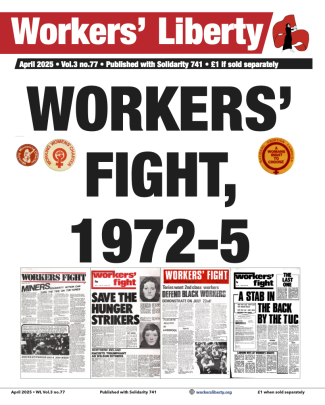
Solidarity has been running since 2002, and is the continuator of several publications before that. One of those was the Workers' Fight newspaper. Its first issues were in January 1972, month of a great miners' strike in Britain and the Bloody Sunday massacre by the Parachute Regiment in Derry. Its last were in October 1975, a few months after the Labour government legislated a £6 limit on wage rises which trade union leaders had proposed for fear that otherwise the army or the far right might be triggered into a coup against the government.
We were then a much smaller organisation, and most of us very young and inexperienced. The whole avowedly-Trotskyist left was possibly smaller (though more active) then than now. The "broad left" (Communist Party and Labour left) were bigger.
But it was a time of great class battles in Britain, dramatic events internationally, and intense and fluid debate within the left. It was a time which made for vivid and weighty memories.
The Workers' Fight newspaper was concerned with reaffirming the ideas of long Marxist tradition in less-than-revolutionary times, with the aim of keeping the ideas in circulation and creating a body of people educated in the tradition and able to give it life in future upheavals. It had reprints, retrospectives, reviews. But in those years especially we could do much more.
As we wrote in mid-1975, in a survey of the first 100 issues, we had "not simply recited correct formulae about picketing and workers' self-defence".
Workers' Fight 22 (15 February 1973) carried the news of the arrest of the Shrewsbury 24, being the first paper on the left to do so.
These were building workers (18 in the first swoop, and then more) arrested months after the 1972 national building workers' strike (the only one of its sort ever), and charged under conspiracy laws for activities on picket lines in North Wales. They came to be known as the Shrewsbury 24 because court hearings were in Shrewsbury. 22 were convicted, and two, Ricky Tomlinson and Des Warren, jailed for long periods. All eventually had their convictions overturned in 2021.
We campaigned consistently for the victimised North Wales pickets. Our was the initiative that led to the setting up of the North Wales Defence Committee. Ours was the suggestion for the committee's bulletins, and we helped produce and distribute all the earlier bulletins.
It would be some weeks before anyone else on the left took any notice. Some of the arrested workers were members of the Communist Party, but the CP's Morning Star initially refused to publish anything.
We helped set up local Shrewsbury Defence Committees. When Des Warren and Ricky Tomlinson had their appeals turned down and were sent back to jail in November 1974, it was our action, on Pochins Manchester Poly site, that spearheaded what could have been a rolling strike movement, if it were not for the sabotage of the Communist Party.
We had had long and fractious debates about the use of the general strike slogan before we started the Workers' Fight newspaper, when we were still a small grouping (the Trotskyist Tendency) inside IS (forerunner of today's SWP), producing occasional discussion documents but selling Socialist Worker weekly.
In 1972, especially around the jailing of five dockers in July under the Tory Industrial Relations Act, we were able to give that slogan life. An unofficial strike surge of some 250,000 workers led the TUC to call a one-day general strike, and the government to find a legal expedient to free the dockers.
The general strike slogan was commonplace then in left-wing papers and in chants on demonstrations. We argued for an open-ended version of the slogan "General Strike to Smash the Industrial Relations Act” which neither posed it as the revolution-or-nothing ultimate, nor foreclosed its political prospects in advance by posing it as an electoral gambit ("General Strike to Kick The Tories Out", a formula favoured at one time or another by all the other avowedly-Trotskyist groupings. Militant, forerunner of the SP, RCP, and Socialist Alternative, made it "24 hour General Strike", telling us that the labour movement was so strong that 24 hours would be enough).
After the July 1972 experience, we published a pamphlet, The Left and the July Crisis, dissecting and criticising the vacillations of the other groups, and making some criticisms of our own agitation. In the occasional magazine we published along with the paper, Permanent Revolution, we translated for the first time articles by Rosa Luxemburg on the general strike.
Mobilisation
Our tiny newspaper was able to be a vehicle for independent mobilisation, too, when the Prevention of Terrorism Act was rushed through Parliament without amendment or dissent in November 1974. We, together with the London branch of the Irish organisation People's Democracy, organised the first street demonstration against that Act.
We had previously, on 25 September 1973, been the only left organisation in Britain to have our office raided by armed police in connection with Ireland. We were able to fill Conway Hall in London with a protest meeting after the raid with speakers from all the other main left groups.
The Catholic nationalist revolt in Northern Ireland had turned into guerrilla war. The Provisional IRA emerged in 1970. The mass internment without trial of Catholic nationalists in August 1971 increased its support, as did the shooting dead of 14 unarmed civilians by the Parachute Regiment on a peaceful demonstration in Derry on 30 January 1972.
Workers' Fight sided with the guerrilla war against the British army of the Catholic nationalist minority in Northern Ireland, arguing that the only way out was through the British state ceasing to prop up the unworkable Partition and through the creation of a federal united Ireland with autonomy for the compact Protestant minority area.
As we would write later in The Left in Disarray, "The British left responded to the beginning of the IRA war in 1971... with panic-stricken cries of dissociation". Most of the British far left dug out the term "individual terrorism" from the Marxist archives. Marxists, so they (falsely) claimed, had utterly denounced the 19th and early 20th century Russian radicals who set to assassinating Tsarist officials. We dug out and reprinted what Marxists had really written about that"individual terroris" in Russia. It was utterly different from what is mostly understood as terrorism today, the killing of civilians supposed to be religiously deviant or associated with the West practised by groups like Daesh and Al Qaeda; and different from guerrilla war too.
Over the years the rest of the far left swung away from denouncing the Provisional' military campaign as terrorist, and towards seeing it as a step in a supposed process of permanent revolution through which a national-democratic struggle would grow over into socialism.
We had argued that a permanent revolution for Ireland scenario was nonsense back in 1966. In July 1972, when talks with the British government during a brief ceasefire broke down, the Provisionals carried out a Bloody Friday bombing of economic targets in Belfast, which killed nine people, mostly civilians. Workers' Fight wrote:"Support for the IRA against British imperialism and its militant allies cannot exclude criticism when they indiscriminately bomb civilians. The terrible tragedy of an intercommunal civil war is very possible."
Workers' Fight also published criticism of the Provisionals from Irish socialist groups. Our criticism would grow over the years. By the time the next Provisional IRA ceasefire (February 1975 to January 1976) broke down, the Workers' Fight group had merged (in December 1975) with the Left Faction of IS-SWP and the paper had been replaced by a new title, Workers' Action. Our more critical articles would cause some contention with our new partners.
In later years, we came to think that we had been too quiet in our criticism of the politics of the military campaign in the 1970s. We explained that the Northern Ireland conflict was not just anti-colonial, as many came to present it. We still felt a moral obligation to play down our criticism of the most militant, with whatever political inadequacies, in battle against the British army which was fighting to sustain a sectarian and historically imperialistically-imposed structure.
In 1972-75 we were at odds with the rest of the left and the far left on Europe.
In 1968-71 our forerunner-group had been the Trotskyist Tendency inside IS-SWP, producing pamphlets and discussion documents on various issues, notably Ireland, but using Socialist Worker on the streets and in the labour movement. (We would occasionally get a letter printed in Socialist Worker. Less as time went on).
It was on the issue of Europe that we were evicted from IS-SWP, prompting us to start our own paper.
Britain had applied to join the European Union (then called EEC, and more loosely-knit than now) in 1961 and again in 1967. It had been vetoed by France. The Communist Party, then maybe 30,000 strong, and influential in the unions and Labour, opposed the EEC-EU for Russian foreign-policy reasons dressed up in nationalist arguments which depended on the idea that the labour movement was much stronger in Britain than in other West European countries and would be levelled down by EEC-EU entry. Many right-wing Labour people argued against it on grounds of trade with the Commonwealth, the ex-Empire, which in the early 1960s was much bigger than with the EEC countries. Some also saw an alternative in the European Free Trade Area (from 1960, with Austria, Denmark, Norway, Portugal, Sweden, Switzerland: a free trade area, but, unlike the EEC even then, not a customs union).
All the avowedly Trotskyist left agreed that bringing down international economic barriers was desirable, but said we could not advise British capitalism on EEC vs EFTA vs Commonwealth. All had some variant of the slogan proposed by IS-SWP until 1971: "In or out, the fight [i.e. the class struggle] goes on").
Attempt
The Heath Tory government of 1970-4 made another attempt to join, and would succeed. Opposition from old-fashioned Tories and almost the whole labour movement was strong. Some at the Easter 1971 conference of IS-SWP wanted to change IS-SWP's line to chime in with the labour movement opposition. The old line was reaffirmed.
Then in June 1971, at the IS-SWP committee, Tony Cliff and Chris Harman moved a tweak: IS-SWP would still have the old line as its first option, but if that had been defeated in a labour movement meeting, then it would "vote with the left", i.e. against EEC entry. Within weeks, and without further formal decision, the supposed fallback option became the operative policy: No to the bosses' Market!
All the other far left groups had already made a similar shift.
The Trotskyist Tendency campaigned for a special conference of IS-SWP to reaffirm the Easter conference policy. We said we had the constitutionally-required minimum number of branches to requisition a conference. The IS-SWP leaders said we were one short. Then they short-circuited the issue by calling a special conference to expel us.
Partly, IS-SWP was now growing fairly fast, and they saw having to debate with us as a diversion. And partly, they had seen us as in poor condition (at a conference of the Tendency in July 1971, two substantial subgroups had split away from us), and wanted to nix us before we could revive on the Europe issue.
But we did revive. Enough that we gave them a real fight at the special conference on 4 December 1971 (we lost about 40:60), and enough that we had the confidence to go for a fortnightly paper after expulsion. In 1971 working-class struggle was still nowhere near as high as it would be in 1972-5. The Tories were making a first attempt at what they would do under Thatcher from 1979, and until the end of 1971 they looked like succeeding. We did not yet know about the big workers' struggles to come in 1972-5; but we were determined that we would be an activist lever in the class struggle, not just a discussion group.
We scraped together funds. Comrades took second mortgages on their houses. We rented an office (though we could pay no staff) and bought a small printing press and other equipment.
Producing the paper was many times more difficult than with the technology of today, and in its first months the fortnightly was, as we ruefully remarked, the first Trotskyist three-and-a-half-weekly in history. But it came out. It regularised. It went weekly, with just four pages, in January 1974, first as an experiment when the Tory government mandated a three-day week for industry because of a world oil-supply crisis and a miners' overtime ban leading up to a strike.
We sold the paper, and with some energy. It was often more difficult then than now to sell socialist papers on the streets, but we sold it on the streets, on picket lines, at strike meetings, round pubs and Labour Clubs, on demonstrations, door-to-door, and outside workplaces. More active people would sell dozens, or even a hundred, of each issue.
We sold with all the more energy to challenge majority opinion on Europe. The EEC was the big parliamentary issue of 1972: the legislation to join passed by only eight votes at its second reading in February 1972, though the Tories had a majority of 28, and became law in October.
In 1974 Labour regained office. Labour leader Harold Wilson staged a re-negotiation and took it as a basis for recommending "yes" in a referendum, 5 June 1975, on remaining in the EEC-EU. Many other Labour leaders said "no", but"yes" won by 67%-33%.
Almost the entire far left was furiously for "no". We recommended not voting. We still thought a "yes" vote suggested approval of the specific terms of EEC entry (which included, for example, higher food prices, and not free movement, which became part of the EU only in 1992) and not just of the general idea of bringing down borders.
In our discussions around the 2016 Brexit referendum, some of us concluded that was a mistake in 1975: voting yes would not have contradicted reforms in the EEC-EU, a few of which indeed happened, and there was no way that British withdrawal could have been a way towards a preferable form of integration. Even in 1975 we said, deliberately to shake up left "no" campaigners, that their stance was really to the right of the bourgeois-cosmopolitan "yes" campaigners.
We covered the Popular Unity government in Chile and the military coup which crushed it in September 1973. We debated with others on the left the tactics and policy of the left in Chile. We gave much coverage to the upheavals in Portugal after the decades-old decayed-fascist regime fell in April 1974, and tried to transmit what we learned from Portuguese political exiles in Britain (the Portuguese Workers' Coordinating Committee) and interviews and discussions done by comrades visiting Portugal.
That too set us at odds with most of the other far-left groups, which swung towards enthusiasm for the left-wing (but militarist-populist) of the Armed Forces Movement of radicalised officers.
Vietnam
We supported the Vietnamese war against US imperialism. In hindsight, as we discuss in an appendix in the new Workers' Liberty pamphletThe Fall of European Stalinism, we were far too soft in criticism of Vietnamese Stalinism. We were still (and would be until the 1980s) Orthodox Trotskyists, looking to the tradition defined by writers such as James P Cannon. Worker' Fight still sometimes had reprints from the SWP-USA (then Cannon's organisation - he died in 1974 - and no relation to the IS-SWP). We still, incoherently, saw the Stalinist states as "degenerated and deformed workers' states".
But we gave that formula the strongest anti-Stalinist twist, giving the most minimal definition to "defence of the USSR against imperialism". In any conflict, or apparent conflict, between defence against imperialism and the proletarian struggle against the bureaucracy, we believe in the primacy of the workers' struggles.Workers' Fight defended bourgeois-liberal oppositionists in the USSR, and when some of us countered with mechanical transposition from Trotsky's attitudes in the early 1930s, we argued it out.
Even on Vietnam we were more critical than other far-left groups. IS-SWP defined North Vietnam as state capitalism, but said much less about that than about the virtues of revolution in general, and in practice, saw it as a very progressive state capitalism.
An incident in early 1976, soon after Workers' Fight was replaced by the new Workers' Action, is telling. A motion from a union right-winger, supporting dissidents in the USSR, came up in a union branch where four of us were members. Each individual had to respond instantly, on the spot. Two of us from Workers' Fight voted for the motion; two of the new comrades from an IS-SWP background, who still had somestate-capitalist view of the USSR, voted against. Nothing wrong with the motion on paper, they said, but on such issues one should vote with the left. Writing for Workers' Fight, selling it, discussing it, had trained us in the idea that, after decades of Stalinist seepage, we could often establish what was really left only by digging deep.
We had a policy of open debate in our paper, not yet codified, but practised. There was a debate, for example, in which some comrades proposed we support a first version of a Two States policy for Israel-Palestine which came from the Democratic Front for the Liberation of Palestine. Most of us rejected that then, and held to the "secular democratic Palestine" formula which we had swung to, like most of the far left, after 1969. The debate would reopen among us from 1976.
We had coverage of the then-lively feminist movement. The National Abortion Campaign was started in early 1975: James White's attempt then to narrow access under the Abortion Act 1967 would fall only after winning two parliamentary votes. The Working Women's Charter, an activist movement formed on a platform adopted by the London Trades Council but rejected by the TUC, started in 1974. There were several large socialist-feminist conferences in the 1970s, and lots of local women's liberation groups of various sorts. Workers' Fight ran a debate on wages for housework. (None of us, and few in the whole feminist movement outside a vocal group round Selma James, backed the actual demand; but some saw some merit behind it than others).
Our summary of our first 100 issues reckoned that we had the merit of "painstaking step-by-step development of ideas, regulated by the class struggle" rather than posing as "world geniuses, cooking up whole new theories on the spur of the moment". The 1970s were all-too-rich in such unappreciated geniuses, usually telling the rest of us that they had discovered what Marx really meant but no-one else had noticed.
Stuck
We also acknowledged misjudgements, bad articles, political mistakes. In late 1973, for example, our initial reaction to Phase 3 [of the Labour government's restrictions on wage rises] was too pessimistic. We could also have mentioned that in 1972 we had got a bit stuck in advocacy of a general strike, tending to pose it as an all-purpose alternative to the political processes within the labour movement, or indeed to lapse into a sort of syndicalism. We set about correcting that in the course of 1973, and stepped up activity in the Labour Party and its youth movement. We criticised slogans like "Labour to power with socialist policies", then, in varying formats and styles, consensus on the far left, advocating specific transitional demands instead. We criticised the Mandelite IMG for the view it favoured in 1975 that the Labour Party was a two-class party with the unions representing the working-class element and the politicians the bourgeois (thus slogans like "a Labour government based on the unions").
In the February 1974 general election we had a little article favouring the nine candidates of the Workers' Revolutionary Party (then still a real left-wing force, with a daily paper, though very aberrant) and the three of the Mandelite IMG as valuable protest efforts. By the next general election in October 1974 we had unanimously come to see it as foolish to backpropaganda candidates for bad propaganda.
The lead story in Workers' Fight 106 in August 1975 was a response to a front-page lead in the Sunday Express, later taken up by the Sun and the News of the World, denouncing a template motion for Labour Parties we had circulated to challenge the Labour government's restrictions on wage rises. Militant (forerunner of the Socialist Party and RCP) felt obliged to dissociate publicly from our thoughts. No-one got expelled, but in the following months we felt it wise to take some evasive action.
The conclusion of the Workers' Fight 100 summary is still true today.
"We do not often end articles with calls to ˜build the socialist alternative" or˜join the party". As answers to the concrete political questions of class struggle, these are empty: what will the ˜socialist alternative" or˜the party" do, and what about the struggles of the vast masses who have not yet joined ˜the party"?
"But it remains true that our answers to those concrete political questions, if correct, cannot be made useful without the active work of the supporters of Workers' Fight. A sword may as well be used to spread butter if it is not in the hands of a warrior. And we need more warriors!"
Comments?We welcome replies, corrections and debate pieces. Contact us