
After leading the Russian workers to power in 1917, the Bolshevik Party pursued international socialist revolution through the formation of the Communist International (the Comintern). The first five years of the Comintern are full of vital lessons for socialists today. One crucial sphere of the Comintern’s work concerned the trade unions and one aspect of it was the Red International of Labour Unions (RILU).
RILU, also known as the Profintern, has mostly been regarded negatively, by both historians and socialist activists. E H Carr judged RILU “a step taken in a moment of hot-headed enthusiasm [which] had unexpected and fatal consequences”. Geoffrey Swain wrote that the RILU was “a footnote [that] never amounted to much”. Pierre Broué’s history of the Comintern characterised RILU as a “failure”.
Similarly, the SWP’s Tony Cliff argued “the trouble with the whole concept of RILU was not merely that it was ambiguous, but that it was fundamentally wrong”. RILU failed because “it was attempting the impossible – to be an official mass union body committed to Communist politics before a revolutionary crisis made such an organisation possible”.
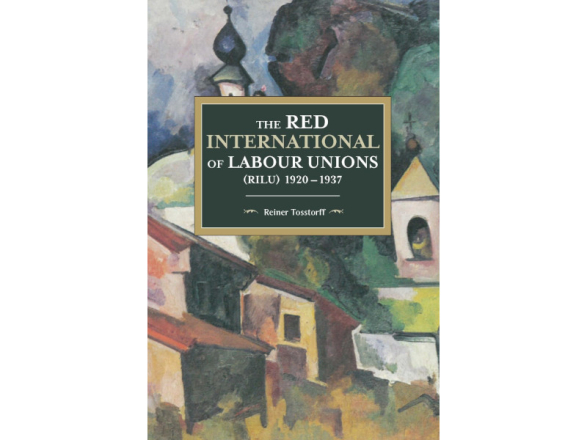
Reiner Tosstorff’s book, The Red International of Labour Unions (RILU) 1920-1937, originally in German (2004) and in English (2015) provides a rounded assessment of the Profintern’s strengths and weaknesses, and outlines the various stages of its evolution. Now, Mike Taber has translated and published the proceedings and resolutions of the RILU’s first congress, The Founding of the Red Trade Union International (2024).
Context
At the beginning of the 20th century, some trade union leaders instigated international collaboration. In 1913, the organisation was renamed the International Federation of Trade Unions (IFTU). During the First World War, the majority of union bureaucrats sided with their own governments, pitting worker against worker in the slaughter. The IFTU was refounded at its Amsterdam congress in 1919. Its representatives took part in the Versailles Treaty and the International Labour Organisation.
By contrast, a layer of syndicalist militants emerged to oppose the growing bureaucratisation of the unions. In 1906, the General Confederation of Labour (CGT) in France adopted the Amiens Charter, which became a model for many syndicalists. Taber’s volume carries a translation. The charter was notable for its rejection of politics in the unions:
“The congress assures to all union members the right to take part, outside the union framework, in any form of struggle that corresponds to their philosophic or political conceptions, reserving only the right to ask, in return, that they not introduce within the union the opinions that they profess on the outside.”
New syndicalist organisations were formed, such as the Industrial Workers of the World (IWW) and the National Shop Stewards Movement. In 1913 they organised a world syndicalist congress, although the CGT remained within the IFTU and did not participate.
The Bolsheviks also had decades of trade union experience to draw upon. During 1917, 2.7m Russian workers were organised in more than 2,000 industrial unions. The Bolsheviks won majorities in the factory committees and the soviets. They also engaged with workers’ control.
RILU founded
RILU was bound up with Bolshevik revolutionary internationalism. The Comintern was founded in Moscow on 2-6 March 1919. It rallied the best socialist militants to form communist parties. Towards the end of 1919, Comintern chair Grigorii Zinoviev and Russian trade unionist Grigorii Tsyperovich made the first public calls for a “red trade union international”.
In June 1920, a conference of trade unionists from Britain, Italy and Russia was held in Moscow. Zinoviev elaborated three possibilities: a communist fraction within the IFTU, an independent revolutionary trade union international, or a trade union section within the Comintern. (He favoured the latter). The International Trade Union Council (ITUC) was formed on 15 July 1920, led by the Russian union leader Mikhail Tomsky, the French syndicalist Alfred Rosmer and Solomon Dridzo (Lozovsky), the Comintern representative. They carried out the preparatory work to establish RILU.
The founding congress of RILU took place from 3 to 19 July 1921. It held 19 plenary sessions, in between the Third Comintern Congress (which trade unionists also went to). Some 380 delegates attended RILU, some with impressive mandates.
Syndicalist forces were strongly represented at the congress. The two most important contingents were the CNT delegation from Spain and the Revolutionary Syndicalist Committees (CSR) in France. Other syndicalist forces present were the Italian Syndicalist Union (USI), the IWW from the United States, One Big Union in Canada, a number of German syndicalist unions, plus others from the Netherlands, Sweden, and Latin America. Two national union federations affiliated to the IFTU also attended the congress: the Norwegian Confederation of Trade Unions and the General Confederation of Labour from Italy.
The RILU congress set five conditions for membership: recognition of the class struggle and carrying it out in practice; recognition of the dictatorship of the proletariat; prohibition of dual affiliation with the IFTU; unity in action by RILU affiliates within a country; and international discipline. A key question debated was the relationship between RILU and the Comintern. Rosmer’s resolution advocating an “organic link” was carried.
Debates
The Amiens Charter was a key referent at the first RILU congress. Lozovsky took a hard line:
“We must propose to our French comrades to work out a new programme instead of their charter. The Amiens Charter was good for a certain period, but now it has lost its significance. It is dead, and let it rest in peace. We want a new programme to answer the requirements of the present day, in which the forms, means, and methods of struggle needed at present would find their echo and reflection. This should be the duty imposed by the congress upon our French comrades.”
Rosmer took a different perspective. He said:
“The Amiens Charter is a document of great importance… It contained different elements: some coming from the anarchists, some from different socialist parties, and others coming from nowhere – the pure syndicalists. All these diverse elements were united by the ideal they aimed at: the suppression of the wages system. They did not care so much to define a new theory, but to establish a correct method of action. In this they succeeded.”
One of the main subjects of debate at the congress was how to approach existing bureaucratised unions: whether to fight to transform them, or to leave them and instead build explicitly revolutionary unions. The German syndicalists put forward the slogans ‘Out of the unions!’ and ‘Smash the old unions!’ Lozovsky chastised this view:
“In fact this slogan, at the present juncture, is not only dangerous but counterrevolutionary. Just think of it. We come to the workers and tell them to smash their unions, when we know that it has taken the working class dozens of years to build them, and those unions have proved to be beneficial to the working class. The workers and the union are strongly linked together. Workers consider the union as their home, and when we come to them and say, ‘smash the union’, we meet with the obstinate resistance of the masses. The masses are unwilling to destroy the unions they have built.”
Workers’ control was another important question at the congress. It meant workers keeping close tabs on operations in the factories under their capitalist owners – through oversight, monitoring and supervision – and struggling to take charge of these operations. Tsyperovich argued that struggles for workers’ control could lead to the political rule of the working class.
RILU stalled
After RILU’s founding congress, most of the syndicalist organisations distanced themselves from the Profintern, notably the CNT, USI, IWW, and the FAUD and AAU in Germany. Many of these forces participated in founding the anarcho-syndicalist International Workers’ Association in December 1922. A few important syndicalists drew closer to the RILU, such as the French CSR, which soon became the CGTU, along with some German syndicalists and individuals such as Andreu Nin.
The national confederations that had considered affiliation to the RILU, such as the CGL in Italy and the labour confederation in Norway, decided against it. Many union leaders were deterred from affiliating by the IFTU’s threats of expulsion.
A second RILU congress took place between 19 November and 2 December 1922, overlapping with the Fourth Comintern Congress. Some 213 delegates from 41 countries attended this RILU gathering. The most important discussion concerned the relationship between the Comintern and the RILU. The French CGTU had not resolved its international affiliation. The Bolsheviks reached a compromise agreement with CGTU leaders shortly before the RILU congress began, agreeing to remove the “organic link” formulation.
However Tosstorff argued that by 1922, “the RILU was able to establish itself firmly as an organisation, while experiencing a certain decline in political influence”.
Decline
After Lenin died in 1924, the troika of Stalin, Zinoviev and Kamenev took over in Russia, to the exclusion of Trotsky. The Fifth Comintern Congress, convened from 17 June to 8 July 1924, began the bureaucratisation of the Comintern through so-called ‘Bolshevisation’ (monolithic, Moscow-approved communist leaderships). The third RILU congress took place soon afterwards (8-22 July 1924) and faced calls for its liquidation. By then, the Russian trade unions wanted to join the IFTU and close down RILU.
RILU held no congress for the next four years and its central council met only once. It lost valuable cadres, such as Rosmer and Nin, who supported the opposition to Stalinism.
By the time the fourth RILU Congress convened between 17 March and 3 April 1928, Stalinism had consolidated its grip on the Russian state, as well as the Comintern. RILU was corralled to support the Stalinist third period lurch towards the sectarian ‘dual unions’. RILU held its final congress on 15-30 August 1930. It was dissolved without a murmur on 27 December 1937.
Balance sheet
RILU never came close to rivalling the IFTU for the affiliation of the bulk of the trade union centres. Nor did RILU give instructions to the communist trade union fractions and therefore it did not influence real industrial struggles or rank and file movements. As Tosstorff put it, RILU “simulated a power and a strength that it did not possess”.
The early RILU floundered because of the change in the situation and the resulting reorientation by the Comintern. Zinoviev pointed out that RILU was formed “at a moment [1920] when it seemed that we would be able to break through the enemy front in a frontal attack and quickly conquer the trade unions”. By 1921, the revolutionary wave had ebbed. The Comintern leadership reassessed and developed a new set of tactics, based around winning a majority of workers through united front work. RILU still largely operated within the framework established in 1920.
The main justification for RILU was as an alliance between syndicalists and communists. Many syndicalist militants rallied to the Russian revolution. It was politically essential and tactically astute of the Bolsheviks to draw these syndicalists into joint activity. RILU was a primary means of this collaboration.
RILU was also a means of communist party building. In the United States, the Communist Party recruited two thousand members from the IWW: perhaps twenty percent of its early recruits. The Bolsheviks made great efforts to convince the syndicalists that their conception of an “active minority” was an underdeveloped form of the revolutionary party. Recruiting and integrating a militant layer of activists into communist parties was facilitated by collaboration around RILU. Convincing Rosmer, Nin, Victor Serge and others were tremendous gains for the Bolsheviks.
Taber’s conclusion is about right. RILU cannot be presented as a model for future attempts at international working class action. But it did provide important experiences that new generations can learn from, including its mistakes.
Comments?We welcome replies, corrections and debate pieces. Contact us