
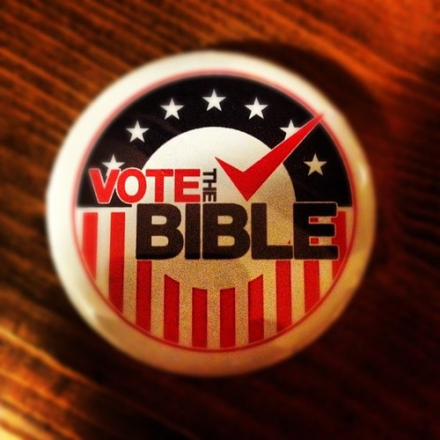
Katherine Stewart, in her book Money, Lies and Gods: Inside the Movement to Destroy American Democracy, argues that although the influence on the Republican Party of a network of billionaires (now commonly referred to as “the oligarchy”) is key to understanding Trump’s regime, this picture is incomplete.
The same billionaires are also the funders of a renewed Christian nationalism. The ideology of that movement is a convenient fit for the billionaires’ preferred authoritarian order. Christian nationalism is not a freaky side-show but is at the heart of the US’s plutocracy.
Republican support has long come from white evangelical Protestants. It now also comes from a majority of Catholics (55%). However, with the overall decline of church-going and the rise of more extreme evangelicalism, and denominations like the Pentecostals, the link between more “out there” religion and authoritarian far right politics has grown.
Stewart shows how an enormously well-funded Christian nationalist network of think tanks, churches and theological institutions was key to winning a second term for Trump. The network has found it expedient to hitch their wagon to the not-very-spiritual Donald Trump.
Christian nationalism believes catastrophic change now afflicts the political order. There are no good political establishment values. and moreover that political establishment wants to crush religious freedom (that is freedom for my religion).
Therefore the government has to force through a more godly rule, embodied in a particular vision of the nation which, the Christian nationalists say, will return America to the spirit of the Founding Fathers, who apparently never intended to separate church and state. Stewart summarises this mythical thinking as “reactionary nihilism”; it draws on US political traditions of paranoia and conspiracism.
Christian nationalism’s sprawling network is both non- and multi-denominational, organised around various nodes which have distinctive political-religious missions. Groups like Moms for Liberty who chase after immoral elements for the school curriculum such as “critical race theory” — a topic which in fact is on no school curriculum — to get them banned.
Although the movement relies on volunteers, the congregations of many thousands of conservative churches, it is not, Stewart argues, a grassroots movement. The role of lay religious organisers and preachers is only to spread the message and convince the followers to accept identity-based authoritarian rule and, of course, to raise up politicians of the virtuous elite to power.
Spectrum
The big political-religious lobby groups include the Federalist Society, The Heritage Foundation (the group behind Project 2025) and the Claremont Institute, at the furthest right of the spectrum. The Claremont Institute has been heavily responsible for the idea that “wokeness” is at the centre of an “administrative state” which must be smashed.
None of this appeared overnight. A massive concentration of wealth has been building up over five decades. Key individuals, their charitable funds and the lobby groups are rooted in the Christian right of the late 1970s and Reagan-era politics. But everything is worse now and because this movement is adjacent or even synonymous with other streams of far right politics its institutions often have the support of the others on US right, such as libertarians.
Stewart helps us understand many other connections. For example, she shows us a connection between US Christian nationalism and the Russian far right through the World Congress of Families (WCF), an organisation that had at its inception the participation of the new Russian ruling class which followed the collapse of Stalinism.
Both Russians and Americans in the WCF and allied organisations saw the usefulness of framing “fear and loathing of gay people and hostility to women’s equality as part of a nationalist, ‘pro-family’ vision that could be used to secure authoritarian forms of governance and protect the privilege and property of an elite”.
Stewart’s important research should arm the left in its fight against the far right in the US and around the world.
Comments?We welcome replies, corrections and debate pieces. Contact us