
Part of a series of articles exploring the role of the left in the great political upheaval in Northern Ireland in 1968-9, written in response to John McAnulty’s polemic (Solidarity 717 )
PD in October 1968
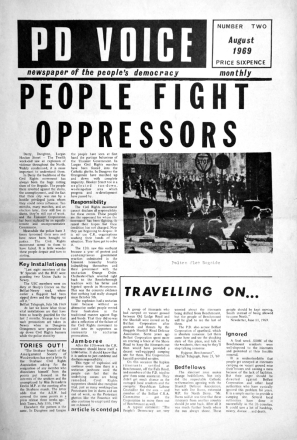
People’s Democracy, which would become well-known as a left-wing force in the turmoil, was set up in Belfast on 9 October 1968.
On 5 October a civil rights (and housing) march in Derry had attempted to ignore a police ban.
The peaceful demonstrators assembled and were then set upon by the Royal Ulster Constabulary (RUC), wielding batons indiscriminately. Labour MPs like Russell Kerr and Anne Kerr were present. Gerry Fitt, the Westminster “Republican Labour” MP for Belfast West, was hit and bloodied by a police baton. The RUC was seen to be on the offensive, beating peaceful demonstrators. We saw one jabbed with a baton in the stomach by an RUC man. It was very like what cops in America did to Black people demonstrating for equal rights. The association of Northern Ireland Catholics and people of colour in the USA came to be a common one.
It was the time of great marches against the Vietnam war and of the American civil rights movement. Disturbing and unsettling film from Vietnam and the USA had been pumped raw and uncensored into American and British TV news. Now we saw bully-boy Northern Ireland police beating Catholics who wanted equality.
In Britain, there was very wide support for the Northern Ireland Catholics. All the British press, the Tory press too, backed Catholic demands for equal rights, for “civil rights”. The song of the American Black people’s movement, We Shall Overcome, was sung on Irish civil rights marches: I remember seeing a whole crowded pub in Derry on a Saturday night singing it together.
An American Black Panther film was popular among Republicans and proto-Republicans in Derry: “The revolution has come/ Time to pick up the gun”. It was sometimes sung satirically, mockingly, against Republicans. People’s Democracy leader Michael Farrell was influenced by the US civil rights movement.
The Provo war was then a thing of the future — 15 months in the future, to be exact. The Republican movement had not yet split, though that would happen soon (December 1969 for the IRA, January 1970 for Sinn Fein).
The police riot of October 1968 made more intensive the pressure on the would-be reforming Unionists in power, under Terence O’Neill as Northern Ireland prime minister. A Labour government ruled in London and was in favour of equal rights for Northern Ireland Catholics. Some of the “leftists” in the government or in the Parliamentary Labour Party, for instance Stan Orme MP, had been educated in an Irish nationalist (Connolly Association) view of the Catholics in Northern Ireland. They were very much for them and against the Unionists. Another Labour MP, Paul Rose, a future judge, wrote a pamphlet on the Manchester Martyrs, Allen, Larkin, and O’Brien.
In Northern Ireland it was Protestant-sectarian, majority rule. The Unionists who wanted reform were in a minority, beleaguered amidst traditional “keep the Catholics down” Unionists.
I once asked a Derry Catholic woman about differences among the Protestants, between, say, Methodists and Episcopalians. She answered: “Ah, no. They’re all the same”. To the Catholic second-class citizens, they were all part of the ruling Protestant elite.
The great British upsurge of opinion in favour of the Catholics in 1968-9 was just; but it was also shallow and thoughtless. The central civil right which the artificial Catholic minority in the Six Counties lacked was national self-determination. That issue would inevitably come to the fore. That was the underlying logic of what led many of them to “pick up the gun”.
The Protestants were an Irish minority; but the second minority, the Catholics of Northern Ireland, were an artificial minority because two Catholic counties, and other Catholic-majority areas mainly along the border with the 26 Counties, had been given to Northern Ireland at partition. The Northern Ireland state had been so carved out in 1920 that Catholics could not foreseeably get a majority there.
On the night PD was declared or the day after, a syndicalist comrade, Ron Marsden, and I, in Manchester, having little knowledge, tried to puzzle out what the new organisation was, politically. People’s Democracy? With a name like that, we thought, it had to be some sort of Stalinist outfit.
The Stalinists called Russia’s satellites in Eastern Europe “the People’s Democracies”. But there were at least three lies in those two words. It was not rule by the people, whatever was meant by “people”. It was not democracy in any sense, bourgeois, proletarian, or any other sense. And there had never been, could never be, a “people’s” state. The state is always a class state.
So, Stalinist of some sort, we had no doubt. In fact, PD in Belfast was led by co-thinkers of IS (today SWP) in Britain, which thought that Russia and its “People’s Democracy” satellites were “state capitalist” formations. Those Belfast people were former comrades of mine in the Irish Workers’ Group. The IWG had split in Dublin on 17 March 1968 with the Northerners, who were all Cliffites, IS sympathisers, on the other side to ours. Cyril Toman, not the notional IWG leader Gery Lawless, spoke for the IWG majority, advocating the system of organisation which IS in Britain was then trying to abolish. I spoke for the minority which would go on to found the League for a Workers’ Republic.
The IWG was mainly an Irish émigré organisation in Britain. It began as the Irish Communist Group, in which Maoists and ostensible Trotskyists managed to coexist for a while, under the political hegemony of the Maoists, who imitated the Irish Communist Party of the early 1930s. In the split that was inevitable, the hard-core Maoists were isolated. The Trotskyists, and others including softer Stalinists, soon abandoned the name Irish Communist Group and became the IWG. That did not render us more coherent.
In March 1968 the IWG split. The minority had no-one in Northern Ireland. The 1967-8 majority in the IWG was a strange conglomerate of IS people who thought the USSR “state capitalist” with ultra-”Pabloites” who retrospectively sided with the Russians against the workers’ rising in East Berlin in 1953. The two groups were united in hostility to the Orthodox Trotskyist faction.
Immediately after 5 October, the Six County Home Secretary William Craig denounced Trotskyism in the Northern Ireland parliament, using a few snippers from the manifesto adopted by the September 1967 IWG conference: “A revolutionary socialist organisation which aims to mobilise the Irish section of the international working class to overthrow the existing irish bourgeois states, destroy all remaining imperialist organs of political and economic control, and establish an All-Ireland Socialist Workers’ Republic”.
Rory McShane, who was a Queen’s University Belfast student elected chair of the IWG at the September 1967 conference, denied all knowledge of the IWG, and the IWG quietly ceased to exist at that point.
But the leaders of PD, except Bernadette Devlin, had been part of the IWG. I could guess, but I never did find out for sure how they came to have a quintessential-Stalinist name like People’s Democracy.
IS and ourselves in 1968
The British group, IS (today, SWP), was going through its own turmoil. Its leader, Tony Cliff, had proposed that its previous federalist and loose organisation be centralised, and the group was in ferment for six months. The ferment ended in November 1968 in a conference which voted to centralise IS and elected a National Committee.
The drive to centralism had been accompanied by a call for left unity. Why left unity? Because, said IS, fascism was an immediate threat in Britain. Tory MP Enoch Powell had speechified that immigration threatened Britain with “rivers of blood”. He had been sacked for it from Edward Heath’s Tory Shadow Cabinet, and London dockers had struck, ostensibly for “free speech” for Powell, but in fact because they agreed with him. Some of those same dockers had from September 1968 been on a ten-week strike against the reorganisation of the ports by the employers.
These events were alarming. Workers’ Fight (forerunner of Workers’ Liberty) had called “for a Trotskyist regroupment” in October 1967, on the grounds that there was no viable Trotskyist group in Britain. That was true to reality. But of course there were ostensibly Trotskyist groups, and they were very much bigger and, as organisations, more credible, than we were. The “Trotskyist regroupment” never happened.
Workers’ Fight was alarmed by the London docks strike for Powell. We did not believe the IS nonsense about “the urgent threat of fascism”; we did however believe in IS’s call for unity, and (falsely) believed that the Mandelites (IMG) would join IS too. We fused with IS at its conference in November. In doing so we lost more than half the previous Workers’ Fight group: they refused to join an organisation we all called “centrist” (vague, half-revolutionary, politically unstable). They were placid sectarians who never did anything in politics more onerous than sing good folk songs well.
Workers’ Fight became the “Trotskyist Tendency” of IS. We considered ourselves Cannonite Orthodox Trotskyists. I had thought the Socialist Labour League (SLL, “Healyite”, then the biggest “Orthodox Trotskyist” group by far) had been ok until it turned very sectarian. It indulged in sectarian strike-breaking to assert its own leadership in the November 1964 engineering apprentices’ strike.
I had been expelled from the SLL in September 1963. That involved a trial with no charge I could reply to and a direct clash with the SLL’s tyrant Gerry Healy. For the next fourteen months I was an SLL supporter but with decreasing commitment. I broke with them when they broke the apprentices’ strike in November 1964. Yes, that was very late in the day. After breaking with the SLL, I joined Militant (as the main other would-be Trotskyist group available).
Ted Knight had operated for Healy in other organisations — he split Militant (forerunner of the SP and others) and the International Group (future IMG), both groups then linked to the “Mandelite” Fourth International (United Secretariat). He had recruited me to the SLL from the Young Communist League five years earlier. I had read some of Trotsky, including his Diary in Exile and the introduction to it by Max Shachtman, and was a subscriber to the Pablo-Mandel magazine Fourth International and the little biweekly International Bulletin they published.
I was a Trotskyist, sort of, but I was a Deutscherite. Knight lent me Trotsky’s Revolution Betrayed, which I had so far been unable to get, and convinced me that only a workers’ rising could overthrow the bureaucracy. He formally recruited me to the SLL.
Shortly before Easter 1965, Gerry Healy sent Knight to see me. Knight proposed that I rejoin the SLL and work for them inside Militant. I refused. I had broken with the SLL politically, forever. I remember talking to Knight in the café, “The Shalom”, on the corner of Queen’s Road, owned by an Israeli who let the YS have the upstairs room for nothing.
On the 1965 annual Easter Campaign for Nuclear Disarmament (CND) march from the nuclear facility at Aldermaston to London (it took four days), I made a point of telling Pat Jordan of the International Group, of which Ted Knight was then still supposedly a member (having split with them from the Grantite organisation, the Revolutionary Socialist League (RSL/ Militant)), that Knight was working inside the IG for the SLL. Jordan was very officious. Oh, they had everything under control. But they didn’t. Thereafter the SLL press, when it referred to me, always said that I was “very hostile” to the SLL. After more than five years’ involvement with them, I was.
Socialist Worker from October 1968
As the Catholic civil rights movement in Northern Ireland, and a Protestant backlash against it, escalated in 1968, the typical response of Socialist Worker was exemplified in an article by Paul Foot (26/10/68), under the headline: “Do-It-Yourself Politics Threatens Northern Ireland’s Police Rule”.
Foot gave readers, who in the main would know next to nothing of the realities of Northern Ireland, details of the discrimination in housing, jobs, and votes against Catholics. Politically speaking, the important part of the article, defining IS’s approach, was this: “The exploited people of Northern Ireland, denied even the semblance of parliamentary democracy available to the rest of the UK, are beginning to ‘do it themselves’, to act to seize the basic rights and services denied them by the intolerant and reactionary government”.
In fact the system for electing Northern Ireland’s Westminster MPs was not interfered with. Election-rigging mainly concerned the local councils in Catholic-majority areas. Foot’s response to what he saw when he visited Northern Ireland in October 1968 was described to me soon after. He had repeatedly burst out laughing, not in scorn, but in disbelief at what the Unionists did. But still he got his facts wrong in his Socialist Worker article
Direct action, said Foot, showed the way. The ruling Ulster Unionist Party set religious sectarianism to divide the workers, he thought.
Foot noted the upsurge of student militancy for civil rights, and claimed that created a “terror of the authorities at the prospect of workers and students acting for themselves”.
All of the IS of 1968 was there. There had been a strong strain of quasi-anarchism in IS’s youth segment. Direct action, “do-it-yourself” reforms, and “militancy” were the central values.
Alongside the quasi-anarchism in Foot’s article, and of IS’s typical approach then, was, right from the start, a lack of awareness of, or a refusal to notice, central features of the reality of Northern Ireland.
In Foot’s picture the fact that “the people” in revolt were only (a section of) the Catholic minority was resolutely pushed aside. He depicted a worker and student uprising against the Northern Ireland equivalent of a Greek military dictator (Papadopoulos) or a white supremacist in Africa (Lardner-Burke).
This was a view of Northern Ireland seen through spectacles that filtered out everything that was specific to Northern Ireland. For the next year, anyone relying only on Socialist Worker for information about Northern Ireland would not have been able to make sense of events there. The national, communal, denominational, sectarian realities of the real Northern Ireland were not admitted into the pages of Socialist Worker until August 1969, when panic led the IS leaders to face realities (sort of) and abandon some of their fantasies.
In December 1968 the IS Executive Committee (EC) agreed: “There was perhaps scope for a campaign on Vietnam Solidarity Campaign lines which should be more fruitful because it could bring workers into contact with the revolutionary left. The campaign should take in questions coming from the south as well, although main emphasis on the North”.
The committee duly agreed:
“a) To educate the group (and the British left, especially revolutionary Marxists);
“b) Start an Irish campaign;
“c) Assist the re-formation of an Irish group”.
The political conclusions and proposals for action from the EC meeting appeared in Socialist Worker on 4 January 1969, on the eve of a meeting of the broader National Committee that would discuss and, notionally, decide. The article, “Ulster: what the left must do”, was the work of former IWG leader Gery Lawless, under the pen name “Sean Reed”.
“The Northern worker will never be won to a programme which calls for the absorption of the Six Counties into the present Southern regime with its Rome rule in the schools which tends to confirm his ever-present fear that a break with Orange Toryism will open the floodgates and relegate him to the position of a second-class citizen. He will only be won for the establishment of a Republic when it is clear in his mind that what is envisaged is a Workers’ Republic in which he as a worker will control his own destiny without fear of Thames or Tiber.
“The complexity of the situation has in the past been used by many in the labour movement in Britain as an excuse for doing nothing, or else indulging in the old British habit of telling the Irish how to run their own affairs. This British... attitude to Ireland will come as no surprise to Irish revolutionary socialists, who have long recognised if not accepted the inability of the labour movement in Britain to show an understanding of the Irish problem. The result of this attitude in practice is that even the best-informed British left-wing organisations fail to take any part in the struggle against British imperialism in Ireland. What is to be done? First and foremost British socialists must refrain from penning long high-flown theoretical articles (which all end up telling Irish socialists what to do) and instead launch a campaign of solidarity with the Irish movement...”
In fact the text of the Socialist Worker article agreed between the IS leaders and Lawless implicitly ruled out self-determination: the worker “will only be won for the... Republic when it is clear... that [it] is a Workers’ Republic”.
On one level this was ultra-left. The “constitutional question” had dominated Irish politics then, and would do for the next 50 years, but IS said it would think about that only after two Irish socialist revolutions, one in the Six and the other in the 26 Counties. The Stalinists presented a “stages theory”, first the Republic (united Ireland), then the workers’ republic. And so did IS, but differently: first win two separate socialist revolutions, Six and 26 County, and then Irish unity (self-determination) could be the next stage.
Despite the reference to socialism as a necessary first stage before Irish unity, the IS demands were not explicitly for socialism, or, in Irish parlance, for the Workers’ Republic.
The IS Executive had chosen as its model the Communist Party’s front organisation, the Connolly Association. The Connolly Association presented itself to Irish workers in Britain as a pseudo-nationalist organisation with a focus on the labour movement. The IS leaders wanted to present IS as a pseudo-liberal, militant civil rights front.
The January 1969 discussion
A new period began with the first “new” IS NC in January 1969, and the EC meeting and Socialist Worker article that prepared for it. A third would begin with Bernadette Devlin’s election as a Westminster MP in April 1969, and a fourth period would begin with IS’s change of line in August 1969 to one of justifying the deployment of British soldiers in the Six Counties and de facto supporting them.
The first post-federalist meeting of the IS National Committee (NC) took place in January 1969. Of course the EC, i.e. the actual leadership, had never ceased to function. How things were going to be was signalled when Cliff marched in at the head of a group of his friends and nominated the entire new EC, including who would represent the loose “block of 11” of which Workers’ Fight was part. Tony Cliff and his allies prepared for the NC by the minutes of the 12 December EC meeting, which Gery Lawless had attended, and the 4 January article.
IS had recently taken over an old warehouse at Cottons Gardens, not far from Liverpool Street station in London. A cluster of chairs arranged in rows was an oasis in the centre of a big and empty room there, faced by a small table at which sat Jim Higgins. I suppose we must have elected him as permanent chair at the beginning.
Ireland was the most important discussion of that January 1969 first NC meeting of the new IS. The “Burntollet” march, ambushed by civilian Orangemen and RUC and B-Specials out of uniform, had just taken place, followed by a serious Catholic mobilisation and Catholic-Protestant fighting when the march got to Derry City (two miles from the Donegal border, and then called Londonderry, in the county of the same name). The Cameron Commission was set up to “investigate” what happened in Derry in January 1969. Its report in October 1969 would cause a new organisation, also named People’s Democracy to be launched. But that was at the other side of the beginning of civil war and the British army coming into mainstream politics as “controller” of the streets in the Six Counties.
The EC had discussed Ireland. IS’s response was now in theory to be discussed and decided by the NC.
The first post-federalist meeting of the IS National Committee (NC) took place in January 1969. Of course the EC, i.e. the actual leadership, had never ceased to function. How things were going to be was signalled when Cliff marched in at the head of a group of his friends and nominated the entire new EC, including who would represent the loose “block of 11” of which Workers’ Fight was part. Tony Cliff and his allies prepared for the NC by the minutes of the 12 December EC meeting, which Gery Lawless had attended, and the 4 January article..
IS had recently taken over an old warehouse at Cottons Gardens, not far from Liverpool Street station in London. A cluster of chairs arranged in rows was an oasis in the centre of a big and empty room there, faced by a small table at which sat Jim Higgins. I suppose we must have elected him as permanent chair at the beginning.
Ireland was the most important discussion of that January 1969 first NC meeting of the new IS. The “Burntollet” march, ambushed by civilian Orangemen and RUC and B-Specials out of uniform, had just taken place, followed by a serious Catholic mobilisation and Catholic-Protestant fighting when the march got to Derry City (two miles from the Donegal border, and then called Londonderry, in the county of the same name). The Cameron Commission was set up to “investigate” what happened in Derry in January 1969. Its report in October 1969 would cause a new organisation, also named People’s Democracy to be launched. But that was at the other side of the beginning of civil war and the British army coming into mainstream politics as “controller” of the streets in the Six Counties.
The EC had discussed Ireland. IS’s response was now in theory to be discussed and decided by the NC.
Many years later, when Jim Higgins, then long out of IS, was writing his very personal account of the history of IS, he wrote to John Palmer to ask him what the IS policy on Ireland had been in 1968-9. It was not obvious to the chair of the NC meetings, Higgins, what the IS policy had been. It had not been clear at the time to him, either, though he spoke, voted, and at one crucial point used his “chair’s” tie-breaking second vote to stop the organisation advocating “the workers’ republic” to the Irish in Britain.
John Palmer had been the main contact for IS with PD and specifically with Michael Farrell. Back wrote Palmer to Higgins, saying that IS didn’t have a policy on Ireland then. That was in big part true. Palmer had been the “main man” on Ireland, backed by Cliff, in 1969. He had reported on Ireland to the NC. He had been PD’s spokesman on the NC. IS did not, he told Higgins, have a policy on Ireland in 1969. (The exchange is in Higgins’s papers at Senate House library.) Palmer meant, I suppose, that IS had no independent analysis of Ireland. But it certainly had a policy: it followed wherever PD led.
And it certainly had appetites. It wanted to grow, and it wanted PD to grow, on any political basis. Later it would want its British-based organisation, the Irish Civil Rights Solidarity Campaign, to grow.
Comments?We welcome replies, corrections and debate pieces. Contact us