
Picking up from the account in Solidarity 731 of how the 1960s civil rights movement in Northern Ireland led to a bloody police assault on civil rights demonstrators in Derry on 5 October 1968
One of the most important responses in Northern Ireland to the bloody events in Derry was the creation of a powerful movement of students to agitate for civil rights — People’s Democracy. PD was based on Queen’s University, Belfast, and initially had many Protestant supporters.
They were influenced by the world-wide student radicalisation of that time, which elsewhere focused on organising protests and solidarity with the Vietnamese against the USA. Many of the leaders of PD were Marxist socialists.
Beginning with a “Long March” from Belfast to Derry through “Protestant territory”, which ended in a police riot in Derry, PD agitated and marched — often very provocatively — for civil rights.
After October 1968, the half-century of the Orange-Unionist majority treating their “Taigs” as roughly as necessary to keep them “in their place”, and being able to do it with little “outsider” awareness and concern, was over.
It was the global television age, with its instant transmission of images across the world. An uncensored stream of horror footage from Vietnam and the US war there had poured daily onto TV screens across the world. So, throughout the 1960s, had the struggles of US black people against discrimination and second-class citizenship — its mass demonstrations, police violence, strutting racist local officials.
Now the UK’s quasi-police-state backyard was erupting. Its one-sectarian-party rule for half a century, its institutionalised discrimination, were on show.
The UK media were universally sympathetic to the Catholic-nationalists. So was the British Labour government. It had already attempted to modify the sectarian political system in the artificial state.
Many of the Catholics saw themselves as akin to black people in the US, and so did the leaders of the civil rights movement, including those like Michael Farrell who were (loosely) affiliated to the International Socialist organisation in Britain.
Some Catholic-nationalist demonstrators sang civil rights songs. In the writer’s observation, in Derry the following year, a film about the US Black Panthers was very popular among militant young Republicans and incipient Republicans, those who would be the soldiers of the IRA war which would begin early in 1971).
The unwanted media attention to the police assault on the peaceful (police-prohibited) march in Derry on 5 October had been aroused also as a result of the work of Northern Ireland politicians such as Gerry Fitt, a “Labour Republican”. Fitt had been elected to Westminster from West Belfast in 1966, and tirelessly brought Northern Ireland affairs to Westminster in defiance of the previous convention that they were not discussed.
Media attention now became an autonomous factor. It changed everything.
William Craig was sacked from the Stormont government. The Protestant working class became increasingly alarmed at the prospect of being “sold out”. The Protestant backlash grew bigger and began to reflect itself inside the ruling Unionist Party.
Central to what happened in the progressive breakdown of the 6-County State was the incapacity of the Unionist upper-class elite to carry the Protestant working class with them on reform. Every Catholic, or pro-Catholic, action stirred up and agitated the Protestant ranks, feeding the backlash. The elite could control neither the one nor the other, and the system was ground to bits between the two.
O’Neill resigned in early 1969, to be replaced by another ex-Army man, his cousin Chichester-Clark. In January 1969 police rioted in Derry’s Bogside, the Catholic slum area built outside the walls of the one-time Protestant City of Londonderry, and beat a Bogsider, Samuel Devenney, to death in his house. The Catholics erected barricades to keep them out.
Serious rioting occurred in July. Then in August the upper class Orange Order, the Apprentice Boys of Derry, staged their annual but now very provocative march on the walls overlooking the Catholic slums. Big clashes developed between the police, the sectarian B-Special constables and assorted ultra-Protestants, “the Paisleyites”, on the one side, and the Catholics of the Bogside on the other.
Barricades were set up, and the Bogsiders held off the forces of the state using stones and petrol-bombs. Protestant bigots attacked Catholic areas in West Belfast and burned out dozens of Catholic families. Barricades went up there too.
The Dublin prime minister felt obliged to say publicly that the South could not “stand idly by”. The Southern state’s soldiers were moved up to the border, where they did “stand idly by”, leaving it to the British army to control the erupting sectarian civil war.
On 14 August the British Army was moved onto the streets to stop the state falling apart. It quickly took control in Belfast and Derry.
Welcomed
The Catholics welcomed the Army as saviours, famously plying them with friendly cups of tea — but they didn’t take their barricades down. The Catholics of Derry and Belfast had seceded from the Northern Ireland state, for the moment. The barricades would stay up, patrolled on the outside by the British Army armed with machine guns and rifles, and on the inside by Catholics armed with hurleys (like hockey sticks), until, after the British government announced it would accept all the reforms demanded by the civil rights movement, and more, the Catholics agreed to take them down in October.
That was the first crucial turning point. The Northern Ireland state had shown itself to be unreformable. It had been designed to serve the Protestant majority and they had a built-in majority against any change they didn’t want.
The Labour government had to decide what to do. As well as sending in the army, it sent in a bevy of civil servants to oversee the chief Northern Ireland civil servants, thus seriously curtailing the independence of the Northern Ireland government. That’s all the British Labour government did.
As our pamphlet IS and Ireland put it:
The cement had fallen out of the rickety Northern Ireland state, and its sponsors. The successors of the master builders who created the monstrous structure in the first place, had to act quickly. Direct intervention from London was the result....
The taking of physical control through the army was the result. A tight military scaffolding was quickly erected to prevent a collapse into chaos. This was the role of the troops. Their meaning was essentially that, though the state structure of the UK had begun to break up from internal contradictions at one of its extremities, the system was still powerful enough at the centre to prevent chaos...
With the steel fingers of the army, Britain quickly got a grip on the situation, and begun a controlled demolition on certain parts of the Northern Ireland set up...
That it would take them 38 years to restore anything like normal government in Northern Ireland — and the present system can not be said to be firmly entrenched or stable yet — that, no one at the time could guess, or even imagine.
Instead of recognising that the system had to be radically dismantled and restructured, the British labour government left it essentially in being, tinkering with it. But a process had begun that would end with the abolition of Stormont in March 1972, thus depriving the Protestant majority, whose right to self-determination the Six County state allegedly gives expression to, of the right to exercise that majority in any local political structures.
The events of August-October 1969 set Northern Ireland on a new trajectory. That was not clear at the time. The youth in the Catholic areas who had been roused up and radicalised, were deflated and disappointed when the barricades came down in October 1969. An anti-climactic normality — except for the British Army now having a central role in controlling the two hostile peoples — set in for a while.
The crisis in the Unionist Party continued, under pressure on one side from the British government to reform and on the other from the Protestant population against “selling them out” to the Catholics or “Dublin”. Chichester-Clark resigned in 1970, to be replaced by the tougher, less genteel and altogether less effete Brian Faulkner.
Paradoxically this period — 1968-1970 — saw the high point of socialism in Northern Ireland. Most of the prominent Catholic activists or representatives were socialists. The exceptions were middle-class civil rights people like John Hume, and even they allied with socialists like Gerry Fitt, MP for West Belfast, and called the party they set up in 1970 the Social Democratic and Labour Party. (Mainly Catholic, it then included some Protestants, like Ivan Cooper MP).
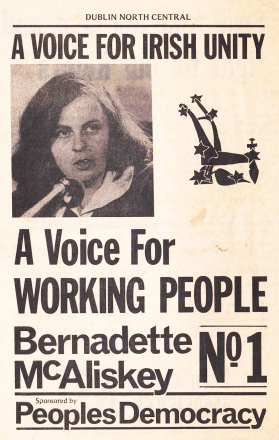
People’s Democracy ceased to be an amorphous student movement in late 1969 and started agitating for socialism and on social questions. PD appealed to Protestant workers to see that socially they had a common interest with Catholic workers. The PD-associated MP for Mid-Ulster, Bernadette Devlin, elected in 1969, was a revolutionary socialist who worked closely in Britain with groups like IS (SWP) and later the SLL (WRP). (Today she is hardly distinguishable from a Republican).
All the leading activists in Derry were socialists, with the leading role falling to the Derry Labour Party, led by Eamonn McCann. In Derry almost all the Republicans were socialists, and some were influenced by Trotskyism. Most of these socialists appealed on social questions to both Catholic and Protestant workers. They all carefully tried to avoid appearing as Catholics or traditional Republicans.
For example, a PD leader, Cyril Toman, who was then a sort of Trotskyist, a sympathiser with IS, tried to get himself a hearing from Protestant workers by erecting a Union Flag over his “soapbox” platform. (Toman would be a Sinn Fein Parliamentary candidate in the early 1980s).
Most of the socialists denounced the idea that there could be a non-socialist united Ireland. Only in a socialist Ireland could the Protestants’ legitimate fears that Home Rule would be Rome Rule be allayed. They roundly abused the ‘Green Tory’ Republic, and marched across the border waving condoms — then banned in the Catholic South — in the faces of the 26 Counties police.
By contrast, the Republicans were eclipsed. Shamed and split by their inability to defend the Catholic areas in August 1969, they seemed to count for little — and anyway the main body of Republicans were, they said, socialists too.
The high point for this Northern Ireland socialism was, perhaps, the Westminster General Election of June 1970. The Northern Ireland Labour Party refused to endorse Eamonn McCann as a candidate, and he stood with the backing of the Derry and Coleraine Labour Parties.
He advocated working-class socialism, which he defined as nationalisation of the commanding heights of the economy. McCann got 8,000 votes.
So there were lots of socialists, many of them Trotskyists of one sort or another. The problem was that they were largely confined to the Catholic community.
There were, of course, also individual Protestants who were for equality for Catholics, and were socialists. Though the big student Protestant support for civil rights fell away very quickly, some stayed. For example, Ronnie Bunting, son of a prominent associate of lan Paisley, joined PD and was reputed to be “Chief of Staff” of the Irish National Liberation Army when he was murdered in 1981.
But those were individuals. The Protestant working class remained impervious to appeals.
Sections of it were “radicalising” and separating off from the traditional Unionist leaders. But, as the old all-class Unionist bloc broke up, the Protestant workers turned to Paisleyism. Their radicalism was diffuse, sectional, fuelled in part by fear of the Catholics in the Six Counties, and defined against them.
Class feeling was strictly confined within their communal framework. If they recognised similar people in similar conditions to their own across the communal divide, they did not go on to conclude that there was a common interest. Communalism shaped and limited everything.
Communal
Northern Ireland’s society split vertically along communal lines in 1969 and after. When the Protestant community split horizontally, it had no positive significance for class politics. It was an affair internal to the Protestant community.
That would be the basic tragedy of Northern Ireland for the rest of the twentieth century, and so far in the 21st: that the Unionist workers’ disillusionment with the Orange bosses served only to build the Paisley Democratic Unionist Party.
The Catholics and their representatives — in the first place the socialists — could, and did, propose working class unity. But they could not impose it on the Protestant workers.
Many activists agreed that “socialism was the only road”, but there can be no socialism without the working class — in this case, crucially, the Protestant working class — so that road was not open.
The consequence for the radicalised Catholic youth was isolation from the main body of the working class and working-class movement, and impotence. The ground was prepared for the Provisionals’ campaign by the impotence, and by the attempts of the socialists to avoid the national question.
As we saw, all the socialists, including the socialist Republicans, steered clear of the national question or renounced it (some of the Republicans hypocritically, tactically). That left the national question and “anti-imperialism” entirely in the hands of the Provisionals, on one side, and the Unionists on the other.
No socialists, Marxist or other, attempted to work out a democratic programme that would allow workers on both sides to unite on an agreement to oppose oppression and the threat of oppression on both sides.
At the end of the 1940s, the tiny Irish Trotskyist group — which had links with the “heterodox” Trotskyists of the US Workers’ Party (Shachtman) — had raised the idea of a federal united Ireland. But that was long forgotten.
The Republican movement had come out of World War Two, in which it had allied with Germany, pulverised and seemingly defunct. It made a principle of physical force and of boycotting the various parliaments (Dublin, Belfast, London) and apart from that was “non-political”. In fact it reflected the right-wing, cold-war atmosphere of Catholic Ireland in the 40s and 50s.
It revived slowly, and in 1956 launched a military campaign of small guerilla actions on the Border. That soon petered out. In 1962, a formal “ceasefire” was declared.
Trying to learn from their experience, some of the leading activists turned “left” and began to talk of using social agitation to gain support for “the national struggle”. They drew on half-forgotten experiences of left-wing Republicanism in the 30s, when left-moving traditional Republicans met the right-moving Stalinised Communist Party of Ireland and together they created a sort of populist Republicanism.
The immediate task was to win national independence (“the Republic”; for the Stalinists, “the bourgeois-democratic revolution”); then socialism would come at the next stage.
The events of August 1969 changed the direction of the IRA too. They were largely irrelevant during the fighting. “Chief of Staff” Cathal Goulding was reduced to making idle public threats. Militants were told that the problem was that the IRA had lent its guns to the Free Wales Army!
In December 1969 and January 1970 the Republican movement split. The break-aways were traditionalists. Many, like David O’Connell, were veterans of what little action there had been in the 50s. Others, like Joe Cahill — sentenced to death in 1942 but reprieved because of his age, while 19-year old Tom Williams was hanged — went back even further. They denounced the “communism” of the mainstream Republicans, though they too called themselves socialists, “democratic socialists”.
The Provisionals’ prospects did not seem very bright: for example, J Bowyer Bell, the author of a learned academic study of the IRA published in 1970, dismissed them as a moribund relic of the past who could not keep up with the development of the mainstream.
In fact the Provos grew with astonishing speed. They recruited rapidly from the disillusioned Catholic youth.
Fianna Fail money helped launch the Provos (Fianna Fail was then as now the governing party in the Republic), but to explain the development of their movement as a result of ruling class divide-and-rule is self-evidently inadequate, and no more than a conspiracy theory of history. As well to explain the Russian Revolution as a German plot because the German general staff allowed Lenin to cross Germany in a sealed train.
Fianna Fail wanted to split and stop the left-wing Republican movement. They did not want what the Provos very rapidly became.
Eamonn McCann has graphically described the Provos’ appeal like this: whereas everyone talked about socialism and “imperialism”, but had nothing to suggest doing about it in the circumstances, the Provos could point to the British soldier standing at the local street corner and say: “There, that’s imperialism. Shoot it.”
The determined avoidance of the national question by the left and the official Republicans — who consigned it to the distant future, together with a socialism that had to wait on the Protestant workers — ensured that the national question, which lay at the heart of the subordinate and oppressed position of the Catholics, was raised, when it inevitably forced its way to the front, in the Provos’ initially right-wing version.
The Provos could, of course, also draw on the Catholic-Republican culture — songs, history, ingrained loyalties — with which the Catholic community was saturated. In late 1969 a staunch old-style Republican like ex-internee Sean Keenan, in Derry, seemed a respected anachronism; within a year or 18 months, people like that were the centre of a powerful movement which had taken in many of the radicalised youth eager to “shoot imperialism”.
One consequence of this was that the Provisional Republican movement would itself become radicalised, especially in Belfast and Derry — though its radicalism was within the limits of one community.
Comments?We welcome replies, corrections and debate pieces. Contact us