
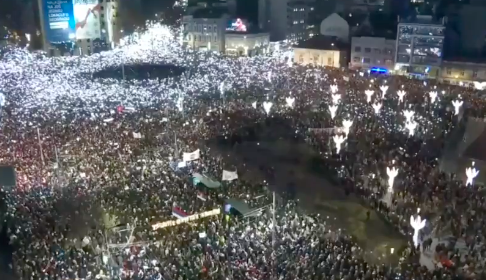
Georgia’s protests against state authoritarianism and Russian domination have had little attention on the British left. Even less has gone to similar mass protests in another European nationalist regime allied to Russia, that of Aleksandar Vučić in Serbia.
Since November demonstrations of many tens of thousands, focused on corruption but raising a range of democratic and social issues, have convulsed the country. Students have come to take the lead, with important roles also by education workers and farmers, in what looks like an amorphous but powerful popular movement with pockets of workers’ action.
The spark: on 1 November the canopy in the main railway station of the country’s second city, Novi Sad, collapsed, killing 15. The disaster occurred two months after an extensive and much-publicised reconstruction job that had produced warnings from building experts.
Vigils for the victims quickly developed into angry demonstrations, also linking up with long-running mass protests against the construction of a lithium mine by multinational Rio Tinto near the small town of Loznica, near Belgrade. After students and lecturers protesting in Novi Sad were attacked by thugs, students around the country began to organise occupations and blockades of their campuses, and have become the iconic force of the movement.
Some of the occupied universities have held large organising assemblies. Secondary school students have also held walkouts.
As well as demonstrations there has been extensive direct action, with repeated short occupations of town centres.
Education workers have gone on strike, with a new strike connected to the protests but raising workers’ industrial demands slated for 20 January. Lawyers have also struck in support of the protests. Hundreds of radio and television workers have collectively and publicly expressed their support, a brave act in a country with a heavily state-dominated media.
Struggle
Postal workers involved in a high profile struggle for their own demands (it’s not clear to me if they’re on strike) held a joint demonstration with pro-democracy students (on Christmas day!)
However, it does not seem most unions are playing any significant role in the protests. Nonetheless, over two months in, demonstrations are continuing in force.
As well as demands for justice and accountability for the station collapse, the demonstrations have called for dismissal of public officials involved in violence against protesters, resignation of the transport and infrastructure minister and a 20% increase in the university budget. They have already won concessions including resignation of the minister, a smaller HE budget increase and release of some documents.
The Serbian government has responded with heavy handed repression, widespread arrests and police violence, particular against student, anti-mining and farmer activists. This is not surprising given its political character and origins.
Prime minister since 2017, Vučić has a very long history in the radically right-wing Serbian nationalist milieu that has dominated the country in various forms for four decades. Joining the far-right Serbian Radical Party in 1993 during the country’s war against the other peoples of former Yugoslavia, he went on to become minister of information under Slobodan Milošević, including during its attempted ethnic cleansing of Kosova: helping the regime suppress independent journalism.
Milošević was overthrown by a movement with similarities to this one in 2000; and for a while Serbia’s nationalist hysteria appeared to be dissipating. But in a world of rising right-wing nationalism Serbian nationalism, too, made a comeback, and Vučić rose to power.
Days after the 1995 Srebrenica massacre, in which 8,000 Bosnian Muslim civilians were killed by Serb nationalist paramilitaries, and thousands raped and tortured, the young Vučić told Serbia’s national assembly: “for every Serb killed, we will kill 100 Muslims”. In 2007 he offered the assembly as a safe house for war criminal general Ratko Mladić, the organiser of Srebrenica.
And in 2024, as Serbian president, Vučić virulently condemned the UN General Assembly’s decision for an annual Srebrenica commemoration.
If his politics have changed — the need for respectability and deniability aside — it seems to be mainly in shifting towards more radical neoliberalism.
Inequality
Serbia combines greater inequality than any EU country (it has been an EU “candidate” since 2012, but actual entry is unlikely any time soon) with a highly authoritarian government wielding radical nationalism in the interests of the rich. In important respects the protest movement is against both.
Readers will not be surprised that Vučić is an ally of Vladimir Putin’s regime, repeating some of its talking points on Ukraine, consistently opposing sanctions, and facilitating commercial flights in and out of Russia. (Simultaneously Vučić talks out of the other side of his mouth, as he wants Serbia to be let into the EU, where it can act as another Hungary.)
With right-wing Russian allies in power in more and more European countries, Serbia’s protest movement — important in its own right — could have consequences beyond Serbia.
Comments?We welcome replies, corrections and debate pieces. Contact us