
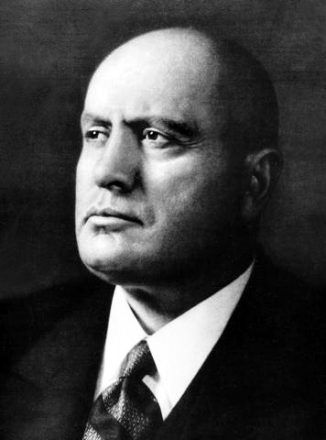
In 1920, in the earliest days of his far-right movement in Italy, Benito Mussolini declared: “Our doctrine is the deed”.
In October 1922 Mussolini, coming by train from Milan to accept the king’s invitation to be prime minister, reprised his 1920 thought: “Action has buried philosophy”. His followers’ “March on Rome” was not very big and did not set off until the king had rejected Liberal prime minister Luigi Facta’s call to disperse it and Facta had resigned. But a show of “action” was enough.
Leon Trotsky summed it up later: “Essentially, Mussolini never advanced any sort of ideology”. Within a few years from 1920 Mussolini was anti-clerical and maker of a deal with the Vatican; anti-monarchist and pro-monarchist; demagogically socialistic and free-marketer; a critic of the Nationalists for refusing League-of-Nations compromises and being “imperialist”, and an ultra-nationalist; an advocate of a “Labour Party” and a union-crusher.
Many are now puzzling: which of the promises made by Donald Trump, or by the far-rightist Javier Milei, who won Argentina’s presidency in November 2023 despite having little prior political base and being known as “the crazy one”, let them win? What rival promises could defeat them? The history with Mussolini shows those are the wrong questions.
Angelo Tasca, who among the leaders then of the Italian Communist Party had the clearest take on Mussolini in the decisive years, wrote about it later. By then he had become a reformist, but the book is still valuable.
The whole political operation depended on a “climate” generated by a widespread feeling that society is in a dead-end, “a sort of particular atmosphere of agitation and delirium... In this atmosphere, reactions have disproportionate amplitude, the sense of proportion is disrupted, and all points of reference are suppressed. Psychological ‘shock’ becomes a necessity... Delirium becomes the normal state of affairs and acquires a malign autonomy”.
“The true originality of fascism is not so much in its... demagogic programme as in the determining and in some ways autonomous role which tactics play in it at the expense of programme. The fascist mystique of the ‘leader’ leads to the same result”.
Holds
The same holds for far-right demagogue leaders in general, even if we want to define them as not strictly fascist. They prevail not because people know what is to be done and see the leader as a reliable vehicle for it, but because they think the “leader” may somehow push through the murk, secure “retribution” for the years of misdeeds everywhere, and make America (or Italy) “great again”.
“By the imprecision and the incoherence of his formulas, Mussolini gave everyone the hope which smiled best for them: the capitalists saw all the public services given over to private industry, the shopkeepers felt themselves relieved of taxes and liberated from state supervision and harassment, and the ‘idealist’ petty bourgeois... thought they would be something — a bailiff or a minister — in the ‘spiritual domain’... Everyone hoped to use [Mussolini’s ascent]: Giolitti [veteran Liberal leader] to push the socialists into collaboration with him, the conservatives to prevent that, the industrialists and agrarians to liquidate workers’ unionism, the monarchy and the Vatican to consolidate ‘the institutions’.”
The left cannot learn from Trump and Milei “what works” electorally. Tasca, with Stalinism in mind, wrote that socialism “cannot use fascist formulas as fascism uses socialist formulas... To suppress thought and conscience is, for fascism, to create its own atmosphere and choose its own methods: in those condition, it is sure to outstrip and outperform its adversary”.
The way forward for the left is not through finding a catchy slogan, but through uniting a sufficient and coherent nucleus of active people educated and motivated to understand the cavorting of capitalism, and to tell the truth about it, soberly and unsparingly. With that nucleus we can rebuild and reinvigorate the larger labour movement.
Tasca’s summary: “The historic role of the working class is to ‘realise philosophy’” — in opposition to the action that would “bury philosophy”.
Comments?We welcome replies, corrections and debate pieces. Contact us