
Rachel Reeves’s Budget on 30 October may come under most attack from the right, for its tax rises.
In fact, the mooted increases in tax on capital gains, on “non-domiciled” plutocrats, on private schools, and on employers, are too little, rather than too much.
It will be a bosses’ budget. It has been designed to increase public investment, a little, so as to improve conditions for private-profit investment.
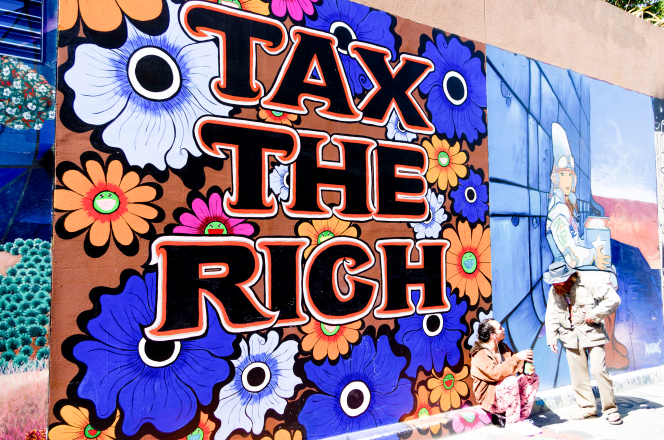
By contrast, a workers’ budget would tax the rich heavily. Total household wealth is £12,000 billion. Profits each year are about £600 billion. The average pay-out to top-100-firms CEO is £4.2 million. Meanwhile, 30% of children (4.3 million) are in official poverty, a 20% rise over the last decade.
A workers’ budget would rebuild public services and restore real wages and benefits.
Tax Justice UK calculates that a wealth tax, increased capital gains tax, and a few other items could raise £50 billion a year. That would be enough to meet the most urgent demands for rebuilding public services. For a real reconstruction we need, for a start, public ownership and democratic control of high finance, to redirect its profits to social purposes.
Reeves does not even aspire to rebuild public services fully. Despite claiming “no return to austerity”, she promises cuts, in order to reassure the bosses and the rich that she is easing their burden as much as she can.
The Winter Fuel Allowance has already been cut back; Tory plans for revised “Work Capability Assessments” for claimants will be activated, bringing cuts in benefits; the government subsidy limiting bus fares to £2 will be cut to make the ceiling £3; and Reeves demands a 2% cut in civil service “back office” costs.
Money is promised for the NHS, but not near enough. Councils and universities will continue down their paths of cuts caused by reduced government funding.
Reeves’s easing of the “fiscal rules” (targets for government deficits and debts) may get through with little fuss. It should.
“Fiscal rules” are only a puffed-up way of a government promising prudence to avoid a “run on the pound” via the overseas financiers who own about a third of UK government IOUs dumping them. Formal “fiscal rules” started with New Labour in 1997; there have been nine different sets, rarely kept to; the current Tory rules are seen even by conservative economists as nonsense.
Only, no easing of the rules can square the circle and win the resources needed to rebuild public services and real wages without taking from the millionaires.
The continued freezing of income-tax thresholds is a sneaky tax rise. It takes more from the better-off — someone on the basic rate will pay 1% more in tax from a 5% money-wage rise which only keeps up with inflation, while on the higher rate it’s 2% more in tax.
But, with inflation, some “ordinary” workers are now on the “higher rate”, starting at £37,701. Better to increase the “additional” rate (from £125,140) from 45% to the 50% it was before 2013, or to previous top rates (60% 1979-88, or 83% 1974-9).
And to increase corporation tax (it was 52% in 1981; it was brought down to 19% by 2017, then the Tories raised it back to 25%).
Since 2012, Keir Starmer has insisted that he is “pro-business”, but also concerned for “working people”.
He has had trouble with the media asking him who exactly he means by “working people”. The answer would be plain if he dared to use the word “class”: the working class is all of us (including children, pensioners, etc.) who depend on the sale of labour-power and the “social wage” to sustain us.
We are working class even if we have a few shares or savings. The capitalist class, the class which gets its income from owning and controlling the productive assets, and thus by drawing surplus-value from the workers who operate those assets, is capitalist even if its members take what are called “salaries” from their posts as managers and directors.
Starmer’s policy is a plea to the working class to hold back and help the bosses make good profits, plus a promise that Labour will nudge those prosperous bosses into social concessions.
The working class can make a new world of liberty, equality, prosperity, and environmental sustainability only by fighting our class struggle against the bosses.
Comments?We welcome replies, corrections and debate pieces. Contact us