
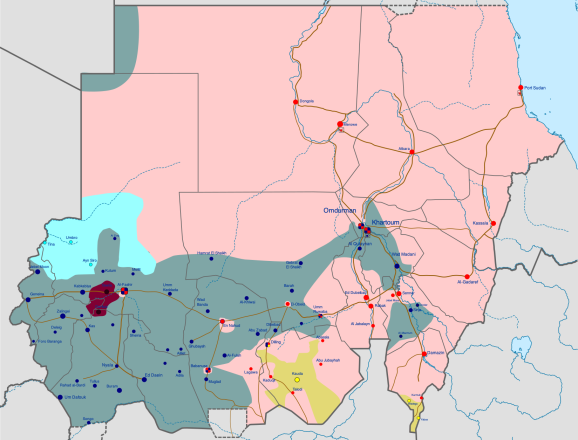
Map (pink = SAF-held, blue = RSF-held, as of 19/8/24) by Elijah Pepe, from Wikimedia
In mid-October the UN renewed its warning that Sudan faces severe famine, stating that 97% of internal refugees (an estimated 13 million) are in danger of starving. Much of the rest of the population is facing increasing levels of food insecurity.1 The UN accuses both sides in Sudan’s civil war, the Sundanese Armed Forces (SAF) and the Rapid Support Force (RSF), of using starvation and blocking aid deliveries as a deliberate tactic.2 The RSF, in particular, has burned crops, destroyed machinery and looted warehouses in the areas where it has seized control.3
A May 2024 report from the Netherlands-based Clingendael Institute projected the immediate prospect of two million deaths by starvation and, if war continues, up to 10 million deaths in the next three years.4 It is likely that international pressure will force opening some aid routes into Sudan (one important crossing into Darfur from Chad reopened in August).5 However, so long as the conflict continues such aid is likely only to mitigate the suffering.
The worst starvation has been concentrated in the regions of Darfur (in Sudan’s west) and Kordofan (to the east of Darfur) where in August the aid charity MSF found in that a third of all children under two were suffering from acute malnutrition. But the situation is poor elsewhere. Cholera has set in following months of heavy rainfall around the capital, Khartoum, where there has been heavy fighting since the start of the civil war in April 2023.6
The RSF continues to make gains in the southeast of the country, along the Nile to the South of the capital, Khartoum, which is now largely controlled by the RSF. The main focus of fighting at the moment is focused on Darfur, an area where the Janjaweed (out of which the RSF was formed) had previously been responsible for a genocide against black African ethnic groups. That genocide is now under way again.
This fighting in the region is centred on the city of el Fasher which had already become a haven for refugees from RSF scorched earth tactics, ethnic cleansing and rape in the surrounding countryside. Many of the refugees are now in camps near the city, the largest being Zamzam, sheltering nearly 500,000. Analysis of satellite imagery in the areas by the Humanitarian Research Lab at Yale show an increase in the number of mass graves in the area as the civilian casualties of fighting in the city increase along with the victims of famine. 7
The likelihood is that as the RSF consolidate their control of el Fasher, the fighting will move to the refugee camps. On 10 October MSF suspended most of its child malnutrition programme in the Zamzam camp due to both sides in the conflict blockading the camp.8
The driver of the war is the conflict between the SAF and RSF for control over Sudan’s resources. But this is enabled by regional powers backing the two sides. There is evidence that the RSF is supplied by the UAE and the SAF by Iran.
The Economist has reported that the UAE’s support for the RSF has developed over the last decade as they have funded the militia to fight for their interests in both Libya (in support of Khalifa Haftar) and in Yemen (against the Houthis). This has led to an interlocking of the business interests of the RSF with the UAE. The RDF’s growth has been funded in part by gold smuggled from RSF controlled areas to the UAE, which may be worth as much as $2 billion a year. The Wagner Group, now more under the control of the Russian state as the Africa Corps, previously had a role in this But the Russian state appears to be disengaging from the conflict. It is possible that Russia would like to have a Red Sea base in Sudan and will co-operate with whichever side prevails.9
There is persuasive evidence that the UAE has created an airbridge to Amdjarass in Chad, which borders Darfur, to supply the RSF. According to the Sudan Conflict Observatory (a platform created by the US State Department) this was built up from May to October 2023. It would explain the supply of armaments to the RSF including munitions, drones and armoured personnel carriers made in, or traceable to, the UAE. Amnesty International and Human Rights Watch have both independently verified these weapons to be in RSF hands.10
The SAF is developing its own supply lines too. It still bears the imprint of the former dictator of Sudan, Omar al-Bashir, who had his roots in the Islamist Muslim Brotherhood. Unsurprisingly, Turkey has been a major supplier of arms. But additionally, since December 2023, several cargo planes have flown from Iranian military bases to the SAF controlled Port Sudan; at the same time Iranian made munitions and, especially, military drones have been used by the SAF.11
There is now a danger that the two sides in the civil war will become entrenched in a conflict well-supplied with arms by two powers, the UAE and Iran, with competing interests in regional dominance. The main victims will continue to be the people of Sudan. §
1 Office of UN High Commissioner on Human Rights, “Sudan faces one of the worst famines in decades, warn UN experts, 17 October 2024, https://www.ohchr.org/en/press-releases/2024/10/sudan-faces-one-worst-famines-decades-warn-un-experts [All weblinks accessed 27 October 2024]
2 UN Office of the High Commissioner on Human Rights, “Using starvation as a weapon of war in Sudan must stop: UN experts”, 26 June 2024. https://www.ohchr.org/en/press-releases/2024/06/using-starvation-weapon-war-sudan-must-stop-un-experts
3 Human Rights Watch, “The Massalit Will Not Come Home: Ethnic Cleansing and Crimes Against Humanity in El Geneina, West Darfur, Sudan” 9th May 2024. https://www.hrw.org/report/2024/05/09/massalit-will-not-come-home/ethnic-cleansing-and-crimes-against-humanity-el
4 “Anarchy in Sudan has spawned the world’s worst famine in 40 years”, the Economist, 29/8/24. Original report Timmo Gaasbeek, “From Hunger to Death”. May 2024, https://www.clingendael.org/sites/default/files/CA_From_hunger_to_death_.pdf
5 Word Food Programme, “First WFP trucks cross Sudan's reopened Adre border with food for communities at risk of famine” 21/10/2024. https://www.wfp.org/news/first-wfp-trucks-cross-sudans-reopened-adre-border-food-communities-risk-famine
6 Colin Poitras , “Humanitarian Research Lab Responds as Violence Escalates in Sudan” October 22, 2024. https://medicine.yale.edu/lab/khoshnood/news-article/yales-humanitarian-research-lab-responds-as-violence-escalates-in-sudan/
7 Ibid.
8 MSF, “Supply blockade forces MSF to stop care for 5,000 malnourished children in Sudan” 10th October 2024,
https://www.msf.org/supply-blockade-forces-msf-stop-care-5000-malnourished-children-sudan ; Vibhu Mishra/UN News, “Sudan: UN urges immediate action to stop fighting in El Fasher”, 18th September 2024. Sudan: UN urges immediate action to stop fighting in El Fasher | UN News
9 “The ripple effects of Sudan’s war are being felt across three continents”, The Economist 29th August 2024.
Source Material, “UAE ‘used Russian mercenary group to arm Sudan rebels” 14th September 2024
https://www.source-material.org/uae-russia-wager-mercenaries-arming-sudan-rebels/
10 Conflict Observatory, “Foreign Facilitators of Weapons Fueling Sudan's Civil War: Trend Report” October 2024. https://hub.conflictobservatory.org/portal/sharing/rest/content/items/2b3ae01b0e2343da8c191bdacabcd153/data
Amnesty International, “Sudan: Constant flow of arms fuelling relentless civilian suffering in conflict – new investigation” 25 th July 2025, and report “new weapons fuelling the sudan conflict expanding existing arms embargo across Sudan to protect civilians” at https://www.amnesty.org/en/latest/news/2024/07/sudan-constant-flow-of-arms-fuelling-relentless-civilian-suffering-in-conflict-new-investigation/
Human Rights Watch, “Fanning the Flames: Sudanese Warring Parties’ Access To New Foreign-Made Weapons and Equipment” September 2024 https://www.hrw.org/sites/default/files/media_2024/09/sudan_weapons_0924_briefing-FINAL-web.pdf ;
11 Sources as previous footnote.
Comments?We welcome replies, corrections and debate pieces. Contact us