
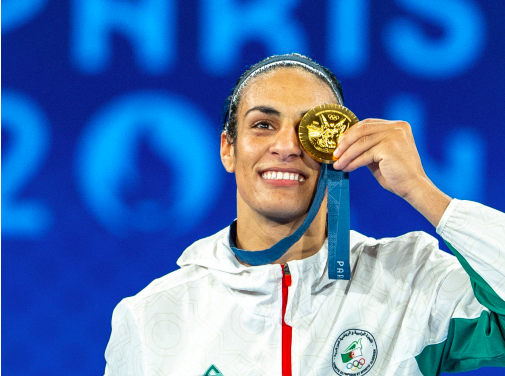
At the recently concluded Paris Olympic Games, Algeria’s Imane Khelif won the gold medal in the women’s welterweight boxing. Her path to the gold medal, however, was clouded in controversy. Notable figures J.K. Rowling and Elon Musk took to the social media to claim that Khelif was male, and that her victory was an embodiment of male violence against women.
This criticism is not new to Khelif. Both she and Taiwanese boxer Lin Yu-Ting – winner of the women’s featherweight gold in Paris – have been disqualified from boxing competitions organised by the International Boxing Association (IBA) following failed gender eligibility tests. Both Khelif and Yu-Ting are cisgender female athletes. Why, then, are they being accused of being transgender?
THE ROLE OF THE IBA
The IBA is itself a controversial organisation. 2020 saw Russia’s Umar Kremlev elected as the IBA’s president. Since his election, he has moved much of the organisation’s operation from Switzerland to Russia, opposed the independent appointment of judges and referees at events, and made the Russian state-owned energy company Gazprom the IBA’s sole sponsor. Gazprom sponsorship is especially controversial given its role in setting the stage for the invasion of Ukraine. Gazprom has also paid for a number of salaried militias in the war.
It was following Khelif’s victory over Azaliia Amineva, and prior to her gold medal match, that she was gender-tested and subsequently disqualified. The same event saw Yu-Ting stripped of her bronze medal. Both were reportedly banned for having elevated levels of testosterone, and in Khelif’s case, for reportedly having XY chromosomes, following a DNA test.
The methodology for these tests has not been made public, and there exists no published medical evidence to verify either of the IBA’s claims.
RACE AND TRANSPHOBIA
This is not the first instance of Olympic controversy in which the transgender status of a female athlete has been called into question. Caster Semenya, the South African middle-distance runner, faced a great deal of vitriol following her gold medal wins at the 2012 and 2016 Olympics. This led to a rule-change requiring female athletes with raised testosterone levels to take medication to lower their naturally-occurring hormone levels.
Khelif, Yu-Ting and Semenya are all women of colour. If we compare the public reaction towards these three women to the reaction towards American Rugby 7s Olympian Ilona Maher – a woman who is more muscular, and just as physically imposing as all three aforementioned athletes – the difference is striking. Rather than controversy over whether or not she is a woman, she has garnered a large following on social media and has appeared on the cover of Sports Illustrated in a swimsuit. The policing of women’s bodies is distinctly racialised.
This is all taking place in the context of the global 'culture war' against trans people. The International Olympic Committee’s (IOC) official response was to distance Khelif and Yu-Ting from transgender athletes. The implication is that this controversy would be justified if one or both of the athletes did happen to be transgender, despite trans women being eligible for many Olympic sports, and very rarely making the grade to compete. The IOC’s own scientific reports have shown that trans women are at a significant physical disadvantage compared to cisgender women across several areas.
A CEILING ON WOMEN’S SPORT
When it comes to male athleticism, much is made of the performance of once-in-a-generation athletes: the likes of Michael Phelps or Usain Bolt, both of whom have significant naturally occurring genetic advantages that allowed them to compete head-and-shoulders above their contemporaries. Those athletes are celebrated for pushing the boundaries of human performance beyond what was thought possible. Compare this to the treatment of exceptional female athletes, particularly black female athletes. The dominance of Serena Williams in tennis was met with racist abuse and ridicule.
Women who are deemed to be performing too well are not encouraged or commended in the way their male counterparts are. They have their gender called into question, and the (often white) athletes they bested are portrayed as having been cheated.
Humans do not fit neatly into two gendered categories. But in so far as these categories do exist, women competing should be granted the same level of respect for their biological quirks that Bolt, Phelp and other male athletes have been.
A RATIONAL RESPONSE
Ultimately, our response should be one that treats athletes with dignity, humanity and respect. This is certainly true at the highest level of sport, but it is even more important at the grassroots. Attitudes at the elite level filter down and women who do not meet conventional standards of femininity will be put off from participating in sports. Sport is for everyone, but in the current 'culture war' against trans people, women, cis and trans, do not come out as winners.
Comments?We welcome replies, corrections and debate pieces. Contact us