
Lizzy Brooks reviews Mary Manning and Sinead O’Brien, Striking Back: The Untold Story of an Anti-Apartheid Striker (Gill, 2017).
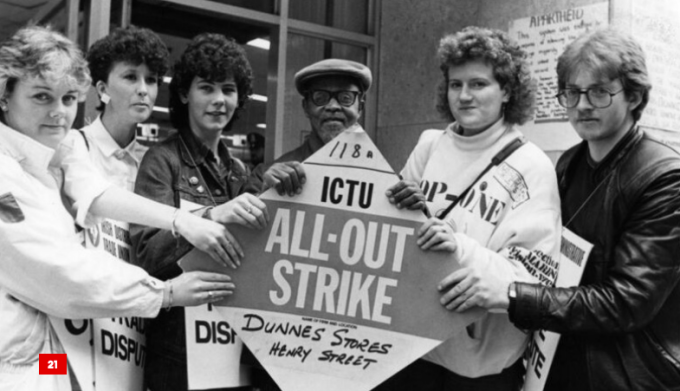
On 19 July 1984, Mary Manning, a 21-year-old member of the Irish Distributive Administrative Trade Union (IDATU), took her place at the till of the Henry Street branch of Dunnes Stores as usual.
A black working-class movement against apartheid was in full swing in South Africa and the IDATU general secretary, John Mitchell, had issued a directive to all union members to not handle the sale of South African goods in their place of work.
Manning was tested first: “I spotted a middle-aged woman in the distance with two large yellow grapefruits in her basket. My heartbeat increased at the sight of them.” When the woman approached her till, Manning nervously told her that, under instruction from her union, she was unable to register the sale.
Manning was suspended. As she was marched out of the manager’s office, the shop was at a standstill. Karen Gearon, the IDATU union rep, took control. Her “booming voice sliced through the stony silence, instructing everyone to cease what they were doing… And that was it – the tills were abandoned, the aisles deserted and half-emptied boxes were left discarded on the shop floor. With that, we all marched out in unison.”
EARLY DAYS
When the heat and passion of the walkout began to subside, and the reality of an indefinite strike began to sink in, some of the Henry Street workers began to drift back inside the store. In the end, ten stayed out on strike: Karen Gearon, Liz Deasy, Michelle Gavin, Vonnie Munroe, Alma Russell, Tommy Davis, Sandra Griffin, Theresa Mooney, Cathryn O'Reilly – and Mary Manning.
By their own admission, these ten workers weren’t moved to action by a deep opposition to apartheid: “if anybody had asked me or any of the other strikers how to spell the word ‘apartheid’ let alone explain its meaning, we wouldn't have known where to begin.” Instead, it had been loyalty to their union that had driven Manning and her colleagues to act, as well as a long-standing frustration with store management. Workers were only allowed three-minute toilet breaks per shift, despite the toilet being three floors up from where they worked. Management took excessive disciplinary action over petty issues like till receipts, and would search workers’ bags as they exited the store, making a point of embarrassing them if pads or tampons were found. Working hours were long, pay was poor, and sexual harassment was the norm. IDATU had been seeking a meeting with the management of the Henry Street branch for weeks.
The strikers set up their picket line, under the instruction of IDATU official Brendan Archbold. At first, Manning was uncomfortable with the expectation that they would call their colleagues breaking the strike ‘scabs’: “Many of those who had gone back into work were my friends and, in reality, I had no beef with any of them. They were in the same boat as all of us outside with regard to bad pay and ill-treatment.” Later that day, however, those ‘friends’ began to throw food down onto the heads of the pickets, calling them “n***** lovers” as they did so. “Any guilt I had been harbouring about calling my colleagues names instantly evaporated... One thing was for certain, a line in the sand had been drawn between us and them”.
NIMROD SEJAKE
A figure of huge importance in the strike was South African Nimrod Sejake. Sacked from his teaching post in 1953 for refusing to teach under the Bantu Education Act, which racially segregated South African schools. Sejake became a full-time campaigner against the apartheid regime. He founded the South African Congress of Trade Unions in 1955, and quickly became a prominent labour organiser and ANC leader in Soweto, a township outside Johannesburg where he lived. Arrested in 1956 and accused of treason, alongside 155 other members of the ANC, Sejake shared a prison cell with Nelson Mandela. Soon after he was forced into exile. By the time he arrived on the Dunnes Store picket line, he had not seen his native country for more than twenty years.
Sejake became a friend and tutor to the strikers. He visited the picket line every day, patiently describing the injustices of apartheid South Africa. The mood on the picket line was transformed. Manning recalled: “We no longer waited like lost souls for the latest update from our union... We had learnt too much from Nimrod about the atrocities in South Africa and there was no turning back. From this point on we were no longer following a union instruction; we were following our hearts.”
Support from elsewhere was less steadfast. The Irish Anti-Apartheid Movement (IAAM) had been founded in 1962 by Kader Asmal. By 1984 it had grown in size and influence and counted amongst its members John Mitchell, the general secretary of IDATU, and Ruairi Quinn, Minister for Labour in Ireland’s Fine Gael-Labour coalition government. Quinn argued he could not get involved in the dispute because it was an industrial, rather than political, matter. Despite John Mitchell’s efforts, the IDATU executive refused to give their support to an all-out strike and offered the ten a measly £21 strike pay per week. Then, in October 1984, even Kader Asmal withdrew the support of the IAAM, stating that the strike had gone on long enough.
Asmal’s betrayal was a particularly painful blow, and Manning turned to Nimrod Sejake for answers. “Kader Asmal wants action, just not your type of action”, he told her. “Ultimately, what really separated us, the Dunnes Stores strikers, from Kader Asmal was how we viewed the change process. Kader was an influential, well-respected and educated man who firmly held the belief that change could only come from the top down.”
THE CHURCH
The strikers were fighting an uphill battle against the Irish establishment: Manning described Ireland as “a country run by men – priests, politicians and businessmen – who wined and dined each other and carried out the real deals, not in the pulpit or the office, but at the bar or on the golf course.” Unsurprisingly, the Catholic church threw its weight behind the Dunnes Stores managers. Priests called on their congregations to cross the picket line from the pulpit. The Dunnes were a good Catholic family, they said.
In September, a group of nuns turned up at the picket line, determined to cross it. It was Manning’s colleague, single mother Cathryn O’Reilly, who faced them down. The Catholic church had an iron-like grip on Irish society, and was especially unforgiving when it came to unmarried women and their children. “That morning when I saw her take on the heartless, petty messengers of the Church… I realised that, in many ways, she was braver than the rest of us. With a responsibility to her young son, then barely three years old, she had more on her plate and much more at stake than any of us. She never reneged on her picket line duties and on days when she had no one to mind her son, she simply brought him with her.”
The influence of the church shaped the politics of the country, top to bottom. The government maintained that it could not intervene in the strike. Opposing apartheid was a matter of conscience, it said, and if a conscience law were to be passed, that would unravel a host of other issues, abortion among them.
GROWING SUPPORT
Dunnes Stores management were going to great lengths to ensure South African goods remained on the shelves. They began to take deliveries in the middle of the night, hiding them in rubbish trucks. The strikers started round-the-clock picket lines, but alone and in the dark, the strikers were more vulnerable to violence from the Gardaí, the Irish police. On one occasion, they turned up – three officers to each striker – rushed and separated the pickets and beat them, leaving them battered and bruised. On another, Tommy Davis, the only man on strike, was arrested, beaten and charged with breach of the peace.
Support for the strikers steadily grew as a result of local press and consistent, patient work by the pickets talking to Dublin locals. By winter, it was common to see more than 300 supporters on the picket line on Saturdays. But the major breakthrough came when Archbishop Desmond Tutu invited the strikers to meet him in London, on his way to receive his Nobel Peace Prize in December 1984. The first Saturday after their meeting, supporters turned out to their picket line in droves: “By late afternoon it was impossible to tell how many were there because the crowds stretched far beyond where the eye could see. We were no longer counting hundreds of supporters – it was now thousands.”
And so the tide turned, and it became clear what a small action by ten workers could actually achieve. “The pavement outside Dunnes Stores on Henry Street was now the place where anybody in Ireland opposed to apartheid came to let their feelings be known... Only months beforehand we were lucky to get through a day without at least one of us being referred to as ‘n***** lover’. Now people young and old were arriving daily, some holding photos of a youthful and charismatic Nelson Mandela, and others holding pictures of the brutally slain activist Steve Biko.” Even the nuns changed their minds. Only a few short months after their confrontation with Cathryn O’Reilly, they were back at the picket line, this time declaring to anybody who would listen that the strike should be commended.
In July 1985, to coincide with the one-year anniversary of the start of the strike, Tutu invited the strikers to South Africa to see apartheid first-hand. The strikers took to the streets of Dublin to raise money to pay their way. One night of shaking buckets around pubs and street corners raised more than £7,500.
When they touched down in South Africa, however, they were immediately arrested. Tutu called a press conference: “Negotiations for our release were not going to be carried out behind closed doors.” After twelve hours, the strikers’ passports were stamped, disallowing them from returning, and marched to a plane to get the next flight back to Ireland. “We never got to see our comrade and hero Desmond Tutu, or to visit the townships and meet with people we were out on strike for. Yet, even in our traumatised states, we knew that [this] was probably going to be the defining moment of the Dunnes Stores strike.”
The plane home was heaving with reporters, and as the strikers passed through security gates in Dublin, they were greeted by an even bigger mob. Brendan Archbold announced the strikers to the crowd as “the ten deadliest shop workers in the world.”
VICTORY
In February 1986, a total ban on importation and sale of South African goods was announced. It was due to come into effect in January 1987, with a three-month phase out period, meaning that by April 1987 not a single South African product would be available to be sold in Ireland. Manning described the moment: “I jumped off the No. 78 bus, ran over the Ha’penny Bridge and all the way up Henry Street. The news had spread so fast that throngs of delighted supporters were arriving into Henry Street by the busload. We were all there, back at the picket line, but this time in victory.”
Dunnes Stores management were determined to fight until the bitter end. While nearly every other business in Ireland stopped stocking South African goods immediately, Dunnes Stores would continue until April. The ten strikers were resolute: “There was no discussion amongst us required – under the circumstances presented to us we wouldn't be going back to work. We would remain on strike until every last item was off the shelves.”
And they did. The Dunnes Stores strikers only returned to work in April 1987, one year and nine months after they had first walked out.
THE END OF APARTHEID
It was the black working-class in South Africa that brought down apartheid. In 1973, a strike wave broke out in the eastern city of Durban. Almost 100,000 workers would take part. The key issue was wages, so low that striking workers were demanding that they be doubled or trebled. Black trade unions and strikes were illegal, so every dispute became a violent showdown with the regime. In 1976 the school students of Soweto called a demonstration against their schools’ adoption of Afrikaans, the language of white South Africans. Hundreds of students were murdered by police, sparking an uprising that spread across the country. General strikes were called in major cities. A Cape Town strike leaflet read: “The racists do not spare the bullets. Their guns try to cut down our march for freedom. But the march to freedom must not end. Reject all concessions that the racists grant us. Concessions are crumbs. We want freedom not crumbs... Strike!”
In the 1980s, workers’ militancy grew and made organisational gains. The Congress of South Africa Trade Unions (COSATU) was founded in 1985, and allied to the ANC. The white ruling class had a choice to make: transition to majority rule or face revolution from below. Negotiations between Nelson Mandela and President F. W. de Klerk began in 1989, over the course of which ANC leaders would trade away significant swathes of the ANC programme, including workers’ rights, wage increases, and wealth redistribution. By 1990, with the help of ANC and COSATU leaders, the strike wave collapsed, and in 1994, South Africa held its first democratic elections. The ANC swept to victory and apartheid laws were scrapped, but little was done to improve the economic situation of the black workers who had made it possible.
In 2013 Mandela died. A strike supporter, who had attended the picket line as a teen, called into the popular radio show Liveline and called on government ministers to give up their seats to allow the Dunnes strikers to represent the people of Ireland at Nelson Mandela’s funeral. It picked up a huge amount of attention, and within a few hours the government had indeed offered the strikers a ticket – but only one. IDATU (by then Mandate) paid for the rest, and on 10 December, the Dunnes Stores strikers flew to South Africa for the second time. Manning recalled: “Adrenaline now pumped through my body in a way that I had not felt since I stood on that picket line as a 21-year-old girl... Here I stood as a woman, in a stadium full of the people I had once stood in solidarity with from thousands of miles away, holding my head proudly once more.”
The final words of Striking Back are devoted to an assessment of post-apartheid South Africa: “Apartheid may have been brought to its knees but the people who helped to bring this about, the ANC, who were now in power and running South Africa, had failed to spread the wealth among all those normal citizens who had rallied alongside them... Nimrod’s words came back to me, and I could hear his voice in my head: ‘It is not just a race issue, it’s also a class issue.’”
Comments?We welcome replies, corrections and debate pieces. Contact us