
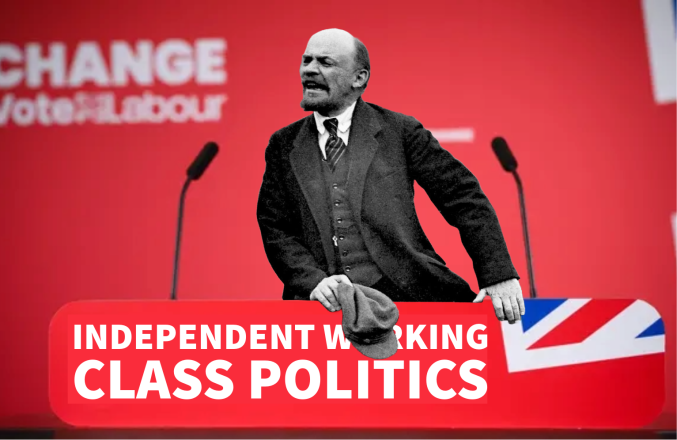
I agree with Jim Denham’s dissection of the CPB’s “total incoherence right up to the vote itself” in the General Election — “incoherence with a dash of Lenin”. Jim rightly pointed out the CPB’s support for a range of candidates whom working-class socialists did not support for various reasons.
However, in his criticism of the approach of the CPB and Andrew Murray to the Labour leadership, Labour MPs and the Gaza votes, I thought Jim left out a critical part of Lenin’s approach to the 1918 newly established Labour Party organisation. Jim wrote: “Murray, who considers himself a leading Leninist with the CPB, seems to have forgotten that just a couple of years after Labour Party leaders had supported the mass slaughter of the First World War, Lenin had advocated not just a Labour vote but Communist affiliation to the Labour Party.”
Lenin, of course, was well aware of the history of the Labour leadership and their support of British imperialism in World War One. He correctly described the then Labour Party as a “bourgeois workers’ party” and, as the 1920s revolutionary CP described it: “…even before the war, the Labour Party had become quite distinctly a class organisation of the proletariat which was dominated by that section of the middle class whose profession it was to organise trade unions”.
At the time Lenin favoured a sharp turn against the sectarianism that had developed in the many newly established communist parties following the October 1917 revolution. In 1920, after much discussion and Lenin’s urging, the Second Congress of the Communist International (1920) came out for CP affiliation to the Labour Party, and it is worth repeating from the relevant resolution.
“The Second Congress of the Third International should express itself in favour of Communist groups, or groups and organisations sympathising with Communism in England, affiliating to the Labour Party… For as long as this party permits the organisations affiliated to it to enjoy their present freedom of criticism and freedom of propaganda, agitational and organisational activity for the dictatorship of the proletariat and the Soviet form of government, as long as the Party preserves its character as a federation of all the trade union organisations of the working class, the Communists should without fail take all measures and agree to certain compromises in order to have the opportunity of influencing the broadest masses of workers, of exposing the opportunist leaders from a platform that is higher and more visible to the masses and of accelerating the transition of political power from the direct representatives of the bourgeoisie to the ‘labour lieutenants of the capitalist class’ [the Labour Party] in order that the masses may be more quickly weaned from their last illusions on this score…”
Although a major part of the new CP (the British Socialist Party) was already affiliated to the Labour Party, the whole CP’s approach for affiliation was rejected by the Labour leadership — such rejection assisted by the sectarian way in which it was couched.
In fact, Labour then was no closed-off, tightly controlled Party. Between 1922-24, there was even a Communist Labour MP for Battersea North, Saklatvala, who was sponsored by the united Battersea labour movement. The question of CP affiliation remained open for years. Until the Labour Party conference of 1925, Communists could be trade union delegates to Labour constituency committees and to Labour Party conference. After 1925, three dozen Constituency Labour Parties let themselves be disaffiliated rather than expel Communists, and formed an organisation of disaffiliated Labour Parties, the National Left Wing Movement, which also embraced left-wing groups in other constituencies. This paralleled the substantial rank-and-file “Minority Movement” that the CP had built in the unions after 1922.
It was the rise of Stalinism in the Soviet Union, and its direct effect on the CP, that had as much to do with the defeat of revolutionary perspectives in the developing British labour movement as the work of the reformist leaders. Firstly the defeat of the 1926 General Strike, and the role of the CP which was summed up with their slogan “All Power to the TUC General Council” when that same body was selling out the strikers. This was followed by the ultra-left Stalinist sectarian turn (“Third Period”) hoisted onto the Communist Party, resulting in the closing down of the National Left Wing Movement and “Minority Movement” amongst other things.
But this reformist labour movement, including the LP, still retained structures within which revolutionaries could operate, even if without the freedoms described by the Communist International in 1920. This remained true but radically changed sixty-plus years later, following the defeat of the miners in 1984-85 and other Thatcher victories, the growing consolidation of the right-wing in the labour movement and finishing with the victory of the Blairites in the 1990s and afterwards. “Old Labour” was transformed into “New Labour” by the Blairites in their counter-revolution — both politically and organisationally — and that is still the legacy today under the present Starmerite-Blairite leadership, and supported by them.
The Blairite counter-revolution meant that the special features which persuaded Lenin to argue in 1920 that British communists should seek to affiliate to the Labour Party — the open, federal structure; the channels that allowed trade-union rank-and-file sentiment to flow into the party relatively easily, at a series of levels — have all been abolished.
However, the Blairite counter-revolution was not complete, and did not carry over into the abolition of the trade union link. This link still exists, if significantly curtailed and now more closely resembling the relationship between donkey and cart. The big unions still have a great potential weight even in Labour’s changed structures should they choose to use it. That possibility exists because trade-union money remains an important part of the Labour Party’s financial support, and the docility of the trade union leadership allowed the Blairites to retain that without the fear of a political cost.
If the conditions under which Lenin argued in 1920 have substantially changed for working class socialists now, the basic rationale for his approach has not — sharply opposing sectarianism; proposals and perspectives for working-class socialists to fight for the transformation of the working class movement as it exists and within that movement.
Solidarity was right to call for a Labour vote everywhere in this year’s election; Labour, still a bourgeois-workers party (even with the axis heavily shifted towards the bourgeois end), was the only governmental alternative to kicking out the hated Tories. The Starmer-Blairite leadership are intent on functioning as a junior Tory government in practice, but whether they get away with it will depend on working-class and trade-union reaction, and helping to generate and focus that must be our priority, and providing perspectives for creating or building a real Labour Party — a trade-union based party, with independent working class politics, that can fight for a workers’ government and act as one.
As part of shaking things up, transforming the movement, that will likely include working class socialists helping to organise independent working-class electoral challenges to “New Labour”, if the Party remains dominated politically and organisationally by the anti-working-class Blairite Starmerites. However, both in approach and practice, such moves will be very different to the present CPB’s incoherent, sectarian approach, taken apart in Jim’s article.
Comments?We welcome replies, corrections and debate pieces. Contact us