
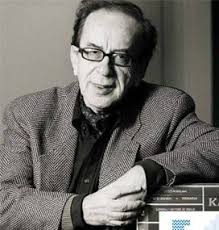
In the dark days of the ultra-Stalinist regime of Enver Hoxha only a few voices penetrated through the barbed wire and closed off borders of Albania, a society run like a cross between a prison camp and an army barracks (its nearest parallel today would be North Korea). Ismail Kadare, that small country’s most famous writer, was one of the very few who was able to express himself even though this meant a constant tussle with the authorities and a period of exile in Paris. Born in Gjirokaster, a small town near the Greek border (ironically also the birthplace of Hoxha), Kadare studied at Tirana University and then in Moscow at the Gorky Institute. In later years this would not have been possible as Hoxha’s increasingly paranoid regime broke its ties with Moscow in 1961 and entered into a period of extreme isolation, its only international ‘friend’ being Mao Zedong’s China. However, this connection didn’t last and in 1978, after several years of tension, Hoxha finally severed relations with the Chinese People’s Republic, thus making Albania one of the most isolated countries in the world.
Initially a poet, Kadare wrote his first novel, ‘The General’ in 1963 which was frowned on by the authorities who still favoured socialist realism. For something like 40 years Kadare fought his corner but as far as I know his work was never banned in Albania, except for a short novel, ‘The Monster’ in 1965. Life was not easy for him but his growing reputation abroad granted him a degree of immunity. In 1990 he left Albania and made his home in Paris. Hoxha had died in 1985 and the regime that followed struggled to maintain his extreme hard-line regime and then collapsed. In what became almost an international ritual, his statue in Tirana was toppled; Hoxha and his legacy were history. Kadare spent his remaining years moving back and forth between Paris and Albania.
His literary output was prolific and earned him much international recognition and various awards including the Man Booker Prize (now the International Booker Prize) in 2005. For me, two of his best novels – which I highly recommend – are ‘Broken April’ (1978) and ‘The Palace of Dreams’ (1981). The former tells the story of Gjorg Berisha who is caught up in a vendetta after he kills his brother’s murderer. The man he has killed belongs to a rival clan and now Berisha must die in a grizzly cycle of revenge dictated by the ancient code of Lekë Dukagjini which can go on for years, often until all the males in both families are dead. The latter novel, possibly his best known in the west, is a mix of the Kafkaesque and the Orwellian set in the days when Albania was part of the Ottoman Empire. Mark Alemi, the son of a well-known family of civil servants goes to work at the Tabir Sarai, a huge government department devoted to analysing and cataloguing dreams in order that potential rebels, assassins and oppositionists can he apprehended before they commit any crime against the regime. As all citizens have to submit descriptions of their dreams, the bureaucracy required to deal with this is gigantic and self-perpetuating. Although a bizarre story, the parallels with totalitarian regimes in many parts of the world, not just Albania, are obvious. Kadare was hauled before a writers’ committee and, at one point, was threatened with being ‘thrown into an abyss’. Kadare survived as, again, the regime – by now visibly crumbling – was keen not to attract critical attention from abroad. Robert Elsie, in his book ‘Albanian Literature: A Short History’ concludes his chapter on Kadare with the following,
‘…Kadare was […] the most prominent representative of Albanian literature under the dictatorship of Enver Hoxha and, at the same time, the regime’s most talented adversary. His works were extremely influential and, for many readers, he was the only ray of hope in the chilly, dismal prison that was […] Albania’.
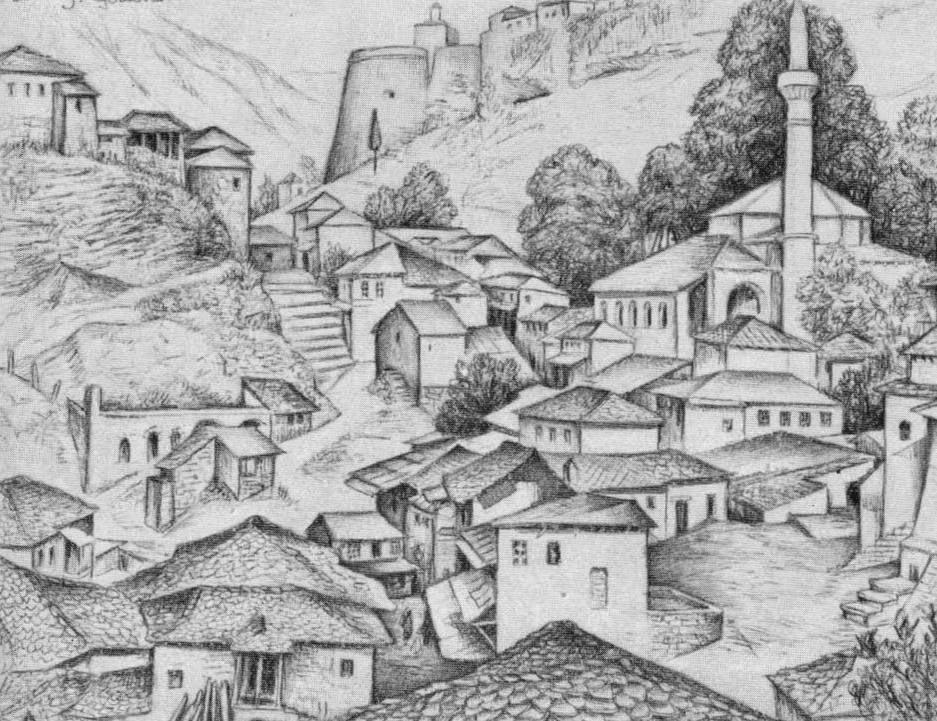
Gjirokastra: Kadare’s place of birth, an illustration by Jan and Cora Gordon, from their book, ‘Two Vagabonds in Albania’ (orig. published in 1927)
Comments?We welcome replies, corrections and debate pieces. Contact us