
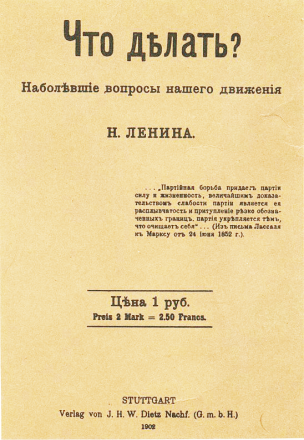
15th in a series of articles around the 100th anniversary of the death of Vladimir Ulyanov (Lenin). Previous articles have traced the pre-Marxist Russian revolutionary movement from the 1860s, and the emergence of a workers’ movement and of many Marxist circles and local groups in the 1890s. This and the next few articles deal with Ulyanov’s arguments on how those circles and groups could be cohered into an effective party.
By Sean Matgamna
Vladimir Ulyanov’s (Lenin’s) What Is To Be Done?, written in late 1901 and early 1902, is one of the most important books ever written. Certainly it is one of the most important socialist texts.
Yet it is often seen, even by people who are not antagonistic to Ulyanov and his work, in the grim retrospective shadow thrown by Stalinism. This, we are told, is the book in which Lenin expounded his notion of a highly centralised party of “professional revolutionaries”, and therefore, whatever Ulyanov’s intentions, it was the seed of what, over the next three decades, developed into the totalitarian dictatorship of the state bureaucracy over the working class and all the peoples of the USSR, that is, Stalinism.
The root of Stalinism lay in Ulyanov-Lenin’s ideas , and the root of Ulyanov’s distinctive approach lay in What Is To Be Done? [1]
The most relentless advocates of this idea were the Stalinist ruling class in the USSR and the Communist Parties all over the world who repeated whatever Moscow said. “Stalin is the Lenin of today”, was one of their key slogans. And Ulyanov-Lenin was the Stalin of yesterday...
Although when published in 1902 What Is To Be Done? was greeted warmly by many in Russia’s Marxist movement, including the future Mensheviks, some later attitudes were prefigured in the year or so of dispute between Bolsheviks (congress majority in the most contentious vote) and Mensheviks (minority) between the July-August 1903 Marxist congress and the outbreak of revolution in Russia in January 1905. Some of Ulyanov’s opponents then — Pavel Axelrod, for instance — said he was the reincarnation of the Russian Blanquist populists.
The lie that Stalinism and Bolshevism were one, or at least, that Bolshevism was the seed and nutriment of Stalinism, has been lovingly sustained and preserved by the bourgeoisie and its academics. Adapted, preserved, and sustained too by quite a few socialists who should know better.
A reading of What Is To Be Done? in its real context demolishes the myths.
At the time, a great network of independent Marxist circles, doing valuable work such as the production of factory bulletins and leaflets, existed all across Russia. Police repression had smashed the Russian Social Democratic Labour Party set up in 1898. The illegal newspaper Iskra (Spark), published abroad from December 1900, was trying to reforge the RSDLP, the newspaper acting as both Marxist propagandist and organisational network.
Ulyanov-Lenin wrote What Is To Be Done? as an exposition of what Iskra (and the journal Zarya (Dawn), of which four issues were published in 1901-2) were doing and wished to do, and what was wrong with those Marxists who opposed them.
Some of those opponents took guidance from the “revisionists” of Marxism in the West, whose initiator, Eduard Bernstein, was a prominent member of the German Social Democratic Party. Ulyanov starts What Is To Be Done? by discussing the demand for the “freedom of criticism” of Marxism within the Russian Social Democratic Labour Party:
“At first sight, nothing would appear to be more strange than the solemn appeals to freedom of criticism made by one of the parties to the dispute. Have voices been raised in the advanced parties against the constitutional law of... European countries which guarantees freedom to science and scientific investigation?”, he asks.
Of course not. But Ulyanov sees in the claim for “freedom of criticism” the demand for “freedom” to revise Marxism from a doctrine of revolution into one of piecemeal reform.
“It is no secret... that two trends have taken form in present-day international Social-Democracy... The essence of the ‘new’ trend, which adopts a ‘critical”’ attitude towards ‘obsolete dogmatic’ Marxism, has been clearly enough presented by Bernstein and demonstrated by Millerand”.
Eduard Bernstein had proposed to change the German party from a movement preparing to overthrow and supplant capitalism into a movement for open-ended reform. Bernstein had defined his attitude in this aphorism about the labour movement in history: “The movement is everything, the goal, nothing”.
Millerand, in France, had become a minister in a bourgeois government, and moreover, in one which also contained General Gallifet, one of those who had butchered 10,000 workers after the suppression of the Paris Commune, in 1871.
Ulyanov charged such people with saying: “Social-Democracy must change from a party of social revolution into a democratic party of social reforms. [Bernstein] denied... the possibility of putting socialism on a scientific basis and of demonstrating its necessity and inevitability from the point of view of the materialist conception of history...
“The very concept, ‘ultimate aim’, was declared to be unsound, and the idea of the dictatorship of the proletariat was completely rejected. Denied was the antithesis in principle between liberalism and socialism.
“Denied was the theory of the class struggle, on the alleged grounds that it could not be applied to a strictly democratic society governed according to the will of the majority, etc.”
Ulyanov explains a mystery — the fact that the criticism of Marxism by Bernstein and his friends, including his Russian friends, had sprung up suddenly so ready-made:
“This criticism of Marxism has long been proclaimed from political platforms, from university chairs, in numerous pamphlets and in a series of learned treatises.... The entire younger generation of the educated classes has been systematically reared for decades on this criticism, [so] it is not surprising that the ‘new critical’ trend in Social-Democracy should spring up, all complete... The content of this new trend did not have to grow and take shape: it was transferred bodily from bourgeois to socialist literature”.
Ulyanov explains the relationship which he sees between the theorising of the German Bernstein and the practice of the French “socialist” minister Millerand:
“The French socialists have begun, not to theorise, but to act. The democratically more highly developed political conditions in France have permitted them to put ‘Bernsteinism into practice’ immediately, with all its consequences. Millerand has furnished an excellent example of practical Bernsteinism... If democracy, in essence, means the abolition of class domination, then why should not a socialist minister charm the whole bourgeois world by orations on class collaboration? Why should he not remain in the cabinet even after the shooting-down of workers by gendarmes has exposed, for the hundredth and thousandth time, the real nature of the democratic collaboration of classes?...
“And what did the French socialists achieve? The reward for... this corruption of the socialist consciousness of the working masses — the only basis that can guarantee our victory — the reward for this is... miserable reforms, so miserable in fact that much more has been obtained from bourgeois governments!”
For Ulyanov the truth of anything is always concrete — it is discernible only in the whole context and framework which defines and qualifies what any part or aspect of a thing means. That people have the right to scientific investigation, goes, he has said, almost without saying. But what does the slogan of “freedom of criticism” mean here and now, at this stage of the development of the Russian movement?
“‘ Freedom of criticism’ means... freedom to convert Social-Democracy into a democratic party of reform, freedom to introduce bourgeois ideas and bourgeois elements into socialism. [2]
“‘ Freedom’ is a grand word, but under the banner of freedom for industry the most predatory wars were waged, under the banner of freedom of labour [non-union], the working people were robbed. The modern use of the term ‘freedom of criticism’ contains the same inherent falsehood. Those who are really convinced that they have made progress in science would not demand freedom for the new views to continue side by side with the old, but the substitution of the new views for the old...”
The Marxist movement is a voluntary association of people who need not a “live and let live” indifference to truth and falsehood, but a rigorous attempt to separate truth from falsehood, and a no less rigorous selection of those admitted to their ranks on the basis of adhering to certain ideas and perspectives. He uses a famous image for what a revolutionary organisation is:
“We are marching in a compact group along a precipitous and difficult path, firmly holding each other by the hand. We are surrounded on all sides by enemies, and we have to advance almost constantly under their fire. We have combined, by a freely adopted decision, for the purpose of fighting the enemy, and not of retreating into the neighbouring marsh, the inhabitants of which, from the very outset, have reproached us with having separated ourselves into an exclusive group and with having chosen the path of struggle instead of the path of conciliation.
“The ‘marsh’ is the realm of eclecticism, theoretical scepticism and recoil from intellectual and political rigour.
“And now some among us begin to cry out: Let us go into the marsh! And when we begin to shame them, they retort: What backward people you are! Are you not ashamed to deny us the liberty to invite you to take a better road! Oh, yes, gentlemen! You are free not only to invite us, but to go yourselves wherever you will, even into the marsh. In fact, we think that the marsh is your proper place, and we are prepared to render you every assistance to get there. Only let go of our hands, don’t clutch at us and don’t besmirch the grand word freedom, for we too are ‘free’ to go where we please, free to fight not only against the marsh, but also against those who are turning towards the marsh!”
The Marxists are concerned to hammer out the political basis for a consistently revolutionary Russian working class movement. He recalls that the German Marxist movement, to which he, like all Russian Marxists and most Marxists everywhere at the time, looks as the great example to follow, has been built by way of a rigorous attitude to principles, politics and theory...
“At the time Engels dealt his blows at [Eugen] Dühring [a university professor who propounded new systems of economics, philosophy, etc], many representatives of German Social-Democracy inclined towards the latter’s views, and accusations of acerbity, intolerance, uncomradely polemics, etc., were hurled at Engels even publicly at a Party Congress. At the Congress of 1877... a resolution [was introduced] to prohibit the publication of Engels’s articles in [the party paper] Vorwärts [Forward] because ‘they do not interest the overwhelming majority of the readers’, and...their publication had caused great damage to the Party, that Dühring too had rendered services to Social-Democracy”.
Lenin now turns to the peculiarities of Russia, where in the mid-1890s the “curious phenomenon” of Legal Marxism had appeared
“In a country ruled by an autocracy, with a completely enslaved press, in a period of desperate political reaction in which even the tiniest outgrowth of political discontent and protest is persecuted, the theory of revolutionary Marxism suddenly forces its way into the censored literature and, though expounded in Aesopian language, is understood by all the ‘interested’.”
The government had regarded only the ideas of the populist terrorists as dangerous and at first welcomed any criticism of them. Then the Government caught on and set its censors on the legal Marxists.
“Meanwhile, Marxist books were published one after another, Marxist journals and newspapers were founded, nearly everyone became a Marxist, Marxists were flattered, Marxists were courted, and the book publishers rejoiced at the extraordinary, ready sale of Marxist literature...It is no secret that the brief period in which Marxism blossomed on the surface of our literature was called forth by an alliance between people of [both] extreme and of very moderate, bourgeois democratic [politics]...”
Then was it not an error for revolutionary and consistent Marxists to ally with people who, thinking they were Marxists, were in fact bourgeois democrats? No, it was not, says Ulyanov.
“Only those who are not sure of themselves can fear to enter into temporary alliances even with unreliable people ... Thanks to this alliance, an astonishingly rapid victory was obtained over Narodism [the populist agrarian socialist terrorists] and Marxist ideas (even though in a vulgarised form) became very widespread...
“But an essential condition for such an alliance must be the full opportunity for the socialists to reveal to the working class that its interests are diametrically opposed to the interests of the bourgeoisie.
“However, the Bernsteinian and ‘critical’ trend, to which the majority of the legal Marxists turned, deprived the socialists of this opportunity and demoralised the socialist consciousness by vulgarising Marxism, by advocating the theory of the blunting of social contradictions, by declaring the idea of the social revolution and of the dictatorship of the proletariat to be absurd, by reducing the working-class movement and the class struggle to narrow trade-unionism and to a ‘realistic’ struggle for petty, gradual reforms...[‘Economism’] in practice... meant a striving to convert the nascent working-class movement into an appendage of the liberals.
“The ‘ex-Marxists’, who took up the flag of “criticism”... entrenched themselves in this literature. Catchwords like ‘Against orthodoxy’ and ‘Long live freedom of criticism’... forthwith became the vogue... This trend did not confine itself to the sphere of literature. The turn towards ‘criticism’ was accompanied by an infatuation for Economism among Social-Democratic practical workers.
“Let the workers carry on the economic struggle.. and let the Marxist intelligentsia merge with the liberals for the political ‘struggle’..”.
Dealing with that “Economism” — the scaling-down of Marxist activity to trade-union-type agitation — is a major theme of What Is To Be Done?
There was a fundamental difference, Ulyanov argued, between mere “Economists” concerned only or mainly with working-class economic agitation, and “party people” concerned with all the issues of politics whatever their relationship to the economic questions that affected the working class. The “party people” had a societal range to their politics, in distinction from the narrowness of the Economists, even though the Economists’ activity concerned workers in a narrow trade-union-type sense.
“The majority of the Economists look with sincere resentment (as by the very nature of Economism they must) upon all theoretical controversies, factional disagreements, broad political questions, plans for organising revolutionaries, etc. ‘Leave all that to the people abroad!’ said a fairly consistent Economist to me one day, thereby expressing a very widespread (and again purely trade-unionist) view; our concern is the working-class movement, the workers, organisations here, in our localities; all the rest is merely the invention of doctrinaires, ‘the overrating of ideology’...
“The Economists want the revolutionaries to recognise the sovereign character of the present movement”... i.e., to recognise the ‘legitimacy’ of that which exists; they want the “ideologists” not to try to ‘divert’ the movement from the path that ‘is determined by the interaction of material. elements and material environment’.... they want to have that struggle recognised as desirable ‘which it is possible for the workers to wage under the present conditions’, and as the only possible struggle...
“‘ Dogmatism, doctrinairism’, ‘ossification of the party — the inevitable retribution that follows the violent strait-lacing of thought’ — these are the enemies against which the knightly champions of ‘freedom of criticism’ rise up in arms...”
[1] Before the What Is To Be Done? of 1902 there was Nikolai Chernyshevery’s famous 1863 novel of the same name.
[2] Plekhanov wanted to expel Bernstein and Bernsteinians from the movement, even though Russian Social Democracy was only starting.
Comments?We welcome replies, corrections and debate pieces. Contact us