
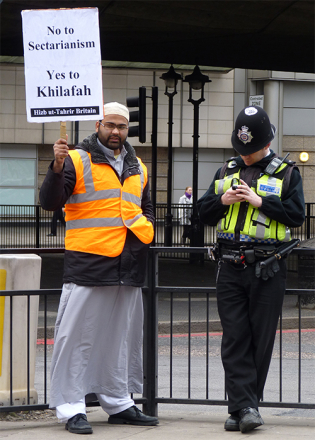
Hizb ut-Tahrir (HT), “The Party of Liberation”, was once the leading proponent of an Islamic state, a Caliphate, to be founded across the Muslim world. Founded in 1953 in East Jerusalem, the group expanded its operations beyond the Middle East and gained a presence in various non-Muslim majority countries, including Britain. It is banned or proscribed in several countries in Europe, the Middle East, Pakistan, and Bangladesh.
In 1986, Hizb ut-Tahrir officially established its branch in the UK (HTB), with the “Tottenham Ayatollah” Omar Bakri Mohammed as its leader. Farhaan Wali, a former member, has written an interesting but brief account of the group's rise and fall in Britain. HTB was threatened with several bans but was finally proscribed by the government in January 2024, many years after it could claim any significant influence among Islamists in Britain.
Wali argues that HTB's core demographic of relatively well-off, middle-class south-Asian and Arab members was always a barrier to recruitment from the majority of Britain’s young Muslims who had more immediate concerns, mostly economic rather than the ideological battle about the religious obligation (fard) to establish a Caliphate. HTB had most of its success, so Wali argues among university students, often those without a strong familial ties their local mosque or faith. Pious but moderate Muslims were less likely to be won over than those who had a Muslim, or British-Muslim identity but little connection to religious practice.
Recruitment involved setting up religious meetings to discuss the Qu’ran and HT texts (halaqah) and street stalls promoting HT and its reactionary views. HTB published a magazine until 1998 (but was a late starter on social media). HTB argued that British Muslims are Muslims resident in Britain but should reject being British (or anything other than being Muslim). HTB campaigned against Muslims voting in elections and engaging in secular society.
After the NUS extended its no-platform policy to cover HTB it set up or operated in front organisations on some campuses as a “culture society” or “1924 committee” while publicly decrying the ban on its activities. Its activity on campuses included promoting antisemitic and homophobic materials. It made some inroads into student Islamic Societies from the 90s to the mid-2000s. Workers’ Liberty also opposed the NUS ban and proposed bans under the Blair government in 2005. Defeating HT on the ideological front is a more effective weapon than state or campus proscription of reactionary ideas. While physical attacks by HTB members on non-Muslims or Muslim opponents of their ideology have been reported, HTB has always been more interested in discourse than action.
HT was hit with splits and personal conflicts that hampered its growth and direction. Omar Bakri Mohammad was expelled and went on to form Al-Mahajaroun, an organisation and its successors, which is now associated with Anjem Choudhury, who is again facing more charges of soliciting support for Daesh.
Wali provides some insight as to why the shift and conflict for HTB activities was down to HT’s policy on recruitment in non-Muslim countries. Whether recruitment was to support the overall mission of HT of establishing Islamic governance in the Muslim world or if there were region-specific purposes to recruitment in Europe and outside of the Muslim world. Other conflicts arose over its attitude to overturning its ban in Pakistan. HT covertly promoted the Pakistan Peoples Party, hoping it would overturn the ban. Others viewed being involved in any secular election as a betrayal.
Jalauddin Patel led HTB from 2000-2006 when they went into heavy decline. Wali uses membership data from west London as an example. The group went from 287 members in 2001 to 17 in 2021. This included its stronghold of Brunel University. The decisive factor to the decline in influence for HTB was 9/11 and the 7/7 terrorist attacks. HT condemned Al Qaeda and other violent jihadist attacks but struggled to differentiate why their own brand of reactionary Islamism was that different to those who carried out the attacks. Like sections of the left, they promoted a view that these attacks were a result of US and UK foreign policy. Under Uddin and his successor Nasim Ghani, all public activity at HTB was stopped and their activity was almost entirely clandestine, certainly never in their own name. The world situation, greater scrutiny of the government of what Islamists were saying, speeches made in meetings and the lack of real-world visible activity helped to speed up the decline. 9/11 saw the end of all dawah stalls in West London and 7/7 stopped any public meetings. After a period they were given the green light to restart activity but as one former members said “we had no resources to do anything”. Following the rise of Daesh (Islamic State) HTB faced a new problem of self-declared Caliphate now in place. HTB denounced Daesh and attempted to distance themselves from this real-world Islamic State. But the revulsion of many Muslims to the actvitiy of Daesh pushed HTB further to the margins.
Some would now claim that as a result of this pressure, as well as from the security services that HTB while anti-democratic and theocratic has modernised. They were badly affected by several members leaving and writing books about the group. And Uddin now going under Mohammad Jalal and having left the organisation is now a proponent for voting for the various “pro Gaza” independents against Labour.
HTB’s proscription as a terrorist organisation was side effect of the crackdown by the government on protest and displays of antisemitism following the Hamas attacks on 7 October. HTB did not join any of the mainstream Gaza demonstrations but instead held their own, much smaller demonstration calling for Muslim armies to invade Israel and “liberate” Palestine. Wali’s book would point to the ban having little impact, their own decline had occurred well before now.
Comments?We welcome replies, corrections and debate pieces. Contact us