
Some of the student protest encampments, and the opening of the Eurovision song contest (7-11 May), have stirred new demands to “boycott Israel” and “BDS”.
Solidarity backs the Palestinians and their claim to an independent state alongside Israel and to equal rights. We oppose boycott. We argue instead for solidarity and links with working-class and democratic forces within Israel and in the Palestinian territories.
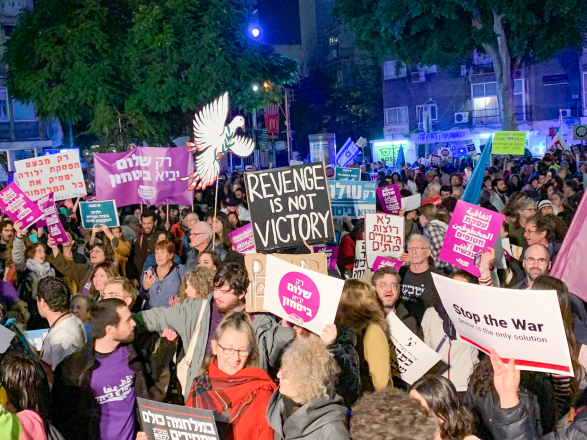
• We support the Palestinian-Jewish anti-war movement in Israel, Standing Together. “BDS” campaigners oppose it, thus harming the anti-war effort.
• With “BDS” unions here have refused links with unions in Israel and support for their struggles. We should support unions across the world, even if we disagree with their policies. The Histadrut union movement organises Palestinian workers and the Palestinian General Federation of Trade Unions has links with it.
• A Palestinian professor at the Hebrew University of Jerusalem, Nadera Shalhoub-Kevorkian, has been arrested for statements about Gaza and released on bail. A hundred other academics at the university (and the university itself) condemned the arrest. Shahloub-Kevorkian also holds a professorship at Queen Mary University, London. “Boycott” must mean Queen Mary should sack her for her Israeli affiliation? That would harm rather than help.
• Universities in Israel have many Palestinian students (40% at Haifa university, for example). Students and academics in Britain will do better to build links with anti-war students and academics in Israel, both Jewish and Arab, and dialogue with the doubtful.
• A block on arms exports to Israel from Britain would be only symbolic (the exports are small), though a good symbol. A block on US arms exports and military aid would be more consequential, though still not decisive (US president Reagan blocked arms supplies to Israel in the early 1980s, without stopping the Lebanon war). Rich universities shifting their investments out of military industries, as from fossil-fuel industries, is desirable. But “ethical capitalism” won’t get us far.
• The South Africa analogy is meant to suggest that we (or “ethical capitalists”) boycott Israel until the regime collapses. But in South Africa, collapse of the regime meant majority rule. Collapse of Israel? That could only be by Iran or some other nearby state conquering it. The boycott-Israel campaign (despite some of its advocates wishing otherwise) is designed to delegitimise the Israeli Jewish nation’s right to self-determination.
• If the boycott-Israel campaign gained more force, it would inescapably also be anti-semitic, targeting Jews in other countries who maintain links with Israel because they have family or friends there, or feel some empathy with Jews there, even though they may abhor Netanyahu.
• In fact workers’ struggles collapsed apartheid in South Africa, not pressure from “ethical capitalism”. Moreover, the South Africa boycott from 1959 never sought a blanket boycott, only a boycott of the apartheid regime and institutions close to it. In the 1980s the African National Congress misused the boycott policy to try to stop direct links between British unions and non-racial unions in South Africa, but we and others contested that and eventually won.
• More here: recent coverage, Workers’ Liberty 3/12, and Workers’ Liberty 3/15