
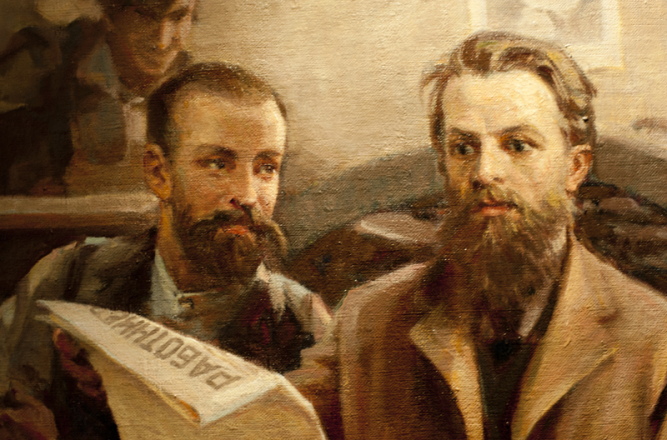
Eighth in a series of articles around the 100th anniversary of the death of Vladimir Ulyanov (Lenin)
Our Differences is the generative text of the working-class political movement that conquered state power in Russia in October 1917. In it Georgi Plekhanov expounded his analysis of Russian society in the form of a devastating and systematic examination of populism in all its sub-sections, Lavrovist, Bakuninist and Blanquist alike. It is one of the great books of revolutionary Marxism.
It was published in 1885, from exile in Switzerland, as Plekhanov’s summing up of the new working-class Marxist course he worked out after the 1879 split in Russia’s revolutionary populist movement.
Trotsky’s later theory of “Permanent Revolution” argued that the working class could win the typical democratic demands of the bourgeoisie — establish a Constituent Assembly, a democratic republic, democratic rights — and then go on, without any period of stable bourgeois power, to create a workers’ government. That is exactly how it happened in 1917. (And, then, things evolved). The theory was accepted, though not in so many words, by the Communist International in 1920.
Identifiable versions of these guiding ideas of Lenin and Trotsky, or approximations to them, are in the 1880s already to be found, in an underdeveloped and unconcretised form, to be sure, in the writings of Plekhanov and Axelrod. When it came to it, in 1905 and after, the former GEL people became convinced that the revolution could not, after all, do without the bourgeoisie, while Trotsky, Lenin and the Bolsheviks took the opposite fork in the road, facing up to the fact that they would have to do it without the bourgeoisie and against them.
As well as being the great scholar of Russian Marxism, Plekhanov was in the Iskra years still the embodiment in that movement of the heroic, audacious, stop-at-nothing, militant spirit of the earlier revolutionaries, with self-sacrifice as needed and always with self-abnegation.
It was Plekhanov who proclaimed at the Marxists’ congress of 1903 that a future Marxist government might well have to violate the rules of formal democracy in the interests of the revolution, insisting against much hostility that the well-being of the revolution would override all other considerations.
If the Russian Social Democracy was the first Marxist party to write the “Dictatorship of the Proletariat” into its programme, and it was, that was the work of Plekhanov.
Yet, in the 1880s, both Black Redistribution (the populist splinter Plekhanov led after the 1879 split in the old Land and Freedom revolutionary-populist group) and then the Emancipation of Labour Group (GEL, the Marxist group led by Plekhanov in exile) seemed to have failed.
Inevitably, GEL suffered from of the collapse of revolutionary populism after the killing of the Tsar (March 1881) and from the disillusion, inertia and fear of the police that paralysed the opposition-minded intelligentsia for a decade.
GEL had the added disadvantage that immediately it could be only a negative, critical force, directed against both the old and the new populism. What it stood for positively lay still in the future.
Black Redistribution failed because it had clung to the old populist policy of organising the peasants long after that policy had repeatedly failed in the 1870s; and because People’s Will (the majority in the 1879 split) was foremost in the field of action againsth the Tsarist regime. All Black Redistribution and later GEL could do in that field was express solidarity with the activity that their rivals were doing.
And GEL failed as an organisation for many years because it oriented to organising the industrial workers as an independent political force when that class was still very weak.
Consistent Marxism in Russia remained almost invisible until the mid 1890s and the onslaught on populism by the “second wave” of Russian Marxists, the “legal Marxists” — Struve, Tugan-Baranovsky, Bulgakov, etc. Marxism was only an element in the eclectic education provided in the surviving populist circles.
Personally Plekhanov and the others had a bad time of it. Lev Deutsch, Vera Zasulich’s partner, the organiser on whom GEL relied, was arrested in Germany and handed over to the Russian authorities, to be jailed and then exiled to Siberia.
For a long time they had no contact with Russia.
They did not recruit amongst Russian exiles, fearing that ill-educated newcomers would dilute the group’s politics, or organisationally destabilise it. That was indeed their experience in the time when they expanded and allied with Ulyanov and other to produce Iskra from 1900.
And they faced tremendous personal difficulties. Plekhanov, who had a young family, had a hard time reconciling himself to the savage poverty that, circumstances being as they were, was the price of doing the work he had undertaken. Observing the poverty in which the French Marxist Jules Guesde had learned to live helped reconcile him to it.
Both Plekhanov and Zasulich were consumptives. Plekhanov almost died of TB in the 1880s, and did die of it in 1918. Axelrod, the one most concerned with organisational questions, who lived by making and selling a sort of yogurt, suffered from psychological conflicts that often made political and literary work impossible.
Nadezda Krupskaya later recorded the impression Axelrod made on Lenin and herself during the Iskra period:
“Pavel Borisovich had lost three-quarters of his working capacity; he did not sleep for nights at a stretch and wrote with extreme intensity for months on end, without being able to finish the article he had started. Sometimes it was impossible to decipher his handwriting owing to the nervy way in which it was written. Axelrod’s handwriting produced a profound impression on Vladimir Ilyich. ‘It’s simply awful’, he often used to say, ‘if you get into such a state as Axelrod’. He more than once spoke about Axelrod’s handwriting to Dr Kramer during his last illness.”
Plekhanov sometimes despaired. He responded to a letter in which Axelrod had tried to cheer him up:
“Your expression, ‘chosen one of history’ makes me laugh. How can anyone be persuaded that he was chosen by history? That is possible only with reference to the past, but with reference to the present, it is senseless and only braggarts and swindlers can look at themselves through such flattering spectacles. And I, I simply am probably a failure, fit now only for the dusthole. I am ill, I know not from what — it must be despair, and it is true that such as I am now, I am not suited for anything, so what is there to talk about? A squeezed-out lemon should be thrown away into the dusthole and forgotten the sooner, that is all. Your belief in me does honour to your idealism… but if it is prolonged it will be funny: who idolises squeezed-out lemons! Now I am sick and in general my condition is wretched, and what is to come — unknown.”
Words that should be carved above the door of every sect’s door, and of every Marxist tempted out of expediency to take the line of least resistance.
When Plekhanov wrote those words, the tide had already began to turn.
In the years after the 1891 famine, Marxist circles, basing themselves on the politics and the work of GEL, multiplied rapidly throughout urban Russia. They remained separate and isolated from each other and mostly had no contact with GEL.
Some impatient younger people out of Russia saw GEL as conservative, inhibitive, over-assertive and out of touch with new conditions in Russia. The combination of GEL and Lenin, Martov, etc, from the St Petersburg League of Struggle, was for the veterans the first long-term such collaboration.
It involved Lenin, Martov and the others siding with the GEL against those with whom the GEL had fallen out (some of whom, People’s Will, had taken terrorism as far as it could go, with the killing of the Tsar in 1881). There is even one academic commentator who argues that the campaign against “economism” waged by Iskra was merely a contrivance, a political blunt instrument, with which Plekhanov, using Lenin, etc, clubbed down his critics.
But indisputably GEL did great work of fundamental significance. An examination of the ideas with which they, and the newer generation, set about building a Marxist working class party in Russia is what will concern us here. We will try to follow them step by step. What had they learned from their experience, and the experience of others of their bent and generation? That will make up our articles to follow.