
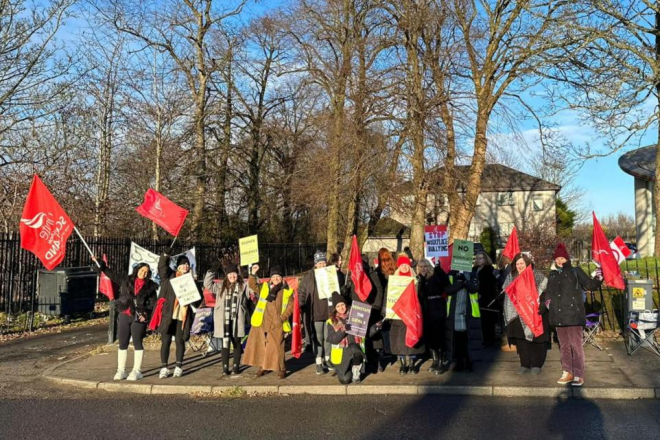
On 29 February staff employed by Glasgow East Women’s Aid (GEWA) were called into a meeting with members of the Board of Directors and informed that the organisation was closing down with immediate effect for reason of insolvency.
There had been no consultation with staff about the closure and consequent job losses, and no notice of dismissal. The staff, members of Unite the Union, had not been given any indication that the organisation (supposedly) had financial difficulties.
The (former) staff also still have no idea whether they will be paid outstanding wages, payments for outstanding Annual Leave, and redundancy payments.
Five of the GEWA staff members were unfairly dismissed last year. Under an out-of-court settlement, the five were re-instated and promised financial damages for unfair dismissal. But now there is, apparently, no money to pay the agreed awards.
A month after the February meeting it is still not clear whether GEWA has gone into administration (which would mean that it could be taken over by another organisation) or has gone into liquidation (meaning that it is bankrupt).
According to a statement issued by the Unite Scottish Region last week:
“Despite Unite being told that a liquidator had been appointed weeks ago – prior to the announcement on 29 February to close the service – it now transpires that, in fact, no liquidator has been confirmed.
This therefore raises serious questions for our members regarding who they speak to about payments including redundancy, wages, and pensions. If none of this can be immediately clarified by the GEWA Board, then it begs the question about whether GEWA is insolvent, and Unite is currently taking legal advice on this potential scenario."
The GEWA closure comes less than a month after a successful industrial dispute run by Unite.
Fifteen members of staff lodged a collective grievance about bad management and bullying last September. They were all suspended. When Unite sent GEWA notice of a strike ballot in October, five employees with less than two years service were immediately sacked.
(Normally, at least two years service is required to be able to lodge a claim for unfair dismissal to an Employment Tribunal. GEWA forgot, or did not know, that two years service is not required for claiming, as in this case, unfair dismissal for trade-union-related activities.)
Strikes every Monday and Friday commenced at the beginning of December and continued into January. All members of the Board of Directors resigned and were replaced by a new Board appointed by the umbrella Scottish Women’s Aid organisation.
In late January the new Board reinstated the five dismissed employees, agreed on compensatory payments for them, lifted all the suspensions, and began an investigation into the conduct of the GEWA manager ("Chief of Operations").
Then, on 29th February, GEWA staff were told that the organisation was closing down because of insolvency.
The background to the dismissal of all GEWA staff is not far removed from the dismissal of all staff at the Free Wheel North (FWN) cycling centre, another Not for Profit Sector organisation based in Glasgow, less than two years ago.
FWN staff – also members of Unite – submitted a succession of grievances about poor management. The Board of Directors then conveniently discovered that the organisation could no longer afford to pay for a workforce, sacked all staff on grounds of redundancy – and replaced them with volunteers.
Apart from pursuing a raft of legal claims, work on which is already underway, Unite needs to campaign around the demand: Open the books!
There is a demand for GEWA services. It has, or had, an office, a refuge, and a workforce. Its last Annual Report (March 2023) showed a bank balance of over £400,000 and reported no problems with funding.
GEWA’s main funders (Glasgow City Council and the Glasgow Health and Social Care Partnership) have both confirmed that they have not cut GEWA funding. So how can it be the case that GEWA, according to the Board of Directors, has suddenly become insolvent?
The four-month-long industrial dispute and five unfair dismissals are clear evidence of mismanagement. Opening the books would show whether that has been compounded by financial mismanagement.
It would also show whether it was necessary to shut down the organisation – or whether closure was just the soft option in comparison to sorting out the record of mismanagement.
The Unite Glasgow Not for Profit Sector Branch has set up a hardship fund for the GEWA staff. It has also written to all councillors, MSPs and MPs in the GEWA "catchment area" as the first stage of a campaign to get GEWA reopened with a new Board.
Victims of domestic violence and the GEWA workforce should not be left to pay the price for the failures of GEWA management and the Directors who sat on the Board during 2023. §