
As ceasefire talks continue with neither outcome nor breakdown, war continues to devastate life in Gaza.
A large majority of the 33,000 people killed are civilians. Many more could die through starvation and disease, with widespread damage to sanitation and healthcare infrastructure, and severely restricted aid supplies.
There is mass internal displacement and homelessness due to the destruction of housing. And over 100 Israeli hostages remain in captivity in Gaza.
On Tuesday 26 March, the United Nations Security Council voted for the first time for a resolution calling for an “immediate ceasefire”, after the US abstained rather than vetoed. The International Court of Justice has ordered Israel to increase the provision of aid to prevent humanitarian crises.
Such gestures of international diplomatic pressure are important, and certainly preferable to the initial response of many western governments and political leaders, which appeared to give carte-blanche to Israel’s actions. But then Russia’s war on Ukraine has attracted widespread diplomatic condemnation, including UN resolutions and rulings from the International Court of Justice. None of it has held Russia back.
The US, Israel’s most powerful ally, continues to publicly criticise Israel’s conduct of the war, condemn the high civilian death toll, and oppose the Israeli government’s announced intention to invade Rafah, the city where many Gazan refugees are sheltering. But it also continues to supply Israel with billions of dollars of military aid and materiel.
Suspending the provision of that aid, as even the right-wing administration of Ronald Reagan did for periods in the 1980s, would be an even more powerful gesture than the UN vote. Internationalist opponents of Israel’s war should demand that, though with Israel already well armed, it is unlikely it would have much immediate impact on Israel’s ability to prosecute its war.
Where, then, is the hope in this bleak scenario? If Israel is seemingly intent on facing down whatever diplomatic pressure is applied to it, and Netanyahu implicitly committed to an endless war to perpetuate his own political career, how can the slaughter be stopped?
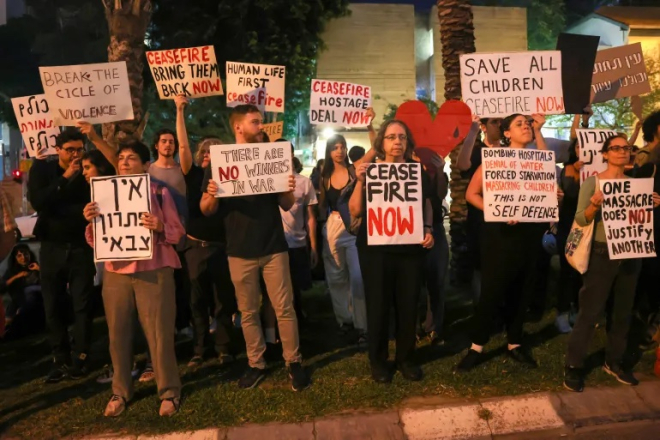
Solidarity looks to social movements in Israel such as Standing Together, which organise around a political narrative based on equal rights for Jews and Palestinians, as key forces for change.
Standing Together has, in recent weeks, continued to organise anti-war protests. It has organised two direct-action aid convoys to Gaza, aiming to raise the profile of the humanitarian emergency within Israeli society. Although the truckloads of aid it gathered from donations from Israeli citizens were blocked at the border by military police, Standing Together is liaising with international aid agencies to find ways of getting the aid into Gaza.
The movement also continues to intervene in the wider protests called by families of hostages, demanding the government concludes a hostage-release agreement, and the anti-Netanyahu protests calling for immediate elections. Standing Together argues that the hostage-release movement and the anti-Netanyahu movement must take up the questions of peace and equality.
Israel’s war has not won the release of hostages. Only two have been rescued by direct military action. Many more have been killed by Israeli bombardment and fire. The Israeli government maintains that its primary aim in the war is to “destroy Hamas”. But renewed rounds of fighting in areas such as Khan Younis, places the IDF previously claimed to have cleared of Hamas battalions, show the failure and folly of that military aim. However many Hamas fighters the Israeli army kills, amidst the civilian casualties, this war will also enable Hamas to replenish its ranks with young men rendered desperate and despairing by the devastation around them.
The destruction of Hamas as a political force can only eventuate from the development of a democratic alternative to it from within Palestinian society. Since the war broke out, there have been occasional reports of protests within Gaza against Hamas, with demonstrators accusing its leaders of hiding in safety, including some who live abroad in considerable luxury, while ordinary Palestinians suffer, starve, and die.
There have also been reports of ongoing Hamas repression, including firing on protestors with live rounds. Any Palestinian taking to the streets to openly denounce a militarised political movement which has ruled Gaza in a deeply repressive, authoritarian fashion displays immense courage. But it is near-impossible for such protests to develop into a cohesive political force capable of opposing Hamas under current war conditions.
It is not the place of a revolutionary socialist newspaper in Britain to give diplomatic advice to either Israel or Hamas; all we can say is that a full ceasefire and end to the war would be best, but a ceasefire of any length would be preferable to the continuation of slaughter. The ceasefire negotiations do not take place in a vacuum, but against the backdrop of the wider political projects of the forces involved. Hamas’s hope in its 7 October attack was to provoke what one of its officials called a “permanent war on all borders”; Netanyahu’s far-right government has responded with unprecedented brutality, impelled in part by Netanyahu’s desperation to maintain his own political power.
The risk of a widening of the conflict remains acute, with ongoing exchanges of fire between Israel and Hezbollah, the Islamist paramilitary party based in Lebanon, across the Israel-Lebanon border. Israel has tightened its occupation in the West Bank, with significant spikes in violence from both the Israeli military and armed settlers.
In Britain, large demonstrations calling for a ceasefire have continued, with tens of thousands marching on 30 March. The largest, most visible, far-left presence on those demonstrations, the Socialist Workers Party, distributes placards with the slogan “Back the resistance”, a toned-down version of the party’s full position: “unconditional support for Hamas.”
Siding with the Palestinians as a colonised and oppressed people is an internationalist duty, but that is different from aligning with Hamas and opposing “two states”. The Israeli Jews have national rights too, and the only democratic policy is “two states”, i.e. the right of the Palestinians to a state of their own alongside a secure Israel.
A movement of solidarity is damaged if it is hegemonised by political forces who advocate siding, “unconditionally”, no less, with one political faction in Palestinian life, and one of the most reactionary. The international movement against Israel’s war must also be a movement of solidarity with those in both Palestine and Israel fighting for a political alternative to the current framework of occupation and religious-supremacism fuelling counter-supremacism. Our horizon is peace and equal rights for both peoples.