
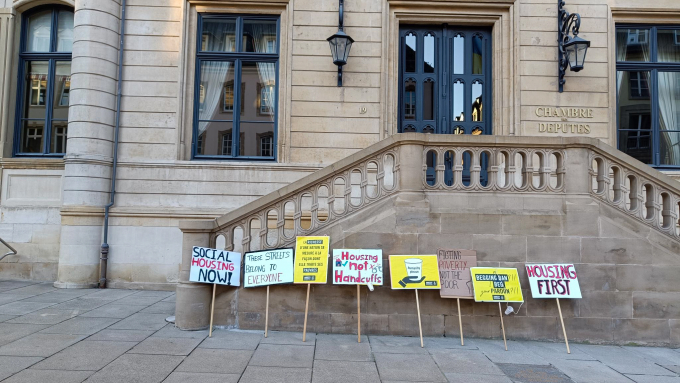
In one of the first moves in his post, Luxembourg’s new Interior Minister Leon Gloden overturned his predecessor’s refusal and stamped his approval on outlawing begging: The law criminalises begging between 7am and 10pm in major shopping streets, common areas, and parks in the capital. Bordering France, Belgium, and Germany, the small country’s status as a wealthy tax haven often overshadows its societal problems such as housing.
The law cracks down not only on undefined “aggressive or organised” begging, but extends to “all forms of begging”. Penalties range from 25 euros to 250 euros fines, with those unable to pay subject to “a few days in prison,” according to local reports. While arrests have so far been rare, checks and resulting intimidation have been frequent.
Local activist, organiser, and member of Luxembourg’s Dei Lenk (the Left) and radical leftist organisation Rise for Climate Bellamy Schneider was one of the first to protest this law. Creating posters and solo protesting outside parliament for several days, Bellamy’s resistance quickly caught on and developed into a team of activists who have gone on to organise several protests with participation from other local organisations, political parties, and Amnesty.
Recalling the early days of the movement, Bellamy said, “As politicians entered parliament, we basically just screamed ‘fight poverty, not the poor’. It was good, because in Luxembourg, our politicians and the people are really not used to protest. We have zero protest culture here and zero resistance.”
And while protests are encouraged to keep people and the media talking, the team is primarily opposing the ban from a legal perspective. “The constitution of Luxembourg says that you cannot ban every form of begging,” Bellamy said. “And the Human Rights Convention of the EU has to be followed if you want to be part of the EU — so our goal is to really appeal to that point.”
While it is challenging, they are with a team of lawyers actively seeking people to represent in court. “If you have people who are illegal immigrants, of course, they will not come with us to court,” said Bellamy. “So we have to really be careful.”
Besides the risk of pointing out unconstitutional weaknesses to the very people who control the law, Bellamy sees these actions as a double-edged sword. “On the one hand, if we win, that sets a precedent for all the other cases and all the other cities,” they said, “But if we lose, it’s way harder for the next cases.”
The vagueness of the laws has upset local authorities, too.
“The police themselves are against this, they have voiced their concern multiple times, saying they have no idea how to deal with this,” Bellamy explained. Luxembourg City cops are largely familiar with beggars, and have taken to advising them on how to dodge unfamiliar policemen from other regions. “They tell the city’s beggars, we know you and we are very sorry for the situation, but we don’t know the other guys — if you see them, just hide your cup".
On 22 March, activists once again gathered in central Luxembourg and marched to the Chamber of Deputies, holding signs and chanting slogans such as “Fight poverty not the poor” and “The streets belong to everyone”.
Representing Luxembourg’s Green Party, politician Fabricio Costa was among those who attended. “[The Green Party] thinks this is the wrong policy, because, first of all, it’s not going to create more safety in the city — beggars are not the main problem when it comes to safety,” he said from outside Luxembourg’s Hotel de Ville (City Hall).
In a sentiment echoed by other parties and organisations, he continued: “It’s also a policy that excludes those who really need to ask for help and that’s, in our opinion, something that we shouldn’t prohibit people from doing — it’s an anti-social policy that is going in a completely false direction.”
As the gap between rich and poor widens, staggering numbers make this unsustainability clear: “In Luxembourg, 0.5% own 50% of land in this country, ruining buildable land,” said Bellamy. “We have just as many empty houses as we have unhoused people. And these houses are often so big that you could put in two or three families.”
“They always say, yeah, we have the best social services, and so on, but the problem is, the only thing they have is temporary structures that people can sleep in. But that’s not enough,” said Costa. “We really need to take measures to take people off the street, not only temporarily, but structurally. We need to invest much more into that, instead of pushing people out of the city.”
The version in the printed paper says "5% own 50% of the land". In fact 0.5% own 50%.
Comments?We welcome replies, corrections and debate pieces. Contact us