
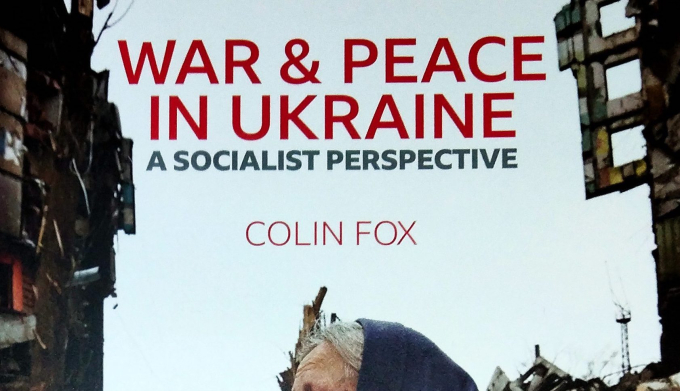
According to the recently published Scottish Socialist Party (SSP) pamphlet “War and Peace in Ukraine – A Socialist Perspective”:
“The SSP … calls on the working class in Ukraine and Russia to rise up against the regimes in both Kyiv and Moscow. To quote the words of the German revolutionary socialist Rosa Luxemburg in 1914 in reference to World War One, ‘the real enemy is at home’.”
In fact, the quote is from Karl Liebknecht. It dates from 1915, not 1914. And what Liebknecht actually wrote was: “The main enemy (Hauptfeind) is at home.”
This kind of outright ignorance masquerading as worldly-wise socialist erudition permeates the pamphlet, written by SSP national co-spokesperson Colin Fox, with additional input from Richie Venton, Bill Bonnar and Ken Ferguson.
In what is already a crowded field, and even allowing for the international competition, the pamphlet is simply the worst example to date of a verbal miasma masquerading as an analysis of the war in Ukraine.
According to the pamphlet: “It is understandable to sympathise with Ukraine … but a thorough understanding of the background and context is more important than sympathy.” In fact, the pamphlet excels in providing neither.
At page 34 of the pamphlet the reader discovers that the Budapest Memorandum of 1994 was an “agreement on autonomy for the Donbas and other ‘rebel’ oblasts (regions).” The Memorandum was subsequently “unilaterally rescinded by Ukraine under advice from neo-cons in Washington and London in particular.”
The reader goes on to discover, at page 43, that the Budapest Memorandum “proposed the option” of “autonomy for Crimea, the Donbas, and other Russian-speaking oblasts within a federated Ukraine.”
Another revelation about the Budapest Memorandum is provided at page 57: The US, UK and Russia agreed to respect Ukrainian sovereignty and its borders “in return for Ukrainian neutrality.”
All of this struggles to reach even the level of mindless incoherence.
The Budapest Memorandum made no mention of Crimea, the Donbas, other “rebel oblasts” or “other Russian-speaking oblasts”. It made no mention of a federated Ukraine or Ukrainian neutrality. It did not make respect for Ukrainian sovereignty conditional on Ukrainian neutrality.
No neo-cons – not in Washington, not in London, and not anywhere else – have ever put pressure on Ukraine to rescind the Memorandum. Nor has Ukraine ever rescinded it. The only country which has “rescinded” it, by seizing Ukrainian territory in 2014 and then launching a full-scale invasion in 2022, is Russia.
(The Budapest Memorandum, which runs to a mere 500 words, guaranteed Ukrainian territorial integrity in exchange for its abandonment of nuclear weapons and their return to Russia. Ukraine could “rescind” it only if it decided to obtain an arsenal of nuclear weapons.)
The pamphlet fares no better in its briefer references, at page 16, to the Minsk Accords of late 2014 and early 2015.
Although the Accords made no mention of NATO or Ukrainian neutrality, the pamphlet defines the Minsk II Agreement as “an agreement on NATO neutrality.” The pamphlet likewise falsely accuses Ukraine of unilaterally withdrawing from the Accords under neo-con pressure.
But the only country which has formally withdrawn from the Minsk Accords is Russia, in a statement issued after its recognition of the independence of the Donetsk and Luhansk ‘People’s Republics’ on the eve of its invasion of Ukraine.
At page 22 of the pamphlet the political party Batkivshchyna is defined as a “far right” political party. Just two pages later, however, it has become a “neo-fascist party” which has “threatened to assassinate Zelensky (sic) if he signs a peace deal or accepts ‘neutrality’ for Ukraine.”
Batkivshchyna is a mainstream political party which vacillates between centre-left and centre-right politics. Its longstanding leader is Yulia Tymoshenko, who has twice held office as Prime Minister of Ukraine. One of its Rada deputies (MPs) is Mykhailo Volynets, president of the KVPU trade union federation.
It has never been a far-right or neo-fascist party. It has never formed an electoral bloc with far right or neo-fascist parties. Nor has it ever threatened to assassinate Zelenskyy.
The political party Svoboda, defined by the pamphlet as “openly fascist” (page 22) and then as “neo-fascist” (page 24), is likewise, but equally erroneously, accused of having threatened to kill Zelenskyy.
It is also portrayed, at page 24, as a growing force in Ukraine and holding half a dozen seats in the current Ukrainian government:
“The BBC recently reported that ‘In four years Svoboda has gone from being a fringe party – receiving less than 2% in presidential elections – to a major player in Ukrainian politics. Its members have six positions in Zelensky’s (sic) government, including the deputy prime minister, general prosecutor and defence minister.’”
If the BBC has ever published such a report, it has disappeared somewhere in cyberspace. And it is completely wrong.
None of Ukraine’s five deputy prime ministers are Svoboda members. Four were elected as members of the Servant of the People party. The fifth is a non-party technocrat. The general prosecutor was elected as a member of the Servant of the People party. The defence minister is a member of the Holos party (roughly: Liberal-Democrat).
Svoboda has been on a downward spiral for a full decade. In 2014 it briefly had four members in the government. By the end of the year it had none. The figure has remained unchanged ever since. Svoboda currently has just one member in the Rada. That alone makes it difficult to have six positions in Zelenskyy’s government.
At page 31 the pamphlet refers to “the so-called Orange Revolution of 2010” – which actually took place in 2004/05 – before moving on to make the claim: “The terms that Brussels put in front of [Ukrainian President] Yanukovych for joining the EU [in 2014] were so disadvantageous and punitive that he was compelled to reject them.”
But Ukraine was not offered membership of the EU in 2014. It was offered an EU Association Agreement. And what compelled rejection by Yanukovych was not the terms themselves but personal threats by Putin to the Ukrainian economy, Ukrainian territorial integrity and Yanukovych himself.
(Yanukovych described the threats in a conversation with his entourage at the EU summit in Vilnius in November 2013, where the Agreement was to have been signed.)
The timing of the Orange Revolution is not the only occasion on which the pamphlet gets confused about dates. According to page 10 of the pamphlet:
“US Secretary of State James Baker gave assurances to Soviet President Mikhail Gorbachev in 1991 that NATO would not move one inch eastwards following the collapse of the Soviet Union. … [US economist] Jeffrey Sachs attended the disarmament talks between Ronald Reagan and Gorbachev in 1991.”
The Baker-Gorbachev meeting took place in 1990, not 1991. NATO expansion after the collapse of the Soviet Union cannot have been discussed at the meeting: The USSR did not collapse until the following year. There were no Reagan-Gorbachev disarmament talks in 1991, and there could not have been any. Reagan’s term of office had expired two years earlier, in 1989.
The pamphlet has similar problems when it comes to cross-referencing dates with statistics. According to page 40 of the pamphlet: “[After his election in 2019] Zelensky (sic) stepped up the shelling of those living in the rebel ‘oblasts’ and left, by UN estimates alone, some 17,000 dead.”
The same claim is repeated as a caption to a picture on the opposite page: “He (Zelensky (sic)) stepped up the shelling of those living in the ‘rebel’ oblast (sic – in the singular) and left, by UN estimates alone, some 17,000 dead.”
But the actual figures compiled by the United Nations put the number of fatalities in the fighting in the Donbas at around 14,400 (3,400 civilians, 4,400 Ukrainian military, and 6,500 members of “armed groups”) for the entirety of the eight-year period between 2014 and Putin’s invasion – not from 2019 onwards.
Most of those 14,400 fatalities occurred in 2014/15, well before Zelenskyy’s election. More than 3,000 civilians were killed in 2014/15. By contrast, just 51 civilians were killed in the two years 2020/21, after Zelenskyy’s election.
Responsibility for the plethora of factual inaccuracies which pepper every page of the pamphlet must lie with the author and his “colleagues in the SSP who helped bring this publication to fruition.” (They should have saved themselves the effort.)
But their pervasive presence can also be explained, in part, by the sources relied upon in concocting the pamphlet, listed in the grandiosely entitled appendix to the pamphlet: “Bibliography – Valuable Sources – Further Reading.”
Apart from three former CIA agents, the “former SNP deputy leader and international affairs commentator Jim Sillars”, a former US Ambassador to Moscow, and “Prussian general and military strategist Carl von Clausewitz”, the list includes:
- Medea Benjamin and Nicolas Davies of the US organisation Code Pink. Until the publication of the SSP pamphlet, their “War in Ukraine” enjoyed the accolade of being the worst book on Ukraine to have been published outside of Russia.
- “Author and activist Tariq Ali”, who scorned claims of an imminent Russian invasion of Ukraine just six days before it happened: “Based on some aerial photos of tents in a field, the Anglophone world has been subjected to a highly orchestrated media campaign, trumpeting at top volume the ‘massive’ and ‘imminent’ Russian invasion of Ukraine.”
- Right-wing US-foreign-policy-realist academics Walt and Mearsheimer, best known for their work of 2006 in which they argued that US foreign policy was controlled by “the Israel Lobby”.
- John Pilger, a one-time investigative journalist who degenerated into a charlatan. In the aftermath of the Maidan popular protests of 2014, he wrote: “Ukraine has been turned into a CIA theme park – run personally by CIA director John Brennan in Kiev, with dozens of ‘special units’ from the CIA and FBI setting up a ‘security structure’ that oversees savage attacks on those who opposed the February coup.”
- Professor Jeffrey D Sachs, one of the architects of the post-Soviet economic “shock therapy” denounced at page 47 of the pamphlet. Sachs has twice promoted his Putin-apologist line on Ukraine on the Russian television talk show of the odious Vladimir Solovyov. His tête-à-têtes with Solovyov triggered an Open Letter of condemnation signed by some 200 academics.
- Most outstanding of all, Patrick Lancaster, described as “an independent US journalist based in the Donbas.”
Lancaster is in fact a shill for Putin, and has been for nearly a decade. Apart from Russian state-controlled media, the other main outlet for his work has been the far-right conspiracy-theory InfoWars website run by Alex Jones. His speciality has been filming staged scenes which supposedly ‘expose’ Ukrainian war crimes. As one exposé of him put it:
“Over the last eight years, he has embedded himself with pro-Russian separatist forces in Donbas, spread pro-Kremlin disinformation about the downing of Malaysian Airlines flight MH17, worked with numerous Kremlin-backed TV stations, and most recently appeared on Alex Jones’ Infowars spreading pro-Kremlin narratives about the war.”
According to Graham Phillips – an even more odious shill for Putin, who formerly worked with Lancaster in the Donbas – Lancaster is “an illiterate, grifting charlatan, with a journalistic acumen and ability lower than a potted plant.”
Colin Fox, on the other hand, classes him as “a valuable source.”
And, of course, not a single Ukrainian writer, academic, trade union activist, feminist, or socialist is included under the heading “Valuable Sources”. But what do “the Ukrainian masses” know of the war? They are, after all, merely “the pawns of the USA, NATO and the west” (page 47).
By contrast with the pamphlet’s egregious factual inaccuracies and bigging-up of Kremlin shills like Lancaster, its supposed ‘analysis’ of the background and nature of the war in Ukraine is positively mundane.
It amounts to no more than an incoherent re-run of the well-worn ‘anti-imperialist’ narrative promoted over the past decade by the likes of Code Pink and the Stop the War Coalition:
- US Secretary of State James Baker promised Mikhail Gorbachev that NATO would not move one inch eastwards (page 10).
(Wrong. There was no such promise. In any case, it could not be an explanation for why Putin invaded Ukraine 32 years later.)
- Responsibility for “the dispute” (sic) lies with “NATO’s relentless eastward expansion since 1991” (page 15).
(Wrong. NATO’s eastward expansion was completed by 2004. It cannot be an explanation for why Putin invaded Ukraine 18 years later.)
- The Maidan protests were “an armed far-right coup directly instigated by the United States” (page 25).
(Wrong. The Maidan protests were a Ukraine-wide mass protest which evolved into a popular uprising against government corruption. Surely the kind of thing socialists should support?)
- Russia began mobilising troops on the Ukraine border “in response to the USA beginning to send lethal weapons to Ukraine in 2019 to use in the escalating war in the Donbas” (page 25).
(Wrong. Russia began mobilising its troops two years later, in the spring of 2021 – for the simple purpose of trying to conquer Ukraine.)
- Ukrainian independence “began to be undermined after 1991 by covert US operations”, Ukrainian independence “went out of the window” after the ouster of Yanukovych, “the Ukrainian masses” have become “the pawns of the USA, NATO and the west” (pages 47/48); Ukraine has “in many ways surrendered its independence” and has become “an American/NATO satellite” (page 11).
(Wrong on every count. Ukraine is an independent sovereign state. The “Ukrainian masses” have agency. And the ouster of Yanukovych was a step forward in liberating the country from centuries of Russian oppression and subjugation.)
- The current war is “not fundamentally a dispute (sic) between Ukraine and Russia alone but a geo-political battle [i.e. between NATO and Russia]” (page 71). The war provides “an opportunity to expand NATO’s influence and power in the world” (page 7).
(Wrong. This is a war in which Ukraine’s right to exist as a state and as a nation is at stake. NATO has been blocking Ukrainian membership for sixteen years, since 2008.)
Confusingly, and inconsistent with the above, an appendix to the pamphlet’s main text describes Ukraine as currently being “engulfed in a civil war” (page 71).
In general, however, Russia’s war of imperialist aggression against Ukraine is redefined by the pamphlet as a war between Russia and NATO (with NATO to blame for the Russian invasion). Thus, according to page 18 of the pamphlet:
“A ‘Blue Labour’ inspired motion passed by last year’s STUC captured the essence of Starmer’s ‘Tory light’ conclusions. The warmongering resolution contained the seminal clause ‘The STUC General Council rejects any suggestion of equivalence between the invader and the invaded’. To genuine internationalists there is of course a very ‘equivalence’ in the imperialist role played by NATO and Russia in the world today.”
The “motion” was in fact a General Council Statement, probably drafted by STUC Deputy General Secretary Dave Moxham (who will not take kindly to being defined as the “Blue Labour” author of a “Tory light warmongering resolution”.)
And the fact that the pamphlet’s critique of “the motion” insists on drawing an equivalence between Putin’s explicitly genocidal invasion – Putin denies the very existence of a Ukrainian identity – and a people fighting for their right to exist should be a cause of concern for SSP members.
It is certainly a cause of concern for Ukrainians. The one occasion on which someone made the mistake of inviting an SSP speaker to a Ukrainian-organised rally in Scotland – in Edinburgh in late 2022 – the SSP speaker was shouted down.
Clearly, the SSP still has some work to do in gaining a hearing for its “call on the working class in Ukraine and Russia to rise up against the regimes in both Kyiv and Moscow.
The pamphlet’s analysis of the war and its background is a rehash, albeit in an even more incoherent form, of the arguments of the Stop the War Coalition. These have been covered in detail in The Stop the War Coalition and Ukraine: A decade of political and factual illiteracy and therefore do not need repeating here.
The ignorance and incoherence manifested on every page of the pamphlet, it has to be admitted, certainly make it an enjoyable read. Rather in the same way that reading a David Icke tract about Archons can be a source of endless amusement.
As a “socialist perspective” on the war in Ukraine, however, the pamphlet is of no value whatsoever. How sad that an organisation which was once a rallying point for the left in Scotland has now decamped into tin-foil-hat territory.