
The 2023 State of the Climate report (Ripple et al. 2023) paints a bleak picture. A record-setting year, maybe the hottest globally in 100 thousand years.
2023 brought yet further extreme weather events, from the wildfires in Canada (in which roughly 10 million ha were burnt) to flooding during the monsoon season in northern India (which killed over 100 people). And a recent review (Armstrong McKay et al. 2022) of Climate Tipping Points (CTPs) shows that as global heating continues, the trend of increasing temperatures and extreme weather events is likely to be accelerated by self-perpetuating feedback loops.
Climate tipping points are critical thresholds beyond which small perturbations (maybe 0.2℃) will set off a feedback loop causing a large, accelerated and perhaps irreversible change to the climate system.
The term “tipping point” was first proposed in a 2005 paper (Lindsay and Zhang 2005) modelling the thinning of Arctic sea ice, and expanded on in another paper (Lenton et al) in 2008.
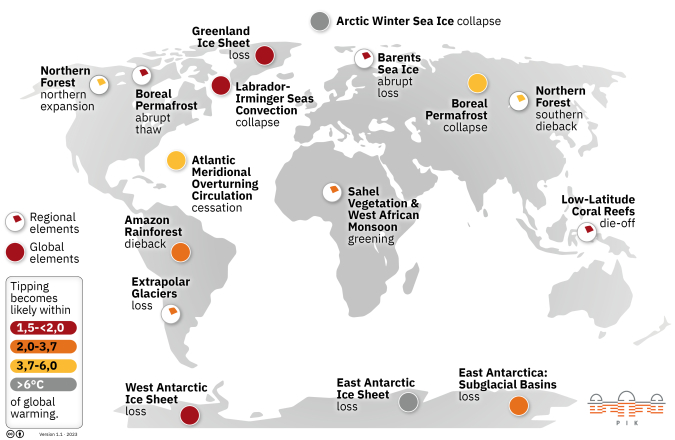
In the 2008 paper, fourteen “tipping elements” (large-scale components of the biosphere which will undergo changes when tipping points are exceeded) were identified. This list was expanded recently https://doi.org/10.1126/ to sixteen elements, split into nine global “core” and seven regional.
Estimates were made for the change in temperature at which climate tipping points will occur. For the Greenland and West Antarctic ice sheets [1], low-latitude coral reefs, Boreal Permafrost, and Barents sea ice, the central estimate (beyond which triggering the tipping point is “likely”) is around just 1.5℃ of warming.
There is further risk of a “tipping cascade” where multiple tipping points interact to amplify each others’ impact. Thus the conclusion that a target of 1.5℃ rather than the Paris Agreements’ 1.5–2℃ warming should be used to inform climate policy. Current governmental policies are thought to lead to about 2–3℃ warming and recent researchers suggests we’ve already surpassed the 1.5℃ target.
A recent UN Interconnected Disaster Risks Report (Eberle et al. 2023) considers not just CTPs, but also ecological and social tipping points (it calls these collectively “risk tipping points”).
It outlines six such tipping points, from mass extinction of species, to groundwater depletion, to the increase in space debris, emphasising how these tipping points feed into each other. A 2022 report (Cernev 2022) on Planetary Boundaries states that “crossing one planetary boundary systematically results in the crossing of others” - and that report was criticised for not covering the full extent to which we’ve already crossed some boundaries]. Of the nine planetary boundaries it outlined, as many as six may already have been crossed.
These recent reports, taken together, paint a grim picture of what is likely to come in terms of climate and ecological collapse and its impact on society. The chaotic and interlinked nature of Earth systems means it is impossible to say with absolute certainty what will happen, but all estimates suggest that corrective action in the form of drastic reductions in emissions is overdue.
There is a risk that the catastrophic language of tipping points will cause policymakers to freeze rather than face the issues: relutance to affront short-term profit interests on the grounds that disaster looks inevitable anyway ends up the same as reluctance to affront those interests in the belief that we have plenty of leeway.
The reports should be seen in terms of every 0.1℃ having an impact.
References
Armstrong McKay, David I., Arie Staal, Jesse F. Abrams, Ricarda Winkelmann, Boris Sakschewski, Sina Loriani, Ingo Fetzer, Sarah E. Cornell, Johan Rockström, and Timothy M. Lenton. 2022. “Exceeding 1.5 global warming could trigger multiple climate tipping points.” /Science/ 377 (6611). https://doi.org/10.1126/
Cernev, Thomas. 2022. “Global Catastrophic Risk and Plaentary Boundaries: The Relationship to Global Targets and Disaser Risk Reduction.” Contributing Paper. United Nations Office for Disaster Risk Reduction. https://www.undrr.org/media/80217/download
Eberle, Caitlyn, Jack O’Connor, Liliana Narvaez, Melisa Mena Benavides, and Zita Sebesvari. 2023. /Interconnected Disaster Risks 2023: Risk Tipping Points/. United Nations University - Institute for Environment and Human Security (UNU-EHS). https://doi.org/10.53324/.
Lenton, Timothy M., Hermann Held, Elmar Kriegler, Jim W. Hall, Wolfgang Lucht, Stefan Rahmstorf, and Hans Joachim Schellnhuber. 2008. “Tipping Elements in the Earth’s Climate System.” /Proceedings of the National Academy of Sciences/ 105 (6): 1786–93. https://doi.org/10.1073/pnas..
Lindsay, R. W., and J. Zhang. 2005. “The Thinning of Arctic Sea Ice, 1988–2003: Have We Passed a Tipping Point?” /Journal of Climate/ 18 (22): 4879–94. https://doi.org/10.1175/.
Ripple, William J, Christopher Wolf, Jillian W Gregg, Johan Rockström, Thomas M Newsome, Beverly E Law, Luiz Marques, et al. 2023. “The 2023 State of the Climate Report: Entering Uncharted Territory.” /Bioscience/ 73 (12): 841–50. https://doi.org/10.1093/.
Note
[1] One reason for ice melt triggering such a feedback loop is that melting lowers the albedo (reflectivity) of the Earth. The melting of glaciers additionally turns carbon sinks into carbon sources and the melting of permafrost releases methane (more than 80 times as potent a greenhouse gas as CO2).