
Fourth in a series around the anniversary of the death of Vladimir Ulyanov (Lenin) in 1924
All populism, in theory, “denied a future to Russian capitalism. The proletariat was assigned no independent role at all in the revolution. It happened accidentally, however, that propaganda designed in its content for the villages found a sympathetic response only in the cities... assembling only the intelligentsia and some individual industrial workers”. (Leon Trotsky, The Young Lenin)
The Workers’ Union of South Russia of 1875 (described in Solidarity 699) survived the arrest of its leaders for a while, and took on a different political coloration.
Its programme now, though it did not demand a constitution, called for:
Factory legislation which would protected the workers against the capitalists’ arbitrary control of their lives;
Freedom of speech, of assembly, and for a working-class press;
Freedom to form unions, credit unions, etc.
Higher wages, and an end to oppressive taxation of the peasants;
Reduction in the hours of work.
The Union of Workers of North Russia was created in Moscow and St Petersburg around 1878.
In 1875 and early 1876 a group of populists published the first Russian working-class paper, Robotnik (Worker). It explained that the Russian workers must “join together with other workers into a great obshchina [commune], to create a world in which the land belongs to all, everything belongs to all”.
Despite its openly populist ideas, Robotnik marked a new stage in the separating-out of a distinct consciousness in the working class. It discussed such things as the British trade unions, critically, but nonetheless in order to see what could be learned from them.
It told of the Babeuf-communist left wing in the French Revolution. It criticised the peasant hero Pugachev, leader of the Rising of 1773-5, for wanting to be Tsar and for not “hanging” merchants and usurers as he hanged landlords.
The base of the group was Moscow, where they had about 20 people working to spread its ideas and win support for them.
Still populists in their goals and conceptions — they raised the slogan, “the cause of the workers and the peasants is one” — they had decided to “go to the people” in the factories. They told the workers: “We need to seize the factories like the peasants need to seize the land”.
One of the activists, Vera Figner, explained their ideas in a fine passage about an exile student group in Switzerland in the mid 1870s:
“We read the Organisation du Travail, Cabet’s Voyage en Icarie, Proudhon’s Plan for a People’s Bank, and everything seemed to us to be practical and feasible. The word ‘utopia’ did not exist for us. We saw only ‘plans’ to bring about a social revolution, and we were equally enthusiastic when we read the speeches of the genius Lassalle [1825-64], who summoned the workers to conquer the State, as when we read the anarchist pamphlets of Bakunin, who repudiated the State and appealed for the ruthless and implacable destruction of its whole edifice.
“Most of us thought that this last idea was best suited to the conditions of Russian life. For us parliament did not exist. There was no question of even thinking of universal suffrage and elections and workers’ delegates.
“In Old Russia there had been governments of the people, as Kostomarov had described; there were artels which we read about in the works of Flerovsky; there was the obshchina... This obshchina was the prototype and at the same time the germ of the just organisation of the future society.
“All the new ideas of democracy and economic equality seemed to us quite irrefutable from the point of view of logic. And if anyone made any objections to them, we thought that he could only be inspired by motives of egoism and fear...
“In the world as it then was, during the time of propaganda, when all those in power were hostile to Socialism, when the government offered only persecution, anyone who took this road must be prepared for every kind of material and moral privation. To be up to the task that awaited him, he must prepared himself for all the blows of fate.
“The asceticism of some who wanted to give up all the goods of the earth achieved the impossible. One day, unawares, the daughter of a landlord from the region of Tambov, called Bardina [of whom we we will learn more later], admitted that she liked strawberries and cream, and was teased by the group to which she belonged. From that day on Vera Lyubatovich [another member of the group], with perfect sincerity, looked upon her as ‘bourgeois’.
“When... the programme of the new revolutionary organisation came under discussion, the girls proposed that it should include a renunciation of marriage. The men protested, and the clause was not accepted.
“Militant Socialism, which promised real liberty, equality and fraternity to the workers and the oppressed; Socialism which refused to recognise the strength and wealth of the powerful, and which was persecuted for the truth which it discovered — this seemed to me a new Gospel... Christian concepts and feelings, the ideas of the sanctity of asceticism and sacrifice, all these led me to the new doctrine... This was the really apostolic mission of our time”.
Return
After returning to Moscow, a number of women, disguised with false papers and imaginary life-histories, went to work in the factories in order to merge themselves with the workers. That meant living in the barracks-like dormitories of the women workers. They were soon exposed and sacked. But they had made contact — and some of the contacts were continued and developed. In a short time they had supporters in 20 factories and small workshops, and their connections spread to the region. Franco Venturi (Roots of Revolution) quotes these descriptions of what they did.
“Beta Kaminskaya took advantage of every possible pretext to start discussions with the workers. If she saw a young man holding the book which his employer had given him and which contained the rules concerning the workers’ duties, Kaminskaya read it to him aloud, explaining the meaning of each rule and showing the workers how each one of the articles was harmful to them and advantageous only to the employer.
“She spoke to them of the lives of workers in the West, of their solidarity and their struggle against exploitation by their employers. Gradually as she got deeper into the conversation, she spoke of history, and told them of episodes of the revolution in France and elsewhere.
“Naturally the workers were very amazed by these stories. Kaminskaya had said that she was of peasant origins; her seriousness and her culture, which were so unusual in a peasant, made the workers conclude that she belonged to the Raskol [the heretical religious sects]. For the women of the Raskol are indeed the best educated of the inhabitants of Russian villages...
“Sofya Bardina took the first opportunity to begin to read a booklet which she had with her, The Story of the Four Brothers. The success was enormous. A large crowd collected round her.
“When she stopped reading, the questions were endless: ‘Where do you come from? Who are you? Who has taught you to read so well?’
“Bardina said that she was from the Raskol, that as a girl she had been employed as a maid by the gentry and that she had learned to read. She had gone back to her village, and there had become a devout reader of the [Christian] scriptures, but now necessity had driven her to try and find work in the factories...
“From then on Bardina frequently visited the men’s dormitories... The workers were proud of her, and on their day of rest, in the inns, they turned to her beseeching her to read them the newspapers”.
Eventually (1875) the populists were denounced to the police, and the group was smashed. Many workers were arrested, as well as the “outsider” populist intellectuals. After three years in jail, they were tried — it became known as the “Trial of the Fifty” (1878) — and seized the chance to use the courtroom to explain themselves and their cause.
One of them, Pyotr Alexeyevich Alexeyev, a worker won over by Sofia Perovskaya, came to be the first proletarian in recorded Russian history to speak “on the record” for himself, for workers like him, and for his persecuted brothers, the peasants, too, indicting Tsarism.
Born in 1849, the son of serfs, he had become a weaver as a boy. At 17 he taught himself to read. The populist propagandists had given him the beginnings of a working-class world outlook. He declared in court:
“I know something about the problems of our Western brothers. Their conditions are in many ways different from those in Russia. Over there they do not persecute, as they do here, those workers who devote all their free time and many sleepless nights to reading. Indeed, there they are proud of them, and speak of us Russians as a people of slaves and semi-barbarians.
“And how else can one speak of us? Have we any free time to apply ourselves to anything? Are our poor folk taught anything in their childhood? Are there any useful and accessible books for the workman? Where and from whom can he learn anything?...
“The peasant reform of 19th February 1861 — this reform which was a ‘gift’ — even though it is indispensable, was not provoked by the people itself, and does not guarantee the peasant’s most indispensable needs. Just as before, we were left without a piece of bread, and with a completely inadequate strip of land, and so we passed under the control of the capitalists...
“If we are unlucky enough to be forced again and again to demand an increase in wages which the capitalists are constantly decreasing, they accuse us of striking and deport us to Siberia. And so this means that we are still serfs!
“If we are forced by the capitalist himself to leave the factory, they accuse us of organising a revolt and use a soldier’s rifle to force us to continue our work, and some are deported as instigators to distant lands. And so that means that we are still serfs!
“From all that I have just been saying it is obvious that the Russian workman can have hope only in himself, and can expect help only from our young intelligentsia which has stretched out a brotherly hand to us.
“It has understood in the depth of its soul the meaning and origin of the desperate complaints which come in from all sides. It can no longer look on coldly at the persecuted, oppressed peasant as he weeps under the yoke of despotism. It alone, like a good friend, has held out a brotherly hand, and in all sincerity wants to lift us out of our difficulties and put us on the right road for all the oppressed. It alone is tireless and leads us on...
“And it alone, united with us, will accompany us until he time when the muscular arm of millions of workers will arise and the yoke of despotism, defended by the soldier’s bayonet, will fall to pieces”.
The court’s response was to sentence Alexeyev to ten years’ hard labour. Sofya Bardina, of whose taste for strawberries and political work inside one of the factories we heard above, also got ten years’ hard labour. After some years she escaped from Siberia, but she committed suicide in exile.
Many others were given heavy sentences. The organisation was wiped out. For a while no organised working-class movement remained in Moscow.
In St Petersburg working-class organisation had not been destroyed when its populist organisers, the Chaikovists, were arrested early in 1874. The workers themselves kept the organisation going and spread its ideas. It developed underground.
After 1874 it was no longer only the revolutionary students who sought contacts in the factories. The workers themselves, once they had been converted by propaganda, took the initiative in tying together broken threads, and repeatedly asking for support and help. Indeed they themselves were now stretching out a “brotherly hand” to those intellectuals who could give more significance to their dissatisfaction and revolutionary spirit.
The beginnings of a self-driven working-class movement, capable of sustaining itself, now existed in St Petersburg. When Zemlya i Volya (Land and Freedom), a tightly organised party of professional revolutionaries whose organisers went armed and were willing to use both terrorisation and terror against oppressors and officials — who would try to kill policemen who attempted to capture them — emerged in 1876, that is what they found in St Petersburg.
Read
Venturi: “By about 1875 there was already a large number of workers in St Petersburg who were not only keen to learn and to read — typical self-educated men from workshops and factories — but who were also well able to hold their own views on the various political ideas about which they had heard the students speak. They were able in fact to contrast populist propaganda with the events of their own lives...
“These workers... were at this time acquiring new personalities through their first experience of political activity”.
In 1875 and early 1876 the surviving Chaikovists resumed work around the St Petersburg factories. G V Plekhanov was involved.
Plekhanov, who did most of his work for Zemlya i Volya (from 1876) among the town workers, wrote a book, The Russian workers in the revolutionary movement, about these working-class militants and their movements.
He found that the mental transformation of those workers, awakened by politics to a new sharp view of their own lives and of their surroundings, generated in them an enormous drive for knowledge and culture.
Marx had summed up the purpose of atheist propaganda against religion in these terms.
“Criticism has plucked the imaginary flowers on the chain not in order that man shall continue to bear that chain without fantasy or consolation, but so that he shall throw off the chain and pluck the living flower”.
And so it was when the populist propagandists stripped away the illusions of the workers in their “Little Father”, the Tsar, in the Church, in God, and in the ruling class. They unleashed an energetic need to understand and to know the truth.
This would be a great fermenting power in the Russian labour movement, as it has been in all labour movements — sharper self-awareness and the sense of ignorance generating the drive for knowledge and leavening the economic and political struggles for working-class self-betterment.
Plekhanov commented:
“When I asked the workers themselves what exactly they wanted from revolutionary writings, I met with the most varied answers. In most cases each of them wanted a solution to those problems which for some reason were of special interest to my individual hearer at each particular moment.
“In the mind of workers such problems were increasingly enormously, and each had his favourite questions according to his own tendencies and character. One was particularly interested in the problem of God and claimed that revolutionary literature ought to use its energies mainly for destroying the religious beliefs of the people.
“Others were interested in historical or political problems, or in the natural sciences. Among my acquaintances in the factories, there was also one who was specially interested in the question of women”.
Workers who became “educated” would become political and “self-motivating” populists. But there were other processes at work too.
In St Petersburg the more educated metalworkers predominated — those workers who were more distant from peasant roots. Elements of the typical town worker’s contempt for the ignorant country bumpkin peasants would soon, even among workers who in general accepted the outlook of the populists, help workers define themselves as distinct from the peasants.
The emergence of Zemlya i Volya in 1876 was a product of harsh and sobering experience in the shambolic “going to the people” in 1874 and after. ZiV’s solution was to rouse the peasants to revolt not for socialism, but, immediately, for “land and freedom”.
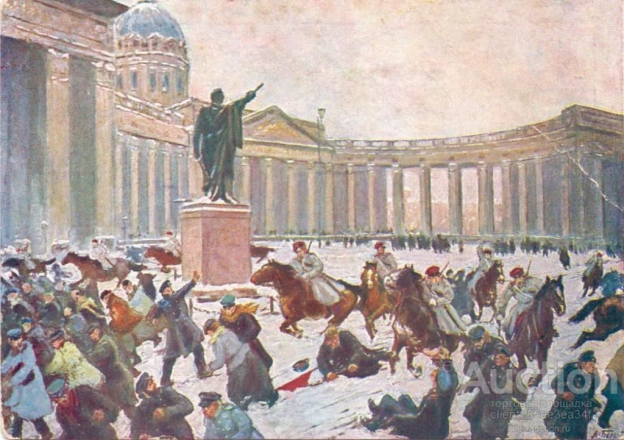
ZiV helped organise the first working-class-initiated political demonstration, in St Petersburg, in the square of Our Lady of Kazan, on 6 December 1876, at which the 20 year old Plekhanov was the speaker, risking ten years hard labour if he were taken by the police.
On the morning of 6 December, perhaps 300 workers and a larger number of students and intellectuals gathered in the square, outside the church. Plekhanov shouted, “Long Live Land and Freedom!’” Workers unfurled a big red banner with “Land and Freedom’”written on it, and Plekhanov started to speak.
The police immediately attacked the demonstration, but the crowd stopped them seizing Plekhanov. A large number of demonstrators and bystanders were attacked and arrested.
Trial
In the ensuing trial, the court was savage with the intellectuals, but relatively lenient with the workers. The strange half-medieval character of the society in which the workers were laying the foundations of a great labour movement is shown in the sentences meted out to some of the workers. They were sent to serve a period of prayer in a Russian Orthodox monastery! Others were deported to Siberia.
By contrast, the intellectual Alexei Emelyanov got 15 years in jail, where he was flogged with such violence that he went mad and died in jail. Two other intellectuals got ten years’ hard labour, and one six. But the workers’ movement survived.
The populists could not but be poignantly aware of the sharp contrast between the mobility and combativity of the urban workers and the inertia in the countryside. Venturi quotes a reflective report for the leading layer of Zemlya i Volya written after Kazan Square. Its author might be Plekhanov, but Venturi thinks probably not.
“The important result of the entire affair is the union that has now been brought about between the intelligentsia and the people”. The author contrasted the workers with the liberals.
“The Russian liberals were very learned. They even knew that liberty had been conquered in the West. But obviously one ought not to try to apply this knowledge to Russia.
“Russia is led along the road to political freedom not by the liberals but by dreamers who organise ridiculous and childish demonstrations; by men who dare to break the law, by men who are beaten, sentenced and reviled.
“The Russian workers had shown themselves more united and compact because of the equality of their conditions; more developed because of the variety of their impressions of town life and because of their frequent and bitter conflicts with the representatives of the government and the ruling classes; and, finally, more open to socialist propaganda...
“The worker is always clearly aware of the injustice of the social regime that oppresses him... He can see that the luxury which is the work of his own hands is enjoyed by others. And so his mentality is attuned to demand a fight which will produce immediate results.
“He does not want to postpone the battle, but he wants to obtain (if not everything he wants) at least as much as possible as can be obtained at that given time. He wants to make at least a breach in that order of things which has become unbearable for him.
“He wants to be a free man with the right to think and speak openly in accordance with his opinions. In fact he sees that to fight against his economic exploiters he must make use of what is called political freedom.
“But this freedom he will have to conquer and he will therefore have to enter into conflict with the very essence of our State system. His activities along the road to freedom inevitably take on a political character. The events of 6 December are the result of this state of mind among the most conscious of the working classes”.
The author concluded that the Kazan Square demonstration showed that in Russia, “the movement would follow the same direction as in the West, i.e. from the town to the country and not vice versa”. Therefore the revolutionaries should organise the urban workers and win them over politically.
The ferment in the working class of St Petersburg and the surrounding region helped make this possible. There was a general revival of the working-class movement. It would culminate politically in the public proclamation of the Northern Union of Russian Workers at the end of 1878, at the height of a strike wave.
Comments?We welcome replies, corrections and debate pieces. Contact us