
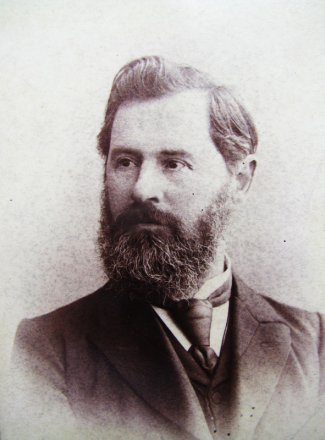
Among the leaders of the Russian Marxist movement, Pavel Borisovich Axelrod was singular. Almost all the others came from the upper layers of society, from families of education and culture, riches or comparative riches, and an ordered place in the world.
Axelrod came from the lowest of the low, from a family of illiterate pauper Jews. His mother was intelligent and sensible, but entirely illiterate. His pious father could read the Hebrew prayers he recited, but was illiterate in Russian. Born in 1849 or 1850, Pavel passed his early childhood in a one-room family hut. His father lacked the internal passport necessary to reside legally in the village where they lived, and went about forever afraid of the police. He borrowed money to start a tavern, and when it failed, was thereafter harassed by the usurers. The family moved around. They spent time in a poorhouse run by their Jewish community.
For the child Pavel there were things more damaging and more permanently scarring than those. In his autobiography, written when he was past 70, he recalled with horror the ingrained fawning, cringing subservience of people like his family towards anyone with the sartorial or other mark of being socially superior.
Then something more than a little like the plot of one of Charles Dickens’ novels occurred. From the 1850s the Russian state provided some state schools for Jews, with the intention of alienating them from Judaism. Intent on saving their own sons from corruption in such places, some pious wealthier people in Axelrod’s community provided clothes and food for starveling children to fill the Jewish quota in the unclean Russian school.
If Axelrod’s pious father had not been away from home, he would most likely have rejected the offer to pay for Pavel’s schooling. But in fact Axelrod’s whole life was switched onto a different and unexpected track.
He went to school, and moreover, though Jews could not be headteachers, the head teacher there was not a Christian bigot. He was very helpful and caring towards the boy.
At over 70, Axelrod could still recall the good feeling when he put on the clothes provided by his benefactors, the warm coat and the shoes, enjoying such things for the first time in his life.
After three years, the 12-year-old Axelrod went on his own to a strange town, passed the tests for entry, and enrolled in a higher school. He had neither money nor a place to live, nor, until an enlightened Jewish family of strangers provided it, the student uniform necessary for attending the school. He slept where he could, and scavenged for food.
Some of his teachers found him after-school work tutoring less accomplished boys, and the 12-year-old, with those small earnings, became better off than he had ever been before. But he stimulated the pupils to question things their parents believed in, and thereby lost the tutoring work.
Reading a book about astronomy led him to question his own religion. He remembered wrestling with his conscience and fervently praying to god to save him from leaving his faith. By the early 1870s he was a populist, a Bakuninist anarchist.
He spent time in Germany and there marvelled at the dignified, self-respecting workers he saw at meetings organised by the German Social Democracy. By contrast, in Russia, the lower reaches of the working class had only — to use the words with which James Connolly described the condition of the “unskilled” workers of Dublin before Jim Larkin and the Irish Transport and General Workers’ Union taught them to organise and fight — the arts of the lickspittle and the toady with which to defend themselves.
Though Axelrod remained an anarchist — and therefore a critic of the German Marxist Social Democratic movement — from that point on his outlook shifted.
He wanted a movement in Russia like the one he saw in Germany. In the still anarchist Black Redistribution group after 1879 he provoked a crisis by advocating the raising of social democratic “minimum” demands, long before the others were ready to turn to politics.
All through his life Axelrod would remain a herald and an advocate of working-class self-organisation. We will see, as the story is unfolded, what he thought that meant in practice. For in the formation of Menshevism, in contradistinction to what became Bolshevism, Axelrod was Lenin’s most consistent opponent.
The version here is abridged from the version in the printed paper.
Comments?We welcome replies, corrections and debate pieces. Contact us