
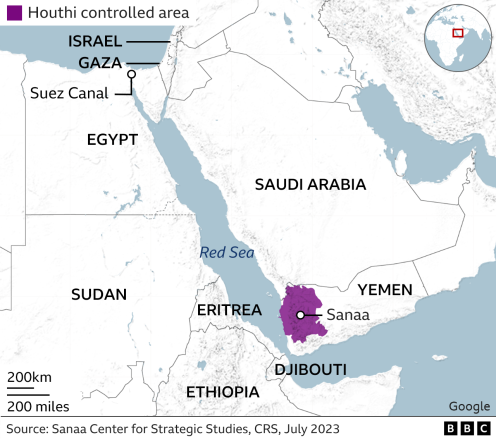
On the night of Thursday 11-Friday 12 January the US and UK militaries bombed sites in Yemen controlled by the Houthi movement. The stated aim of the action, according to a UK spokesperson, was to, “protect vessels and freedom of navigation [in the Red Sea],” by destroying Houthi military bases, radar installations, drone and missile launch sites.
The US claimed to have hit 28 targets with 150 missiles. The Houthis say there were 72 strikes and five of their fighters were killed. They promised to take revenge on the US.
The relatively small death toll, if accurate, probably indicates that the sites the US hit had been largely evacuated. The US issued a warning to the Houthis, in advance, and probably has not so far done much damage to Houthi military infrastructure.
Since October the Houthis have launched missile and drone strikes on the Israeli port of Eliat and international shipping in the Red Sea in support of Hamas in Gaza.
On 19 November Houthi troops landed by helicopter on Galaxy Leader, a Japanese-operated cargo ship linked to an Israeli billionaire. The hijacked ship was taken to Salif, a port in Western Yemen.
The Houthis have conducted 27 attacks on civilian ships since mid-October and on the evening of Tuesday 9 January they launched 18 drones and three missiles at UK and US warships which had been sent to the Red Sea to defend the shipping lanes.
Cargo has been re-routed, and complex supply chains have been disrupted, including, for example, Tesla and Volvo car production in Europe which depends on components shipped from Asia.
The Houthis are Shiite Muslims based in the north of Yemen who currently control most of the inhabited areas of the country, including the capital, Sana’a, which they overran in 2014. The ultra-reactionary movement’s main slogan is, “God is the greatest, Death to America, Death to Israel, Curse the Jews.”
The Houthis are aligned with Iran, which supplies them with weaponry and training, although they are from different branches of Shiia Islam and are not natural close allies. The Houthis retain their own independent command structures, have a distinct set of priorities, and are not Iranian state puppets.
The Houthis' campaign to support Hamas by targeting ships in the Red Sea is to be condemned. Disrupting the world economy in this way, for these reasons, is not a progressive act “against imperialism” or a “defence of the Palestinians.” These are actions of a religious-military dictatorship motivated by ideological sympathy for the Hamas pogrom against Israeli Jews.
But it is not clear that the US-UK military action will help – that it will stop the Houthis, who seem to be looking for a confrontation. The Houthi movement has just emerged from a long-running war with a Saudi-UAE-led coalition. They have built a sophisticated, large and adaptable military machine.
The Saudis aimed to smash the Iran-backed movement and launched 25,000 airstrikes on Yemen over seven years after 2015. The Houthis saw off the Saudis and UAE troops, and emerged stronger and much better armed. The Saudi action pushed the Houthis closer to Iran.
The US-UK action has strengthened the Houthis’ position inside Yemen. There was an enormous demonstration against the Western bombing in Sana’a on Friday 12 January.
The Western powers have also made a regional war more likely.
What the US and its allies should do, positively, is openly demand that the Israeli government stops the war in Gaza and offers the Palestinians a free, independent state alongside Israel. That is the right thing for the Palestinians, who are harmed by association with the Houthi movement. A Two States settlement would undercut the Houthis politically.