
Rabbits in Australia
Stuart Jordan’s “Nativism, species, and ecology” (Solidarity 695) is interesting, draws attention to an important report on “Invasive Alien Species”, while presenting an alternative perspective. Yet it seems to me far too strong in its critique of the report, in playing down the risks that the report raises.
The International Panel on Biodiversity and Ecosystem Services (IPBES) is for biodiversity and ecosystems what the infamous IPCC is for climate change. Both are rightly respected UN-established bodies. As Stuart recognised, this is an extensively researched, comparatively comprehensive, and serious report, commissioned following a much wider 2019 publication, alongside similar on the stated other four key drivers of biodiversity loss: changing use of sea and land; direct exploitation of organisms, such as over-fishing; climate change; and pollution. Its careful and evidenced claims come with confidence intervals.
I, like Stuart, am no expert in the field. I therefore would be very cautious about making such a withering critique of the closest to a “consensus” document in the field.
The report’s 56-page “summary for policymakers” is persuasive and alarming. Stuart’s critique here is not comparable to his or others’ reasonable critiques of IPCC and similar assessments for conservatism. The political context arguably encourages IPCC publications to compromise with what seems “realistic” in modelling the possible speeds of transition; political pressure, scientific caution and “consensus” arguably plays down extreme risks which are (on current models) low probability but very devastating — where a more precautionary approach may be warranted. Stuart’s critique of the recent IPBES IAS report is pushing in the other direction, and a much stronger break with its findings.
Stuart makes a number of profound mistakes in his reading of the report and to draw his conclusions (see appendix). What Professor Chris D Thomas says, as quoted by Stuart, is more measured and interesting.[i] Thomas raises important questions about, for example, balancing protecting ecosystems against destruction caused by invasive species while protecting species’ survival by allowing (or supporting) them to migrate to adapt to climate change. How accurate his characterisation of existing approaches to invasive species is, how far his critique would apply to the IPBES IAS report, and indeed how true his claims are, I don’t know either way. But where Chris Thomas does flag difficult trade offs,[ii] Stuart’s additions mostly seem to play down the problem.
Zack Muddle, Bristol
Appendix
Where there aren’t comparable trade-offs precautionary approach to major threats to biodiversity. If the IPBES is right, the non-linear and often delayed impacts of widespread invasive species, on top of all the other pressures on biodiversity, threatens significant irreversible devastation. If the threat is — as now — taken less seriously, we may find out that the scientific majority is wrong too late.
“Studies with evidence of negative impacts exist for more than 3,500 of these [37,000] invasive alien species”, found IPBES. Stuart interpreted this as “only 3,500” having negative impacts, “suggesting that over 90% of invasive aliens have either neutral or positive effects.” But an absence of evidence does not mean an evidence of absence. The report elsewhere assesses proportions of known positive as against negative impacts, and finds a much less rosy picture than Stuart implies.[iii] That said, they do not, as Stuart’s article suggests, pretend that there are never positive impacts.
But even supposing Stuart were right, and only 10% had a so-far known negative impact, that is no reason to take the risk less seriously. A small proportion of a very large phenomena can still be a large problem. Putting aside delayed, non-linear, or unclear negative impacts, there is no reason to suppose that we can know in advance which 10% will have negative impacts. So a general precautionary approach against introductions may remain fully justified.
Stuart’s doing-down of the report and the problem on the basis that a $423bn cost may (by comparison to one other report) include say 0.24% on golf courses is misplaced. Stuart here correctly highlights differing class priorities, but the report shows the problem is much more serious, breaking the $423bn down:
“The vast majority of global costs (92 per cent) accrue from the negative impacts of invasive alien species on nature’s contributions to people or on good quality of life, while only 8 per cent of that sum is related to management expenditures of biological invasions. The benefits to people that some invasive alien species provide do not mitigate or undo their negative impacts, which include harm to human health (such as disease transmission), livelihoods, water security and food security, with reduction in food supply being by far the most frequently reported impact (more than 66 per cent).”
Stuart writes that “some invasives... do cause huge problems but… it is not clear that it is their alien character which is the problem... the report includes the dengue fever virus, the chytrid fungus (responsible for amphibian extinctions) and other microbes. It seems to me that these microorganisms have negative impacts not because they are invasive but because they are powerful pathogens.”
With dengue fever virus, the invasive species discussed was not the virus but the vector, particular mosquito species (as with malaria, chikungunya, Zika, yellow fever and West Nile fever). But more importantly, Stuart oversimplifies the relationship between pathogens and disease. Where pathogens have long been endemic in a particular population, their disease impact is often comparatively low. There is strong selective pressure on both the species they infect and the pathogens themselves to be able to harbour them without excessive disease or death. As well as the species, individuals they infect develop resistance.
Covid-19 probably originated in bats, and spilled over to humans via an intermediary species such as racoon dogs, evolving as it did so. Humans likely played a role in both stages in that spillover. But the bats from which the progenitor virus spilled probably didn’t get ill. These issues apply within as well as between species: both can be seen with the amphibian fungus. European colonialism introduced deadly epidemics to populations around the world: where European individuals may harbour dormant “common colds”, immunologically naive Native Americans people were killed by them. The list goes on and on. Poster child of UK “nativist” biology, the red squirrel, dies from diseases that the nativist’s arch nemesis, the grey squirrel, carries but does not die from.
“The report implicates invasive species in 60% of extinctions but presumably much of this is simply that alien species move into degraded ecosystems created by other human activity”, states Stuart. Not so simple. “Invasive alien species have contributed solely or alongside other drivers of change to 60% of recorded global extinctions, of which 90% occurred on islands.” A much stronger claim, a more significant problem.
The report talks not just about the prevention, eradication, and control of invasive species, but also about mitigating their negative impacts.
“The multi-billion dollar conservation industry with its focus on keeping species within their native ranges may actually contribute to extinctions by preventing species from moving”, writes Stuart. It’s not clear to me the latter allegation is fair. But alluding to the financial interests of the conservation industry while ignoring the much bigger financial interests in other directions is skewed. As the IPBES report makes clear, the kind of steps needed will come at a significant cost to corporations and governments, and are mostly not being done.
IPBES is not a for-profit organisation, and “each of our Reports is the result of usually 3-4 years of exhaustive global collaborations – between hundreds of the leading scientists, experts and knowledge-holders in the specific fields from every region of the world (including very specifically, indigenous and local knowledge). These processes include two entirely transparent rounds of open expert review – with comments and suggestions invited from anyone globally who has expertise to add – and with every comment and every response from the authors shared openly online. The draft reports are then considered and eventually adopted as co-owned products by our more than 140 member States in an intensive line-by-line intergovernmental session. The results – including key message and policy options – stand apart as the best-available assessment of the state of evidence and knowledge on the topic in question, and are used extensively to inform policy, decisions and action around the world.”
Other critiques could be made of some wider narratives about invasive species, though I don’t think they could be levelled against IPBES, and I’m not sure if Stuart was concerned with them. Sometimes the rhetoric and cause can dovetail with xenophobia, sometimes it goes alongside playing down other devastating impacts, such as climate change, and sometimes it cohabits with an excessive focus on the most attractive species, eliding wider ecological considerations.
I know that Stuart generally takes ecological issues seriously, and indeed flagged both the report and Chris Thomas to readers of Solidarity, but these corrections are necessary.
Footnotes
[i] In the printed Solidarity 695, the paragraph beginning “There are some invasives...” is attributed to Chris Thomas, but is Stuart’s. It is correct online.
[ii] See also this interesting article by Chris Thomas on difficult trade-offs in a different though related area: Chris D Thomas et al., "Reconciling biodiversity and carbon conservation", Ecology Letters (2013) 16: 39–47. doi.org/10.1111/ele.12054
[iii] “Impact reports by some Indigenous Peoples and local communities document 92 per cent negative impacts and 8 per cent positive impacts on nature caused by invasive alien species.” Elsewhere, it finds 68% and 32% respectively. There's more of a breakdown of impacts in this graph:
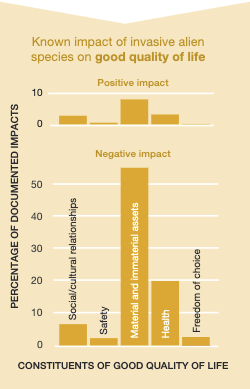
That all said, proportion of impacts negative impacts isn't (necessarily) the same as proportion of species with a net negative impact, but it gives an indicator of the issue.