
On 14 January, Israel’s assault on Gaza passed its 100th day. At the time of writing, the death toll was nearing 24,000. According to Israel’s own statistics, around 66% of casualties have been civilians. Of those, a large proportion were children.
The UN says around 60% of homes in Gaza have been destroyed. Some 80% of the population is now internally displaced. With healthcare infrastructure severely degraded, additional crises arising from homelessness and the spread of disease could lead to even more deaths than the direct Israeli attacks.
Large street protests have taken place recently in Israel calling for Netanyahu’s resignation. On 13 January, thousands protested in Tel Aviv, Haifa, and elsewhere. These protests, which include families of hostages, are not explicitly anti-war, but are fiercely critical of Netanyahu’s leadership.
But the Israeli government offers no credible plan for the rebuilding of life in Gaza, nor any realistic horizon for when the war will end beyond vague statements about “destroying” or “eliminating” Hamas. However badly its immediate military capacities are affected, Hamas will surely be able to replenish its ranks with young men who see no other immediate avenue for resisting Israel. This is a perspective for endless war.
Israeli raids continue in the occupied West Bank, where Palestinians have a degree of nominal autonomy over fragmented areas, within an overall framework of de facto Israeli military dictatorship.
Inside Israel, the state is trying to clamp down on anti-war agitation. Several anti-war protests have happened, but one in Haifa, called by a coalition led by the left-wing party Hadash, has been denied a police permit (that is, effectively banned, on the pretext that the police could not ensure its safety). A demonstration planned in Tel Aviv by Standing Together, Women Wage Peace, and others, was also denied a permit. Protests planned in November, in majority-Palestinian-Arab cities within Israel, were also banned.
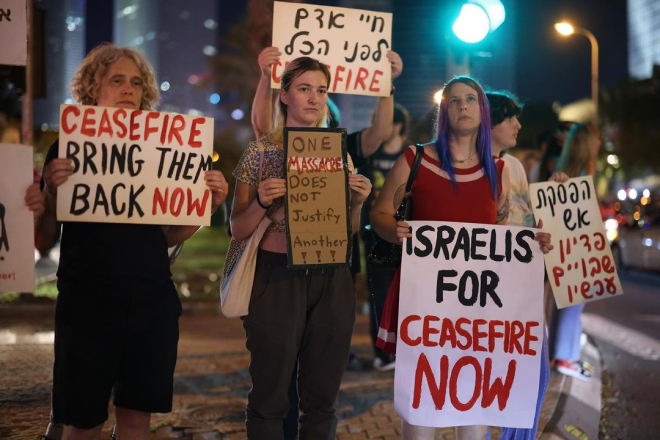
Standing Together is organising for a new protest on 18 January, and fundraising towards organising costs. A Standing Together rally in Tel Aviv on 28 December, which mobilised around 1,000 people, was the largest protest against the war in Israel since it began. Standing Together and other left-wing, anti-occupation, and peace campaigns argue that a ceasefire agreement is the only means not only to stop the destruction of Gaza, but to ensure the safe return of hostages held by Hamas.
Perpetuating the war is vital for Benjamin Netanyahu’s political career. As long as it continues, he can argue for all internal political conflict to be deferred in the interests of “security” and national unity. On 1 January, Israel’s supreme court struck down the law passed by the Knesset (Israeli parliament) to severely restrict the court’s powers, part of a package of judicial reform pushed by Netanyahu and his far-right allies which was a further blow especially to Palestinian rights.
Prior to the war, that move might well have destabilised the government and would surely have re-ignited the mass protests that were taking place across the country. But the war gives Netanyahu cover, and Israel’s mainstream opposition, united with the government behind the cause of nationalist vengeance, has been timid at best in calling for Netanyahu to go.