
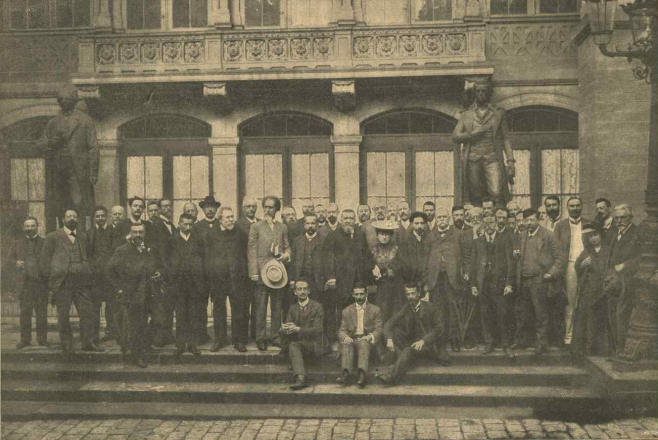
Above: some of the delegates at the international socialist congress in 1914. In the middle: Rosa Luxemburg (in hat) and to her right Jean Jaures
In August 1914, the Second International collapsed after most of its constituent parties sided with their own governments and sanctioned the First World War slaughter. At its height, the Second International included mass working class parties, notably the German SPD with more than a million members, as well as other sizable parties in France, Italy and elsewhere in Europe and North America.
Mike Taber’s new book, Reform, Revolution, and Opportunism: Debates in the Second International, 1900-1910 (2023) is a welcome contribution to help today’s activists learn the lessons from the Second International. This new volume complements Taber’s earlier book, Under the Socialist Banner: Resolutions of the Second International, 1889-1912 (2021).
History
The Second International was founded in Paris in 1889. Its first congress laid out the revolutionary orientation: “The emancipation of labour and humanity cannot occur without the international action of the proletariat – organised in class-based parties – which seizes political power through the expropriation of the capitalist class and the social appropriation of the means of production.”
The Second International held subsequent congresses in Brussels (1891), Zurich (1893), London (1896), Paris (1900), Amsterdam (1904), Stuttgart (1907), Copenhagen (1910) and Basel (1912). These were regarded as the world parliament for the labour movement. Delegates mostly came from socialist parties in Europe, North America and Australia. Only parties in Argentina, Japan, South Africa and Turkish Armenia were represented beyond the core.
The virtue of Taber’s books is to lay out both the resolutions agreed, but also the process of debate that led to them. Taber is right that oral debates have one important advantage over written exchanges – speakers tend not to sand down the rough edges of their words. Such verbal duels provide a candid window into the underlying differences, which are sometimes glossed over in formal resolutions. The usual format was for alternative drafts to first go to a commission for debate, followed by further discussion and voting in the main congress.
These books illustrate the strengths and weaknesses of the Second International. On the plus side, these were deliberations by serious working class leaders, who represented tens of thousands of militant workers. On the down side, most of these parties and their leaders became sclerotic, bureaucratised and reformist. This would seal the Second International’s fate in 1914.
Taber’s new book collects five of the most relevant debates: on socialist participation in bourgeois governments, colonialism, immigration, women’s suffrage and war.
Socialists in bourgeois governments
In June 1899, the socialist lawyer Alexandre Millerand accepted a position in the capitalist government of France as minister of commerce. At the Paris Congress in 1900, a resolution authored by Karl Kautsky condemned socialist participation in capitalist governments under “normal” circumstances, but left the door open for “exceptions”.
An alternative by Jules Guesde and Enrico Ferri prohibited any socialist participation in bourgeois governments, arguing that socialists remain in “irreconcilable opposition”. Ferri dubbed Kautsky’s text a “rubbery resolution” for the way it fudged the issues. Guesde argued that a socialist who entered a bourgeois ministry might still believe themselves to be a socialist, but they would cease to be so. It was not possible to serve two classes.
Although Kautsky’s resolution carried in 1900, by the Amsterdam congress in 1904, opposition had hardened. The “exceptional” clause was eliminated. Ferri argued: “If one sticks too much to principles, action risks becoming futile. But if… one forgets principles, then we lose the route indicated by the compass and the working masses become disoriented. So tactics must proceed from principles… Our compass is the class struggle.”
Colonialism
European colonialism had been going on for centuries by the time the Second International was formed. However modern imperialism as the re-division of the globe took a turn in the 1880s and culminated in bitter rivalry for colonial possessions between the big powers.
The colonial question was discussed at every Second International congress from 1896 onwards. Initially they voiced support for independence struggles. However by 1904, Hendrick van Kol, a leader of the Dutch party, openly backtracked. By the 1907 congress, right-wing social democrats openly advocated a “socialist” colonial policy, supporting the “civilising mission” of Europeans towards “backward natives”. Kol made racist jokes about Europeans getting eaten if they went to Africa with machines. The commission passed Kol’s draft by 12-10, but Kautsky’s sharper resolution against colonialism won the congress floor vote, though only by 127 votes to 108.
This signified a serious degeneration, as Lenin noted in his report. The only saving grace in 1907 was a short address by Bhikaiji Cama, representing the Indian National Congress. She gave an impassioned speech for the right of self-determination for India.
Immigration
The Second International discussed the related international question of immigration, which also divided left and right across the organisation. Since the 1880s, a raft of anti-immigration laws had passed, including the prohibitions against Chinese and Japanese people in the USA, the White Australia policy and Aliens Act in Britain.
In 1896, a resolution stated that trade unions “should not appeal for restrictive legislation against the immigration of aliens”. However in 1904, the US delegate Morris Hillquit presented a resolution using racist tropes such as “workers of backward races (Chinese, Negroes, etc)” and argued it was “absolutely necessary to keep the coolies away”. The congress ran out of time with the discussion.
The immigration debate in 1907 was bitter. Hillquit talked of migrants as strikebreakers that “cannot be organised”. However Hungarian delegate József Diner-Dênes replied that “we must permit completely free immigration and emigration”. A broadly pro-migration policy was carried.
Women’s suffrage
The Second International discussed women’s liberation at five congresses, beginning with Clara Zetkin’s speech to the founding congress in 1889. In 1891 it passed a brief resolution calling for complete equality. In 1893, it carried a resolution on protective legislation for women workers. In 1904, it passed a short resolution in favour of universal women’s suffrage.
The 1907 congress marked a qualitative improvement. An international socialist women’s conference was held in Stuttgart, just before the Second International congress. The women’s conference carried a strong resolution for women’s suffrage, rejecting both the Fabian compromise of property qualifications and the downgrading of campaigning on women’s votes in countries like Austria, where male suffrage had still not been won. This was then put to the congress.
Zetkin told the congress, “our fight for votes for women is not a suffragist movement, but a mass movement of the working class”. The next international women’s conference in 1910 would make international women’s day a key mobilising demand, one that still resonates to this day.
Militarism and war
At all but one of the nine congresses between 1889 and 1912, the Second International opposed militarism and war. The crucial fault-lines were exposed at the 1907 congress, where four separate resolutions were debated. Bebel supported defence of the fatherland on grounds of national self-determination. Perhaps the sharpest intervention was made by French delegate Gustave Hervé, who advocated a general strike to stop any outbreak of war. Hervé lashed out at the SPD leaders:
“You have now become an electoral and accounting machine, a party of cash registers and parliamentary seats. You want to conquer the world with ballots… the whole German Social Democracy has now become bourgeois… Today Bebel went over to the revisionists when he told us: ‘Proletarians of all countries, murder each other!’”
Although the Stuttgart resolution incorporated amendments from Luxemburg, Lenin and Martov in its final draft, the breach was visible. Subsequent resolutions held out pious hopes for disarmament conferences between the big powers, or abstract calls for reduced military spending. Despite some strong words at Basle, in 1914 the Second International was unable to hold the line.
Conclusions
Taber is right that the Second International of 1889 to 1914 cannot offer a guidebook for the present. However properly examined in context, the experience of socialists a century ago can provide valuable lessons and examples. It is somewhat ironic that some of the lefts in the Second International, such as Guesde, Ferri and Hervé, supported their own governments in 1914, while more serious lefts such as Lenin, Luxemburg, Radek, Marchlewski and Rakovsky remained firmly international socialists.
At present in some circles on the left, there is a vicarious social democratic nostalgia for the glory days of the Second International. This is sometimes expressed by the embrace of Karl Kautsky, at least before 1914. This represents a yearning for mass working class parties and perhaps, a more consensual, less sectarian form of socialist politics. Such sentiments are understandable, but naïve. The best of the Second International was continued and developed by the Comintern, at least in its first four congresses, and then by the Trotskyist movement. The best of the Second International is part of our renewal, as long as we discard the baggage that prompted its demise.