
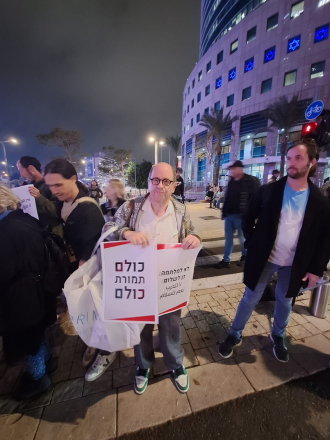
Adam Keller, a longstanding peace activist in Israel, spoke to Solidarity in December 2023. Since then he reports that police repression against anti-war demonstrations has lessened and that there is some small but growing discontent about the war among Israelis as more hostages die and more soldiers are killed.
The situation since 7 October is very bad. That's not surprising. At least since 1967, there has not been a war which had so much such unanimous support in Israel.
Those of us protesting the war and calling for a ceasefire are a very small minority in Jewish-Israeli society. Even some people in general on the left will tell you how they are supporting this war, terrible thought it is. I think there is a comparison here for us with the collapse of the Social Democrats who fell in for support for their own nations in the First World War. I have had some activists tell me that Israel should bomb Gaza like Dresden was bombed in the Second World War. Others will justify the killing of children to prevent them from becoming future Hamas fighters.
In criminal trials, you have the concept of “insanity”. And I think that Israeli society is seeing the kind of fear, a collective “insanity”. The optimistic way to think about it is that people will come to their senses eventually. It is now a trend among relatively leftwing people to say Hamas must be destroyed. To do this, the army has to do what it is doing. For them, after Hamas has been destroyed, then we could make peace with the Palestinians and win the two-state solution. I don't have confidence in this kind of “peaceful solution”.
What Hamas did on 7 October was a terrible war crime. Some victims were peace activists like Vivian Silver, with a long history of opposing the occupation. This Hamas attack was very blunt and indiscriminate. But I think I understand why they came to this area. The Palestinians in the Gaza Strip have many grievances against Israel, starting, of course, with 1948. There were so many Palestinians who were expelled from their homes. And the way they were squeezed, especially into the small sliver of land that became the Gaza Strip. And they can look at the beautiful flourishing kibbutzim built on the land, which used to be Palestinian villages in 1948.
And then you can add the last 20 years of this siege, the siege which was suffocating Gaza and the earlier waves of bombing, which were destructive enough but nothing like the present wave. Those Palestinians who broke into Israel on the 7 October, knew that they had just one day for revenge and on the following day, they would be pushed back, arrested or killed. So they wanted to make the most of this one day and to get as much revenge as possible. And unfortunately, they succeeded.
Israel does not have a limited one day for revenge; they can do it over weeks and months. And I'm sure that many Palestinians now in Gaza are feeling they will want revenge. And they will succeed if we don’t break this cycle of violence.
There have been efforts by the police to completely forbid any demonstrations against the war. They argued that Hamas must be destroyed, and if the war is stopped before it happens, Hamas has won. So calling for a ceasefire is support for Hamas. The reports in Israeli media of demonstrations against the war in Europe or the US just refer to them as pro-Hamas demonstrations. If the Prime Minister of Spain or the UN Secretary-General calls for a ceasefire, they are just labelled as Hamas supporters. Some of the right-wing called for demonstrators to be put on a bus to Gaza. Initially, some small early demonstrations were broken up violently by the Police. Some protests against this violence suffered a similar fate. But now the Supreme Court has ruled that we can demonstrate against the war. We are not always in agreement and happy with the Supreme Court, but we had been on the streets demonstrating to protect it from Netanyahu before this war.
The largest demonstration in Tel-Aviv was around 2000 people. Most have been smaller. There are demonstrations now in different places, including mixed cities like Haifa and Jerusalem. But in some largely Arab towns, they were due to go ahead but before the Supreme Court ruling, which meant they didn’t happen.
Hadash, which I am a member of, has been threatened with a meeting in Galilee being cancelled, and we’ve had to change venues. The Police are saying that “seditious speeches” may be made. And Ben-Gvir heading up the Police and security partly led us here. He was viewed as a bit of a clown until 7 October. While he was making all the very angry noises, there was this mass anti-government movement in the streets with hundreds of thousands demonstrating. Since the beginning of the war and with an angry nationalist atmosphere in the streets he is using his new powers to press ahead with his agenda.
He is in charge of the prisons and wants to worsen the conditions of the Palestinian prisoners and detainees. Not just the Hamas prisoners who are suspected of having taken part in 7 October. He wants something like medieval dungeons, underground, tiny cells with no windows and 24-hour solitary confinement in the dark. A country which calls itself civilised should not treat even the most terrible prisoners in this way.
Hundreds of Palestinians are held in what is called administrative detention, detention without being charged with any crime. When it comes to prisoner exchanges, I am sure Hamas demand the release of people who have been charged with murder in Israeli courts and have been sentenced to multiple life terms and not just those who have been detained without a trial. Certainly, if they are to release any of the Israeli soldiers being held. For many Israelis, these prisoners are very dangerous terrorists with blood on their hands. And for many Palestinians, they are heroes who have been fighting for the freedom of their people. But the pressure from Israeli society would mean that to get the hostages released; the public would be prepared to have almost anyone released in a prisoner exchange.
While our anti-war demonstrations are very small, and we have little expectation that they will shift opinion now, they are a matter of principle. But the largest movement, a genuine mass movement, is the protests to release the hostages. That is a very popular cause affecting the whole of Israeli society. It is a mass movement. It is not just the families of the captives. It is many thousands on these demonstrations.
The families of the captives and the captives have enormous public support. These demonstrations are, of course, not against the war. Most people who attend there say they are for the war, for destroying Hamas, but the priority should be to free the hostages. And this a contradiction the more you intensify the war, the more you take, the greater risk that the captives, all captives, will themselves be killed.
In fact, the captives who have come back are saying one of the most frightening experiences is the bombing by the Israeli Air Force.
The peace movement is also participating in these demonstrations. We are quite marginal, but while these are not anti-war demonstrations, in practice, they are about putting a brake on the war. When you are a left-wing group, you are also trying to introduce yourself into all kinds of demonstrations, which are partially going in the right direction, even if they don't go all the way.
Some on the extreme right are also participating. In some cases, they argue that we have to continue to finish Hamas. And if the if the captives are killed, then that's a pity. But this kind of stand of the extreme right is quite unpopular. When the extreme right publicly attacks the hostage's families, they are running against the general trend of public opinion. We can talk to people at these demonstrations and have arguments with them. At a previous demonstration in Tel Aviv, we had a big sign saying, “There is no military solution”. A young man on a motorcycle stopped and shouted yes, there is a military solution. The only solution is a military solution. Then I shouted at him, If that's what you think, why are you not now in Gaza fighting? A What do you want? Do you want to let other people die for your military solution?
A third set of demonstrations is happening, calling for Netanyahu's immediate resignation. They accuse Netanyahu of being responsible for Israel being surprised by Hamas on 7 October. They are not as widely supported as the hostage release demonstrations. We also participate in these demonstrations, which are also gathering momentum. They represent a continuation of anti-government, anti-judicial reform protests. There is a certain element of Israeli public opinion that is very anti-Netanyahu, and the fact that he's responsible for what is unquestionably the biggest military fiasco in the history of Israel is another reason to dislike him. There is a debate in this movement. Some want him gone now, others at the end of the war.
This is all happening at the time of further disturbing developments in the West Bank, where settler attacks are increasing on the isolated Palestinian communities, especially the shepherd communities, which are the weakest and most vulnerable part of Palestinian society. And the settlers want to force them off the land and are often succeeding. There are very courageous activists going there and standing in solidarity with the Palestinians and very often getting themselves violently attacked by settlers and sometimes getting severely wounded and having to go to hospital. Looking The Occupation In the Eye, are doing very good work here. I think this is the very best grassroots movement on the Israeli left.
When we demonstrate, we also take up this subject. We talk about Gaza, but we also talk about the de-facto ethnic cleansing which is going on in the West Bank and the settler violence.
The increase in settler violence is also linked to a very serious situation in the army. To a considerable degree, the army command has lost control of the units on the West Bank. Many of the soldiers are settlers and sympathetic to the settlers. There has been a sociological shift in the military. Historically the kibbutz movement was the backbone of the Israeli army. Its members have been represented highly in the officer corps.
But this has shifted over the years. The settlers now have taken the position of the kibbutzniks. Young people, and often young women who oppose the occupation, do not like what the army is doing. So what kind of person chooses to devote their life to a military career? The people who are comfortable with the occupation are the settlers who are now over-represented among the junior officers of the Israeli army. And they are over-represented in both the West Bank and those who are now fighting in Gaza.
There are reports of soldiers in Gaza who are for wiping Gaza out, ethnically cleaning it of Palestinians and rebuilding settlements that were dismantled. Photos have already come out showing anti-Palestinian and anti-Arab, nationalist graffiti, which the high command has ordered to stop but is continuing. These are soldiers defying their leaders. Recently a photo of a soldier showed them standing by the slogan “Instead of erasing graffiti, let us erase Gaza”.
I don't know if this is going to happen, but I think that we are coming closer to a situation where we might have something like what happened to France in 1958 with the uprising of the French army in Algeria in cooperation with the French settlers. I think we are starting to have the ingredients that could lead to some kind of military coup or rebellion, which might be led by middle-ranking officers, majors, captains, and settlers.
If the United States manages to put pressure on Netanyahu to stop the war in Gaza before Hamas has been destroyed, as they see it, then there might be this kind of uprising or right-wing protests inside the Army.
Many rumours say Americans want the war to end by Christmas. Some in the army would be less demagogic than Netanyahu and accept you can't get rid of Hamas as a whole. But they want to get rid of Hamas as a semi-military organisation which has heavy weapons and is organised in battalions and brigades.
Israel has full divisions inside the Gaza Strip facing off against Qassam battalions only a mile away, and it still takes them days to declare if they have been successful. This gives you some idea about the persistence of the Hamas people as fighters. There is also the fact that there were two times before when the Israeli army conquered the Gaza Strip in 1956 and 1967, when the Gaza Strip was just one of many fronts and when the Gaza Strip was then defended by the Egyptian army, which is a fully-fledged army, the of a sovereign state. Now the Israeli army is committed to the Gaza Strip, and still, it is taking them two months to conquer something like half of the Gaza Strip. So if it succeeds in conquering the whole Gaza Strip, which I think they can they can do, it will mean killing a huge number of Palestinian civilians. This collateral damage, so-called, might allow you to conquer the whole Gaza Strip, but then you will still have the Gaza Strip full of Hamas people who will not be organised in battalions and brigades. There will be just these small groups of two, three or five people who will be still very determined to carry out guerrilla attacks. And they will be all over the Gaza Strip, with arms caches with not only large weapons but also with anti-tank missiles. And they think that then the Israeli army could very well end up with 10 or 20 years of guerilla war as Israel had in Lebanon.
Some Israeli government ministers have said explicitly that the next step should have been to order the Palestinians to cross the border into Egypt. And then to block them from being allowed to come back.
But President Sisi is not willing to hear of this. Over ten years ago, there was a revolution in Egypt which overthrew the Mubarak regime, and two million very angry and bitter Palestinian refugees streaming into Egyptian territory could very well be the start of another wave of protests or a new revolution in Egypt. I think many people in Egyptian society would be very happy if there were something to break open the Sisi regime that could be a new Egyptian revolution. And Sisi is very aware of it and will do everything to stop it.
Sisi is very close to very big building contractors in Egypt. They have big engineering projects in Gaza with government funding and rebuilt Gaza once, making big profits. And know that now Gaza will need to be rebuilt again, and the profits for Sisi will be even larger. I imagine it would be worth at least $200 billion. Sisi can then take credit for this. I think he has no incentive whatsoever to let Palestinian refugees go into Egypt.
Can Netanyahu survive this? That is the major question for a lot of Israeli society. Golda Meir paid the price for a military fiasco in 1973, for Israel having everything, having been surprised by the Egyptians and the Syrians. So there is the problem that Netanyahu was responsible for, which was, in many ways, an even worse fiasco. He's preparing preparing to survive. He has already tried to shift the blame to the army and the intelligence communities, towards the left, towards anybody, anybody except him! Exactly how do you define the end of the war? But he is preparing to establish a position where he will not resign despite the huge demonstrations against him before the war.
In the polls, you see very clear trends that consider a significant number of Likud voters are breaking away from Likud and mainly going to the party of Benny Gantz. He has established his reputation as being centre-right and a responsible politician, He is just as clear about fighting Hamas as Netanyahu. Still, he's considered a sober man, not driven by emotion or acting out of fear. I'm not happy with the idea that he will be prime minister. In some ways, he might become even worse than Netanyahu because he will have some public credit.
There will be no left-wing government in Israel in the next year or two for sure, but also, our outcomes depend on what happens in the United States. If Biden starts putting serious pressure on Israel, then the many people who are saying they will make no concessions to the Palestinians may change what they are saying.
The situation of the Palestinians inside Israel is very complicated and contradictory. On the one hand, they have been politically radicalised. It is now common to call them Palestinian citizens of Israel, which is important. In the past, they were usually called Israeli Arabs. They say we are Palestinian citizens of Israel. So younger people have more of a Palestinian identity than the elders.
On the other hand, they are more and better integrated into Israeli society. They all speak Hebrew; they are heavily involved in the medical profession, even in Jewish cities, from nurses and pharmacists to doctors. But there are many professions where they are almost completely unrepresented, and they feel and are discriminated against.
The Nation-State Law, which declared that the only nation recognised in Israel is the Jewish nation, generated lots of anger and protests. And there is the continued problem of refusing building permits, so houses get built anyway and then destroyed. There are contradictory forces that both push for more integration but also push against it. There have been riots in mixed cities during previous bombings of Gaza but not since 2021. On the contrary, there has been quite good neighbourliness despite the tension. Standing Together has taken the initiative in Tel Aviv and elsewhere to create the so-called Jewish-Arab solidarity groups.
That sort of organisation looking to build up Jewish-Arab solidarity despite the war is important in trying to confront any manifestation of racism and discrimination.
Ben-Gvir wants to create militias among Jewish Israelis and to stir up tension between Jews and Arabs inside Israel. He wants a massive distribution of guns, often to notorious racist activists, who will be empowered to patrol around at night. This is very scary.
The Palestinians, with Israeli citizenship, are very worried about what is happening in the Gaza Strip, about the evacuation orders and the threat of deportation, particularly the real threat that they would be deported to Egypt if Egypt was willing. The memory and history of the Nakba are very deep among all Palestinians, whatever the circumstances. And I think that some of them are clinging to their being part of Israel as a protection. Israel cannot deport its citizens.
The Bedouins in the Negev are also in a difficult situation. Because on the one hand, some of them are serving in the army; they are not obliged to, but some volunteer. But they also suffer very much racist discrimination more than nearly anybody else. They have these villages that are not recognised by the government and that are denied basic services like electricity and water. And the government is all the time destroying houses in these villages. On 7 October, Hamas treated them as Israelis, kidnapped some of them to Gaza and Bedouins were also killed in the missile attacks. This is a very real issue for the Bedouin communities.
The Iron Dome missiles are expensive and the system computer-programmed not to send the interceptors if it is predicted that the rocket will fall in an open area outside the city. The Bedouin villages in the Negev are all defined as open areas. About a third of Israeli citizens killed by Hamas rockets are Bedouin. And many of them have relatives in Gaza.
So some Bedouins are particularly angry with Hamas and have more of an affiliation with the Israeli state, and that might explain some of the research and surveys from the Israel Democracy Institute that showed that Palestinians in Israel felt more a part of Israel since 7 October. But I don’t think that can be the whole picture.
In terms of how people might view what is happening now, both in Israel and outside, it is important to clarify some things. There are a lot of people who are willing to see only the atrocities which were committed by Hamas on 7 October and unwilling to hear about Palestinian victims in the Gaza Strip.
And you have not so much in Israel, but worldwide. You have quite a lot of people who are willing to see the suffering of the people in Gaza and are not at all willing to acknowledge what Hamas did.
Or worse, who want to find ways to deny what happened or that Israelis deserved it and worse. I think that these positions are mirror images.
You could say there is a kind of implicit assumption that you want your side to have the status of the victim because the victim has the license to do whatever he wants. So there is the assumption that if Israel is the victim, then Israel has the right to bomb Gaza, to starve Palestinians and to force millions of Palestinians to leave their homes. And if Palestinians are the victim, then Palestinians have, if they get a chance, the right to go into Israel and to kill Israelis indiscriminately and rape Israeli women and so on.
I think that this whole concept of the victim with an unlimited license to do whatever he wants is wrong. And it should be said that when you have been the victim of some kind of violence or oppression, it's not that it's symmetrical, The Palestinians have been much more the victim and much more the oppressed. But that does not justify all responses. That Israelis have been the victim for one day does not give Israel a license to do everything which it is doing. I think this is an important point for people worldwide to understand.
Finally, I wanted to say something about the rise in antisemitism that we have witnessed since 7 October, which I know has happened in Britain. It is certainly wrong to blame Jews and Jews outside Israel for what Israel is doing. The most you could say is that if there are specific Jews who are very much identifying with Israel and advocating what Israel is doing, then it is legitimate to denounce these particular Jews, not because they are Jews, but because they are advocating for Israel’s war.
But it is wrong to target Jews because they are Jews, and Israel’s government, not Jews, are responsible for what Israel is doing. The rise in antisemitism is also calling into question one of the many tenets of Zionism. It had been said that Israel's creation as a Jewish state was going to put an end to antisemitism. This has been proven false Now, it turns out that that what the Jewish state is doing is increasing antisemitism or giving pretext for antisemites to be antisemites. That is something which somebody who believes in Zionism as an ideology should seriously think about. How did the dream of Zionism turn into something that the founding fathers of Zionism certainly didn't expect?