
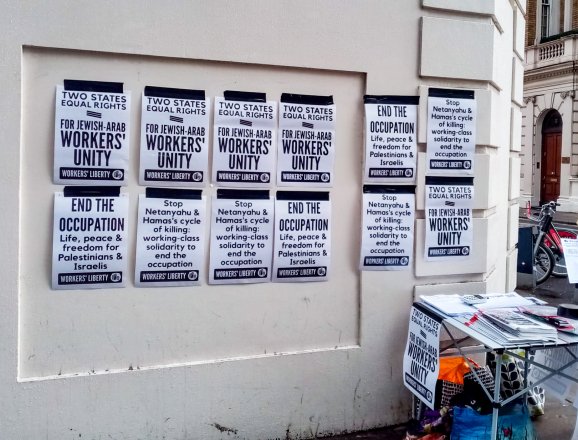
Solidarity advocates self-determination for both the Israeli-Jewish and Palestinian Arab nations, in other words “two states”, a real independent Palestinian state alongside a secure Israel.
Such mutual esteem and mutual recognition of rights, we argue, is the only possible basis for unity of Israeli-Jewish and Palestinian-Arab workers and Arab workers more widely. It is part of the democratic component of a socialist programme in the region.
In other words, we uphold for the Israeli Jews and the Palestinian Arabs the same principles as we uphold for the world’s other nations.
Karl Marx scorned “recipes for the cookshops of the future”. We can’t hope to place ourselves as recipe-advisers for “cooks” who, in any near future, will be the Israeli and Palestinian and other bourgeoisies. We have no detailed “two states” scheme of “our own” — no variant of “our own” on, for example, the Geneva Accord, which has the practical advantage of being agreed by negotiators from the last serious Israeli-Palestinian talks, after the talks broke down. We have assessments and general principles.
Borders
As everywhere, we would work for the lowest possible borders between Israeli and Palestinian states.
At the same time, we do not advocate self-determination being conditional on low borders. For a nation to relax its borders with its neighbours requires some sense of established security, which may take longer than an agreement sufficient to allow basic self-determination.
For over 20 years now, most of the powers-that-be have accepted on paper the principle of two states, in the same way that governments everywhere have come to accept, in principle at least, the right to independence for the peoples ruled by the big colonial empires which dominated the world for most of the 20th century. That acceptance-on-principle is a gain won by struggles: both the Palestinian Arabs’ “first intifada” from 1987 and the battle of the Jewish community in what became Israel against Britain and British-sponsored Arab states in 1945-8.
As socialists, we do not rely on capitalist governments to do even what they agree on principle should be done, or to do it right. Trotsky put it like this: “We are not a government party; we are the party of irreconcilable opposition... Our tasks... we realise not through the medium of bourgeois governments... but exclusively... through explaining to the workers what they should defend and what they should overthrow. [That] cannot give immediate miraculous results. But we do not even pretend to be miracle workers. As things stand, we are a revolutionary minority. Our work must be directed so that the workers on whom we have influence should correctly appraise events…”
The current war looks like pushing the USA to new efforts for “two states”. Our job in any case is to assist mutual recognition “from below”, so as to speed any progress which comes from shifts “above”, to maximise the impact of workers’ and democratic agitation on the shape of that progress, and to link workers’ unity on that basis with workers’ unity on social questions.
In the last 20 years of impasse, though, some people have given up on “two states”, and instead say there must be “one state”.
We are for neighbouring nations freely merging into larger states. But even, say, France and Germany, won’t do that any time soon. Nowhere do we say that nothing short of two neighbouring nations merging can be even a first step. Why, then, say that for the Israeli Jews and Palestinian Arabs?
Netanyahu and his like have a Jewish-supremacist “one state” plan. Hamas has an Islamist “drive out the Jews” one-state plan. A democratic one-state plan presupposes both nations already seeing their differences as minimal, and freely agreeing to merge; each being confident that the other is no threat to its own self-determination.
The UN partition plan of 1947 and the British Peel Commission plan of 1937 were for forms of “two states”. The Jewish community accepted both. The Palestinian Arab leaders rejected both, and insisted on “one state” with an Arab majority where Jewish immigration and land sales to Jews would be banned. Since the reason why large numbers of Jews had gathered there in the first place was to establish somewhere where Jews fleeing persecution (and then the Holocaust), could come to be with a dense Jewish population able to defend itself without having to rely on the goodwill of a hostile or uneasy majority, they wouldn’t accept that.
The UN 1947 plan provided for a Palestinian Arab state. In the 1948 war most of the allocated land was seized by Jordan (the West Bank) or Egypt (Gaza). The Palestinians had no confidence to resist.
Until the late 1960s, the post-1948 issue was seen as one of Israel and “the Arabs” in general. The Palestinians were a footnote.
Literally. In a big pamphlet of 1958 on The Arab Revolution, Michel Pablo, a leading Orthodox Trotskyist of the day, declared that: “For the Arabs 1920 was the year of catastrophe — Amal Nakba... The creation of the states of Syria, Lebanon, Transjordania [Jordan], Palestine, and Iraq [by French and British power, from the collapse of the Ottoman Empire] appeared to them as an absurdity contrary to all historical, cultural, and religious traditions”.
Pablo advocated a pan-Arab revolution, simultaneously unifying, anti-colonial, and socialist. From his angle, deeply involved with Algeria’s fight for independence, Israel and “the refugees” (from the 1948 war) figured only in a footnote: Israel should have “self-government”, and “the refugees” should be “reintegrated” in the Palestine area of a “United Arab Republic”.
In the 1960s autonomous Palestinian nationalism burgeoned. “Nakba” came to denote more often 1948 than 1920. Secular nationalists now proposed a (single) “secular democratic state” in the territory delimited as “Palestine” by the British after World War One. The Jews would have the rights of “religious minority”.
Nation
But the Israeli Jews were a nation, not a religious group — most are “not religious” — and were no more willing to trust minority status than in 1948. A very large proportion of them, by then, were descendants or members of the Jewish minorities who had fled en masse from persecution in the Arab states after the late 1940s.
In the early 1970s, a leftish (Stalinoid) Palestinian faction, the DFLP, mooted (a form of) “two states”. By 1988, under the impulse of the first intifada, the PLO accepted “two states”. The “secular democratic state” became the property only of the would-be Marxists who had got it from the PLO in 1969 and now held onto it when the PLO had discarded it. In recent years, in a worrying shift, some leftists tend to summarise their alternative to “two states” simply as “one state”, relegating to a lower profile the “secular” and “democratic” provisos which the PLO rightly thought necessary even to get past first base.
In 1993 Israel recognised the PLO and began, on paper, edging towards “two states”. But the pressure to make “two states” a reality could not conquer the inertia that time round.
Negotiations
For almost all the last 20 years, Israeli governments have stonewalled even on negotiations. The Palestinian Authority set up in 1994 has been unable to muster enough political authority among its own people to be effective. The USA, seeing the impasse as a likely source of disruption, made sallies in 2003-4 and 2014 to push towards “two states”, but gave up.
Much of the time, Israeli governments have said that there is no “partner for peace”. Facing Hamas and a Palestinian Authority ultra-fearful of Hamas, in immediate terms that has has had some truth. Israeli governments have found it easier to “live by the sword”, as Netanyahu is reputed to say, to “contain” the Palestinians in cramped semi-autonomy in 166 separate patches of land, and to cramp them further by expanding settlements in the West Bank, than to do things which could bring forward the “partner for peace”.
A common argument against “two states” is that it is unrealistic: Israel will never concede it. But stronger nations have before now been forced to ease their chauvinism and relax their grip on subject peoples. They have never agreed to dissolve the existence of their core nation into that of a minority with no right of self-determination. “One state”, in a benign “let’s forget nationality and just live together” form, is vastly more improbable. In its Jewish-supremacist Netanyahu form it is, sadly, a looming threat.
In real political life, and despite the wishes of some of their more left-wing authors, “one state” schemes tend to function as yet another way of “delegitimising” Israel and “legitimising” fantasies of liberation by way of conquering Israel: since Israel will not agree to this or that one-state formula, and its authors declare that “one state” to be the compulsory minimum, therefore it must be conquered.