
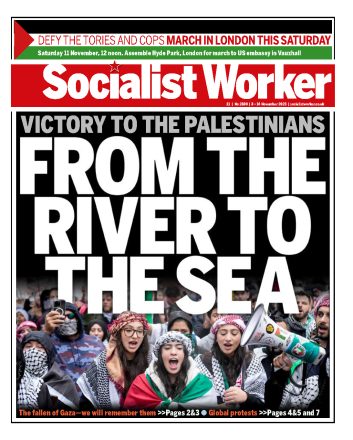
The other day a Labour activist, a supporter of ceasefire and someone who has worked in the West Bank, made an apt comment to me on the use of the “From the river to the sea” slogan.
Some may first think it’s a bland “freedom everywhere” call. By now they must know that most Jews see it as threatening; as meaning Arab or Islamic rule in all of 1918-48 Palestine, “from the river to the sea”, and the wiping-out of Israel. So, use a different slogan, unless you want to make the threat, or don’t care.
After some weeks of Gaza demonstrations, those who still go along with “from the river to the sea” must, at least, not care. Most are far from hardened Israel-haters. But they allow themselves to be drawn into the retinue for hardened Israel-haters. When we go to the demonstrations to argue for “two states”, many are receptive, but as yet we are a small minority there. We can win the argument only if we mobilise more forces, and only if we don’t fool ourselves that people are already “with us” when they are not.
The current agitation around Gaza is full of slippery formulas. Many were deliberately designed to be slippery. If we fall into one inadvertently, we should climb out again.
As Simon Nelson says, the headline “Neither Netanyahu, nor Hamas, but...” was my idea. (Others nodded it through.) If I’ve been made aware that it can read as “neither Israel, nor Hamas”, or “Israel has no more right to defend itself than the revanchist-exterminationist Hamas”, then I should take account.
The comrade who pointed out that reading to me suggested “No to mass bombing, no to Hamas” as a possible alternative. Not perfect, but better to have something that avoids an implication that a crushing of Israel is no more undesirable than crushing of Hamas. Hamas being crushed would be good (we say that while also opposing the horrors of the Israeli war in Gaza, and saying that anyway this war won’t “destroy” Hamas). Israel being crushed in the “permanent war” drawing in Hezbollah and Iran which Hamas hopes to trigger would be bad.
Could “neither Netanyahu” in the headline mean Netanyahu resigning or being voted out (as of course we wish)? Hardly. There would be no symmetry in the “neither... nor…”. “No to Hamas” there can’t refer to Hamas resigning or being voted out.
The war now does not depend on Netanyahu personally. If Gantz replaced him, Israeli policy would change little in any short term. However, in Gaza, a survey on 6 October had 67% saying they had little or no trust in Hamas, 73% wanting a peaceful settlement with Israel, more preferring the notoriously corrupt Fatah than preferring Hamas. 7 October was aHamas atrocity, not an operation by “Gaza”.
(Predictably, on 31 Oct-7 Nov people in Gaza (and in the West Bank too) responded differently to pollsters. 75% said they approved of 7 October, 88% that they viewed Hamas positively, 73% that they expect Hamas to win this war.)
We’ve repeatedly asserted in Solidarity (and quoted leftists in Israel asserting) that Israel has a right to defend itself. It needs to be asserted. Right now, on the left especially, it doesn’t go without saying.
A full ceasefire now might let Hamas quickly regain its military base in Gaza? Maybe. From our point of view that’s a downside. It is overshadowed by the horrific toll of the bombing, the evacuations, the siege, etc., all of which, as we have repeatedly argued, will not “destroy Hamas” longer-term. US Assistant Secretary of Barbara Leaf says that the death count (currently 15,000 on Hamas figures) “could be even higher” when the dead hidden under destroyed buildings, and frail people now dead from the consequences of the meagre supplies, healthcare, etc. are added in.
We don’t and can’t offer "realistic” military advice for a neat “alternative Israeli self-defence” tactic. We are not miracle-workers. Our job is to say what is, and state the basic principles for a way out. We shouldn’t have a would-be snappy headline, or illusory “realism”, blur that message.
Our opposition to the current Israeli war, with its horrors, makes necessary a conscious effort to have the baseline of Israel’s right to exist not submerged in immediate reactions.
We can’t rely on benign interpretation of ambiguous formulas. British public opinion has long been inclined to the thought that any language against Israel is all right because Israel is so strong and aggressive that worry about hurt to it is disingenuous fuss.
Another example: the current marches are routinely described (and not just by SWPers) as “for Palestine”, or “pro-Palestine”. Of course we want relief for the Palestinians under bombardment and siege, and we are pro-Palestinian in general. “Pro-Palestine” is not clear here, especially as much of the tone is as much “Palestine will win” as “stop the war”. The force in military battle at present is Hamas, not “Palestine”. The map-images defining “Palestine” displayed on the marches delete Israel. Actually “pro-Palestine” serves as a bridge from pro-ceasefire to varying forms of pro-Hamas.
We say: stop. But if we let the basic stance of Israel having a right to defend itself, and the politics of a democratic settlement, be buried in our assent to the widespread demand to stop, then we fail at what we must do and no-one else is doing.