
It surprised me that there was no formal policy on working at heights before the early 2000s. In the early part of my time it was expected of you to get up there, somehow, and get the job done without falling off.
I was terrified of working at heights and would not even go up a step ladder if I could avoid it. As time went on, however, it was made clear to me that it was part of the job and so up I went, learning how to juggle an AVO meter, oil can, various spanners, cleaning fluids, and cloths.
The principle was straightforward: keep three points of contact at all times, that is two feet and one hand, or two hands and one foot if you were trying to manoeuvre so as to access some difficult piece of equipment which some clever designer had put out on a limb.
Eventually, I overcame my fears and actually started to enjoy climbing some of the signals. The higher ones gave quite spectacular views of the countryside or the roofs of buildings in our cities that most people don’t see.
But it was still risky, with structures being old and corroded, and often no indication of just how frail they were.
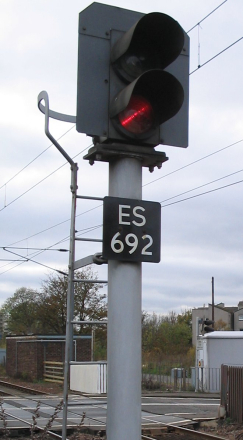
Outside Barnsley was one of the tallest signals, about 60 ft. It was an old mechanical signal which required oiling and a wipe-over to clean the glass lens. Being the youngest, I was detailed to go and climb. Off I went with my oil can and cloth. As I got about half way up I started to realise just how tall this thing was, so clutched the ladder a bit tighter.
I should point out that all signals have a fixed steel ladder up the back, and sometimes a platform at the top to stand on. This particular one had a platform at the top. As I put my foot on it and raised my other foot it gave way. Down went the oil can, as I desperately clung onto the rail round the top of the ladder and looked down to see what was left of the oil can. Not a great deal.
In Sheffield, there is a bridge called the Wicker Arches which carried the old Trans-Pennine route from Sheffield to Manchester via Penistone. The route had been electrified in the fifties with gantries which carried overhead lines and sometime also had signals which we had to service.
Some Einstein in the design department had the ladder from the signal coming down — but it finished over the drop to the ground some 65ft below, so you had to get on top of the wall, swing yourself out onto the ladder and repeat the process when you came back down along with any tools you had.
Nowadays, the climbing has been brought into the 21st century with the use of harnesses and climbing hooks, but it can still cause problems due to human nature. It takes quite some time to put on your equipment over the top of your other hi-visibility clothing. Especially if it’s a “quick’’ job like wiping over a signal lens or dusting inside a signal head, and the protective equipment can limit your flexibility, the temptation is not to bother and hope nobody sees you.
Yet again, something that looks “fixed” in the management manuals, but isn’t always in the real world.