
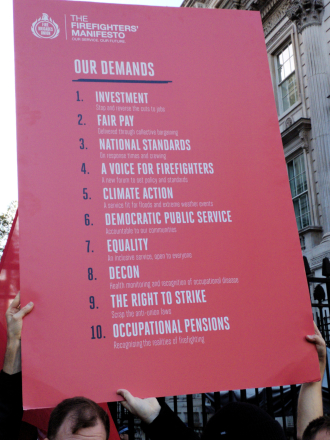
Nearly a thousand firefighters rallied at Westminster on 1 November to make political demands about the fire and rescue service. The FBU launched its Firefighters’ Manifesto, pulling together its assessment of the state of fire and rescue and the union’s main demands on central government.
The past 20 years have devastated the fire and rescue service. The so-called “modernisation” reforms imposed by New Labour and accelerated by Tory-led governments since 2010 have worsened the service in every respect.
Ministers removed national standards, including fire cover, which has led to slower response times for fire engines getting to incidents. They tore up safeguards on the number of firefighters and imposed austerity cuts, which has since led to the loss of 20% of the workforce, nearly 12,000 firefighters.
Ministers deregulated building safety standards and weakened fire safety, scrapping fire certificates and diminished enforcement, which has led to terrible tragedies, most devastatingly with the Grenfell Tower fire. They scrapped the statutory advisory body, the CFBAC, which oversaw fire safety and firefighter standards.
Ministers have also privatised and contracted out parts of the service. They attempted to sell off fire services via mutualisation, privatised the Fire Service College, imposing PFI-funded fire stations and equipment. Chief fire officers enriched themselves, while justifying and implementing these changes.
At the same time, governments and employers froze and capped firefighters’ pay and attacked conditions of service. They have imposed drastic measures such as crews of three on a fire engine (instead of five) and day crewing, meaning fewer firefighters at night. These have worsened the service to the public and put firefighters at greater risk.
The FBU argues that the downgrading of the fire and rescue service has taken place at the same time that firefighters have had to tackle greater risks. Firefighters continue to deal with thousands of fires, as well as road traffic collisions and other non-fire incidents. Firefighters are on the frontline of adaptation to climate change, tackling floods, storms, droughts and wildfires with increasing frequency.
Aging
Firefighters have also had to deal with the aging population and other wider work such as bariatric patients. Firefighters worked throughout the Covid-19 pandemic and many carried out additional work to support the NHS and vulnerable people. All these risks have increased and deepened during the first decades of the twenty-first century. In the context of austerity and deregulation, this has weakened UK-wide resilience.
The FBU’s manifesto underlines the necessity of investment in the fire and rescue service. This is the key to improving public safety and improving the pay and conditions of firefighters. The union also wants democratic control over the service, rather than the fragmented current system, split between councillors, police and crime commissioners and unelected boards. The FBU emphasises the need for professional standards and for a statutory advisory body to drive those improvements.
Throughout its history, the FBU has been crucial to the professionalisation of the emergency service and its skilled workforce. For the last 20 years, the union has been excluded from influence on regulation and guidance. Ministers and chief fire officers have made a mess of it. The FBU underlines the need for workers’ voice and workers’ control, both for the democratic management of the service and for the central role of its members.
The FBU is taking its manifesto to national and local politicians over the coming months. This will also inform its campaign around the general election and the agenda for an incoming Labour government. Mobilising its members is crucial. The November rally was a good start to the campaign.