
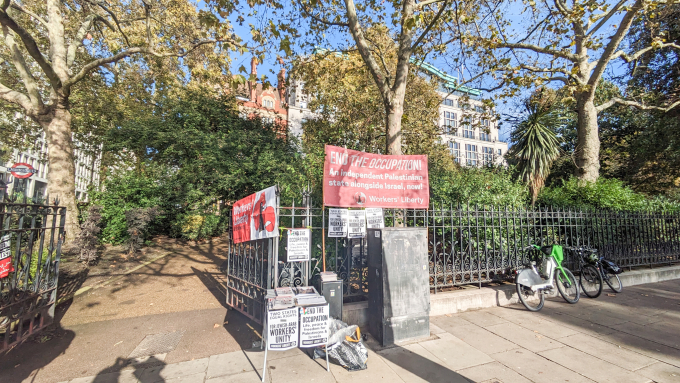
As Israel’s assault on Gaza continues, with the Palestinian death toll passing 10,000 (four thousand children), the Israeli state and the settler movement are intensifying repression of Palestinians elsewhere — both in the West Bank, and of the Palestinian minority inside Israel itself.
The Israeli campaign group Yesh Din, which monitors settler violence, reports 172 incidents in at least 84 Palestinian towns and villages since the Hamas atrocity on 7 October. The Palestinian Authority’s Health Ministry says 130 Palestinians have been killed, by settlers and by Israeli security forces. A New York Times article reports almost 1,000 Palestinians have been displaced from their homes.
A leaflet placed on the windscreen of cars in Palestinian areas reads: “A great catastrophe [referencing the ‘Nakba’, the Arabic word for catastrophe, the name Palestinians give to their displacement in the 1948 war surrounding Israel’s foundation] will descend upon your heads soon. We will destroy every enemy and expel you forcefully from our Holy Land that God has written for us. Wherever you are, carry your loads immediately and leave to where you came from. We are coming for you.” Israeli figures report 550 Palestinian attacks on Israelis — settlers and military personnel — in the West Bank since 7 October.
Ben Gvir
ATimes of Israel article on 4 November reports a clash in a cabinet meeting between far-right minister Itamar Ben-Gvir and Ronen Bar, the head of Israel’s Shin Bet intelligence agency.
Many figures in Israel’s security establishment are, like the USA, concerned about the risk of a second war in the West Bank, or even a third one, with Hezbollah, on the northern border; Ben-Gvir and other Jewish-supremacist politicians barely conceal their positive desire to provoke wider war. The Financial Times reports a split in Israel’s cabinet over whether to suspend paying over tax revenues collected on behalf of the West Bank’s Fatah-run Palestinian Authority, with Bezalel Smotrich pushing hard to cut payments.
Some in Israel feel that the tilting of Israel’s security priorities towards defending settlers in the West Bank helps explain why Israel was so exposed on 7 October. (Israel could easily repair its neglect on the Gaza border; instead, Netanyahu seeks revenge).
Commenting on the recent appointment of Zvi Sukkot, a member of the Knesset from the far-right Religious Zionism party, to head a subcommittee on West Bank security, left-wing MK Offer Cassif said: “A day before the horrific massacre in southern Israel, Zvi Sukkot initiated a pogrom in the heart of Huwara, in which a Palestinian youth was murdered. 32 battalions were there to protect Sukkot’s pogromists, and only two battalions remained on the border with the Gaza Strip.”
Crackdown
Meanwhile, Palestinian citizens of Israel face a growing crackdown on their rights. Israeli newspaper Ha’aretz reports a “systematic witch-hunt”, involving “arrests, interrogations, firings, [and] expulsion from college.” There are several instances of health workers in particular being targeted. Israel’s health sector has a mixed workforce, and is one of the main places in Israeli society where Israeli-Jewish and Palestinian-Arab workers work alongside each other. Ha’aretz reports Palestinian nurses who immediately volunteered for additional shifts to treat victims in the aftermath of the Hamas massacre on 7 October being suspended from work following allegations of support for Hamas.
Ha’aretz also reports: “Certain local authorities, including the Tel Aviv suburbs of Ramat Gan, Givatayim and Bat Yam, have gone as far as to ban Arabs from certain realms of activity. For example, Givatayim Mayor Ron Kunik shut down construction sites in the city, explaining that the very presence of Arab workers is problematic at present, because people are anxious. Following court intervention, work was resumed, but under guard. In Ramat Hasharon, Arab cleaning women were not allowed to work at their jobs in schools, until an arrangement was worked out whereby they would be present only after classroom hours and would have no contact with the schoolchildren.”
Israel has also recently sent over 3,000 Palestinian workers back to Gaza. The workers had been held in Israel since 7 October, many reporting that they faced arrest, torture, and interrogation. Palestinian worker Zaki Salameh, quoted in an Al-Jazeera article, said: “They wanted to know what we knew about the Al-Aqsa Flood operation. Some of the young men were tortured and insulted in a very brutal way. The questions were ridiculous. The Israelis know exactly who we are, and if we had any ties to Hamas, we wouldn’t even be granted the work permits.”
Immediately prior to the 7 October attacks, Israel had increased the number of work permits granted to workers from Gaza, as part of a Qatar-brokered deal following protests at the Gaza border. Israel now says it is “severing all contact with Gaza”: “There will be no more Palestinian workers from Gaza. Those workers from Gaza who were in Israel on the day of the outbreak of the war will be returned to Gaza.”
Netanyahu has rejected calls for a ceasefire without first the release of Israeli hostages. But his strategy of relentless bombing and a ground invasion is surely risking the lives of those hostages and may already have killed many. The best hope for stemming the tide of death is that Israel feels compelled, by a combination of international and internal pressure, to pull back, creating space for mobilisation to re-emerge for a democratic settlement, equal rights and a real independent Palestinian state alongside a secure Israel.
We say that in full awareness of how reactionary Hamas is, and while recognising Israel has a right to self-defence. Given how deeply Hamas is embedded in Gaza, its influence elsewhere, and its international links and support from Iran, those insisting Israel must push along present lines until Hamas is “destroyed” are endorsing an almost boundless war. That war will “destroy” tens of thousands of civilian lives and deepen the despair and yearning for revenge on which Hamas feeds. Netanyahu has no workable “endgame” for this war, only his push for revenge.
The best source of hope inside Israel itself comes from the Arab-Jewish social movement Standing Together. In recent days it has held a number of solidarity gatherings in mixed cities, mobilising 250 in Tel Aviv and 600 in Haifa. It has organised “Solidarity Guards” to mobilise Palestinian and Jewish citizens to carry out mutual aid work, community organising, and to resist racist incitement. A demonstration was also held in Tel Aviv to demand a ceasefire.
Significantly, a demonstration organised by families of hostages held by Hamas marched on Netanyahu’s residence, facing down mounted police in the process.
There is undoubtedly a strong spirit of patriotic-nationalist fervour in Israel and broad support for its war, but there are growing cracks. Socialists internationally must do all we can to support those organising on the ground for a different future.
• Ceasefire! End the siege. Free the hostages
• Peace. Equal rights. Two states: a real independent Palestinian state alongside a secure Israel
• Workers’ unity.