
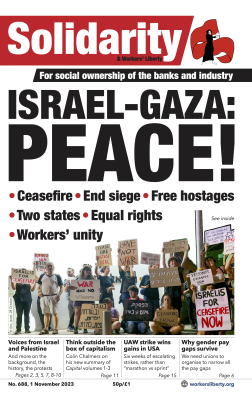
The front page headline on Solidarity this week says “Peace”. It is a way of saying in one word what we said in three (“stop the massacre”, “stop the war”) in previous issues .
It is also a slogan rarely used by Marxists in recent decades. Why, and what is different now?
From the early 1950s, and the reverberations persist, the Communist Parties in the stronger capitalist countries made “peace” a big slogan and busied themselves heavily with building “peace movements” designed essentially as adjuncts to the USSR’s diplomacy.
For Algeria’s independence war, the French Communist Party’s slogan was mainly “Peace in Algeria”. For the Vietnam war, “Peace in Vietnam”. Marxists criticised because this meant pleas to the French and US governments for restraint, and evaded siding with the insurgents in the colonial and semi-colonial world against imperialism.
Most of us were insufficiently critical of the insurgent movements (FLN in Algeria, NLF in Vietnam), but we were right to side with them against France and the US.
Hamas is not of the same sort as the FLN or the NLF. It is not a national liberation movement, not even one with bad politics. It aims to drive out the Israeli Jews, not to win an independent Palestinian state. With Hezbollah, it is part of a loose network centred round Iran, a large state which also proclaims “death to Israel”.
Doubt also attaches to the peace slogan because Lenin early in World War One criticised it as weak. Basing himself on the pre-1914 socialist movement’s (correct) predictions that world war would in time trigger great uprisings against the war-making governments, he said: turn the imperialist war into a civil war.
Trotsky, sharing the same basic attitude to the war as Lenin, nevertheless advocated also using the peace slogan. In hindsight , we think Trotsky was right. In fact, later in the war, Lenin tacitly came round. For example, in the run-up to the workers’ revolution in Russia in October 1917, he proclaimed his slogans as: “Power to the Soviets, Land to the Peasants, Peace to the Nations, Bread to the Starving!”