
1791: French revolution grants equal rights to Jews, ending thousands of years of discrimination and sometimes murderous persecution against Jews in Christian Europe. In the first half of the 19th century it looks as if this bourgeois equality will spread. Jews finally gain full legal equality in England in 1890.
1881: Wave of pogroms in the Tsarist Empire, followed by a series of laws discriminating against Jews. Antisemitism starts rising again in Europe.
1897: First congress of the Zionist movement. Settlements in sparsely-populated and less economically developed lands — the Americas, Australia, New Zealand, etc. — are widely regarded at the time as brave pioneering, even by those who give consideration to the rights of the people already there. The Zionists propose Jews can build a new collective life and ensure mutual defence in Palestine, where there is a longstanding minority of Jews and the main city, Jerusalem, has a Jewish majority. They are a small minority among Jews in Europe.
1903-6: New wave of pogroms in the Tsarist Empire. Start of systematic building of Zionist settlements in Palestine (then an ill-defined area long ruled by the Ottoman Empire, centred in what is now Istanbul) on the basis of “Jewish labour only” (aiming to build up a working nation, not a settler caste exploiting others). In the Ottoman Empire Jews have long been disadvantaged, but less than in Europe.
1908: “Young Turk” revolution in Ottoman Empire. This sets off a rise of Arab national consciousness.
1914: Ottoman Empire joins World War 1 on the side of Germany.
1917: Seeking Jewish support in the war, both France and Britain promise to back a “Jewish national home” in Palestine. Simultaneously, seeking Arab support, Britain promises to back Arab national claims.
1917-18: France “gets” Syria and Lebanon from the collapsed Ottoman Empire; Britain “gets” Iraq and Jordan and Palestine (it already has semi-colonial control of Egypt).
1920-1: Palestinian Arab riots against Jewish immigration. Jews are now 10% of population (were 14% in 1914). The Jewish colonists establish a militia, the Haganah. The British limit Jewish immigration and sponsor a Supreme Muslim Council. They will spend the rest of its time in Palestine “balancing” between Jewish and Arab communities, alternating concessions and suppression on both sides.
1929: Renewed anti-Jewish riots after many Jews arrive from persecution in Poland. The British at first propose banning almost all Jewish immigration, but back down.
1933: Hitler comes to power in Germany. Flood of Jewish migrants. By 1936 Jews will be 28% of population, although Arabs are also migrating into Palestine.
1936-9: Mass Arab revolt in Palestine. British bloodily repress the revolt.
1937: A British Royal Commission proposes to partition Palestine into Jewish and Arab states. Jewish leaders accept this. Arab leaders reject. Britain drops the proposal.
1938: USA convenes an international conference, supposedly to help Jewish refugees from Nazism: only the Dominican Republic offers an open door.
1939-40: Britain limits Jewish immigration to Palestine to 75,000 over five years, and bans almost all land sales to Jews.
1944: Radical Zionist groups start armed struggle against British in Palestine; the mainstream Haganah joins in from late 1945. In 1946 Jordan becomes independent, though its army is still commanded by British officers.
1947: Seeking to rid itself of Palestine, Britain refers the question to the United Nations.
29 November: The UN decides to partition Palestine, but no agency to implement the plan. Jewish leaders accept the plan, Arab leaders reject it. The British withdraw over the months to May 1948. Fighting between the Jewish community and Arab militias, mostly coming from Syria, but supported by Arabs in Palestine.
1948: 14 May: Jewish community proclaims the state of Israel as per UN plan. Arab armies enter Palestine with talk from some leaders of “driving the Jews into the sea”. Although US and UK put on an arms embargo, and the UK is passively on the side of the Arab states (the main ones are British semi-colonies), Israel wins the war thanks to arms supplies from Czechoslovakia organised by Stalin in the hope of disrupting the British Empire. Israel rounds out its UN-plan borders; Jordan (the West Bank) and Egypt (Gaza) annex most of the land allocated for a Palestinian state. 700,000 Arabs flee or are driven out of what will become Israel in the course of war, in three waves between December 1947 to November 1948. An Arab minority of about 20% remains in Israel.
From 1947 (in many stages): About 600,000 Jews flee or are driven out from Arab and other Middle East countries, to Israel.
Early 1950s: Sporadic and ineffectual peace talks between Israel and the Arab states fail. Israel refuses to readmit refugees, Arab states other than Jordan refuse to integrate them, and the UN relief operation set up for them (UNRWA) becomes indefinite.
1956: October-November: Israel, France and Britain attack Egypt, in response to the nationalisation of the Suez Canal on 26 July. They withdraw under US pressure. Israel seizes the Sinai peninsula, but withdraws in 1957 under US pressure.
1964: May: Creation of the Palestine Liberation Organisation (PLO), at first a figment of the Egyptian government, from late 1960s more autonomous. High tide of Arab nationalism and renewed talk by Arab leaders of defeating Israel.
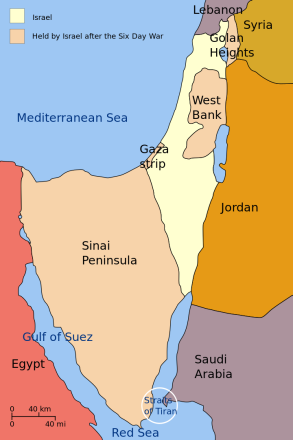
1967: June: Israel defeats the Arab states in the “six day war”, occupies Sinai, the Golan, the West Bank, Gaza and East Jerusalem. It then offers “land for peace”. The Arab states refuse. The US allies more closely with Israel after 1967.
1969: PLO adopts programme of “secular democratic state”.
1970: September: Jordanian army attacks PLO guerrillas and the refugee camps they are based on, driving Palestinian militias out of Jordan.
1973: October: Egypt and Syria launch war to recover territories occupied by Israel in 1967, but fail.
1974: June: PLO makes its first move towards “two states”. (The pressure comes from leftish Palestinian groups).
1978: September: Egypt and Israel sign a peace deal; Israel withdraws from Sinai (1979-82).
Early 1980s: Number of Israeli settlers in West Bank starts growing fast.
1982: June: Start of Israeli invasion of Lebanon, followed by siege of Beirut, aimed at defeating the Palestinian militias then strong in Lebanon and installing an Israel-friendly (Christian Arab) government in Lebanon. The main political-military effect is to stimulate the rise of Hezbollah. Israel occupies areas of southern Lebanon until 2000, but then withdraws.
1987: December: Palestinian uprising in the occupied territories (“first intifada”) begins.
1988: PLO moves to “two states” policy.
1993: September: The PLO and Israel sign a peace document for Israel to concede Palestinian control of increasing areas of the West Bank and Gaza. That process continues slowly and falteringly over the next eight years, but simultaneously Israel builds more settlements.
1994: October: Peace treaty between Israel and Jordan.
1995: September: “Oslo II” agreement signed in Washington.
November-December: Israel completes its withdrawal from West Bank towns, except Hebron. The West Bank takes roughly its current shape: islands of Palestinian quasi-autonomy (currently 165 of them) each surrounded by Israeli military control and increasing Israeli settlements.
2000: September: Breakdown of Israeli-PLO talks, and provocative visit by right-wing Israeli leader Ariel Sharon to the Al-Aqsa precinct in Jerusalem, spark “second intifada”.
2001: January: Last-gasp US-sponsored talks between PLO and Israeli government break down, though they have come close to a flawed version of “two states”. Then George W Bush becomes US president, and right-winger Ariel Sharon wins Israeli elections. Since then Israeli governments have settled into “containing” the Palestinians rather than seeking a settlement. Israel imposes complete blockade on the Occupied Territories, and in March-May temporarily reoccupies all West Bank cities except Jericho.
October: In run-up to 2003 invasion of Iraq, USA makes its first official statement backing an independent Palestinian state; but puts little pressure on Sharon.
From March 2001 , and through 2002: Suicide bombings of Israeli civilians by Palestinian Islamists.
2002: March. The Arab League adopts a peace plan — “two states” with the 1967 borders, Arab recognition of Israel. (They also make a blurred and ambiguous call for the “right of return”). No progress in talks, not even after US sponsors a “roadmap” in 2003.
2005: Aug-Sep. Israel carries out withdrawal from Gaza proposed by Ariel Sharon in 2003 (retaining large controls over Gaza’s supplies and borders).
2006: July-August: War between Israel and Hezbollah.
2007: June. Hamas makes a coup to take over Gaza from the Palestinian Authority. Israel and Egypt impose a blockade on Gaza, which remains. Israel and Hamas have fought sizeable wars in 2008-9, 2014, and 2021.
2013-4: New US effort to get negotiations. No result.
2020: September: Abraham Accords. Bahrain, Morocco, Sudan, and UAE recognise Israel.