
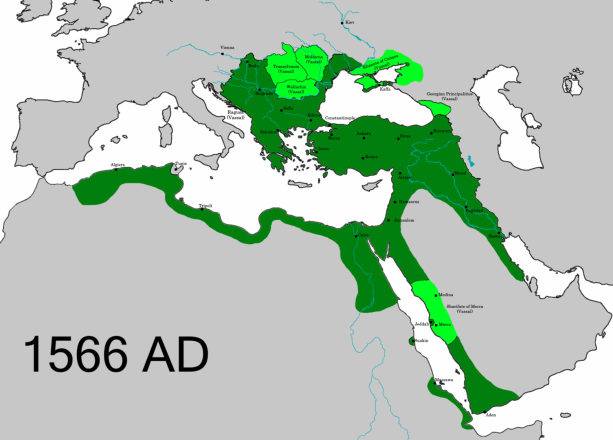
On Sunday 29 October, the Republic of Turkey turned one hundred years old. This was the culmination of a process that began in the nineteenth century, and marked the victory of Turkish nationalism over not only the European imperialist powers, but also the vast array of minority peoples that had inhabited the Ottoman Empire.
The period of Tanzimat in the then over-500-years-old Ottoman Empire (meaning reorganisation or restructuring, as with perestroika) began in 1839, and was an attempt to “modernise” the empire to bring it line with the other imperialist powers within the Concert of Europe. It created a professionalised bureaucracy, and attempted to draw Muslim and non-Muslim subjects under a single rule of law. (Before then, there were separate court systems for Muslims and for Jews and Christians, and special taxes for non-Muslims).
The period came to an end in 1876 with a palace coup and the establishment of a constitutional monarchy, with a constitution and a semi-elected parliament which included representation for non-Muslim communities. This constitutional period lasted for less than two years, as in 1878 Sultan Abdul Hamid II restored himself to the position of absolute monarch, and ruled as such until 1908.
The Young Turk revolution of 1908 was led by Turkish officers and intellectuals, but was crucially supported by the non-Muslim bourgeoisie (the Muslim bourgeoisie was a relatively weak force). Elif Çağlı’s book From Bonapartism to Fascism compares 1908 to the 1848 revolutions in Italy, Austria, and Germany. They “came late” and failed to sweep out the old feudal order, instead coming to a compromise with it. Just as 1848 in Germany was followed by the authoritarian and top-down revolution led by Bismarck in the 1870s, 1908 in turn followed by Mustafa Kemal’s establishment of the Turkish Republic. The Ottoman state apparatus was not smashed to pieces, but co-opted and then pruned of its offending elements (the Sultanate, the Caliphate, etc.).
Despite the multicultural nature of the 1908 revolution, the dominant ideology within the leading party (the Committee of Union and Progress (CUP)) was increasingly an exclusionary Turkish nationalism. The Ottoman defeat in the Balkan Wars in 1913 meant that the empire lost the vast majority of its majority-Christian lands in Europe, and its leaders sought to “strengthen” the Turkish nation within Anatolia. This meant the assimilation, expulsion, or destruction of any non-Turkish populations (see Solidarity 589 ).
The War of Independence
Turkey entered World War One on the side of the Germany and Austria, under the leadership of the CUP’s Three Pashas: Talaat, Enver, and Djemal. After their defeat the UK-French Allies occupied Constantinople and drew up a plan of partition for the Ottoman Empire. The Treaty of Sèvres signed in 1920 but never implemented left the Ottoman Empire as a rump state in Anatolia, with territory ceded to Greece in the west and Armenia in the east, the Middle Eastern holdings passed over to Britain and France as mandates, and large areas (including Istanbul) under “zones of influence” with British, French, and Italian rule.
Mustafa Kemal (Atatürk) came to the leadership of the resistance against the new Allied order. He had been a senior commander at the Battle of Gallipoli in World War One: one of the Ottoman Empire’s few successes among a litany of embarrassing defeats, and crucially a place without a large population of Armenians to be robbed, deported, and slaughtered. (In 1915-16, the long-established Armenian community in what is now Turkey was wiped out, one million of them killed). Perry Anderson described this as his “moral luck”: Atatürk escaped any responsibility for the Armenian genocide due to an accident of appointment; as an additional benefit was not forced into exile to escape Allied prosecution for war crimes at the end of the war, unlike many other Ottoman generals.
The nationalist rebels fought against the Greek invasion force which landed at Smyrna (largely known today by the Turkish name, İzmir) and pushed out further into western Anatolia. They fought against French forces in southeastern Anatolia, and alongside local uprisings in French-occupied Syria. They also fought against local Allied-backed revolts and sections of the Ottoman Army, such as the “Army of the Caliphate”. Nationalist victory was declared in July 1923 with the Treaty of Lausanne, and the Republic was proclaimed in October.
However, the War of Independence was not just a war against the invading Greek and French armies. Like the Russian Civil War saw shifting alliances between different paramilitary forces, and minority groups attempted (unsuccessfully) to realise their national aspirations.
The overlapping series of genocides against national and religious minorities in Anatolia did not end with the fall of the CUP government. The process was in fact continued by the nationalist movement and later the Republican state. The Armenians, Greeks, Kurds, and Assyrians were the targets of these genocides. In this article, I will give detail only on the ethnic cleansing of the Pontic Greeks.
The Pontic Greeks are a population of Greeks indigenous to northeastern Anatolia, largely near the Black Sea coast. During World War One they were targeted for extermination and expulsion into the Syrian desert. The opening line of the Nutuk, Atatürk’s “authoritative” speech to the Turkish parliament on the history of the independence movement was: “On the 19th of May 1919, I landed at Samsun.”
What he did not say is this: his act, which marks the beginning of the national struggle as far as the official historiography is concerned, was immediately followed by the ethnic cleansing of the Pontic Greeks of Samsun. That was followed by the show trials and executions of the surviving Pontic Greek elite in the Amasya trials of 1921, and was finalised by the population exchange of 1923 when the entire remaining Greek population of Turkey was deported en masse, as was the Muslim population of Greece.
Turkey: a sub-imperialist power
In the late Ottoman period and the early Republican period, Turkey was both a victim of imperialism and had imperialist ambitions of its own, many of which it was able to achieve. The Ottoman Empire was subject to capitulations granting favourable treatment of European merchants, and various European powers were designated as “protectors” for Christian and Jewish populations within the empire, a status which in reality served as a pretext for external control. However, the Ottomans also ruled over a vast land empire in Europe, the Middle East, and North Africa, and responded brutally to any murmurs of independence.
The Bolsheviks, the Communist International, and its constituent parties tried to grapple with this tension, but for the most part erred on the side of support for the nationalist movement. They gave military and financial support to the Turkish nationalists, and the Greek communists (at that time organised as the Socialist Labour Party of Greece) played a heroic role agitating against the invasion and supporting the Turkish nationalist movement from within the rank-and-file of the Greek army. This history is complex, but there are certainly many legitimate criticisms of the actions of the Turkish and Russian communists in this period which deserve serious consideration. The Bolsheviks were motivated by ideological reasons, but also by immediate geopolitical concerns and the immediate survival of the Soviet government during the existential threats of the Russian Civil War.
The Turkish War of Independence was all of these different things at the same time: a struggle for self-determination against imperialist occupation; a civil war between competing material and ideological interests within Anatolia; an exclusionary and murderous struggle for supremacy by ethnic nationalists. The Republic of Turkey founded at the conclusion of the conflict bears the pockmarks of this legacy to this day.